The Rising Demand for Smarter Clinical Documentation
Clinical documentation has become one of the most time-intensive responsibilities for healthcare professionals worldwide. Physicians today spend a significant portion of their working hours updating electronic health records (EHRs), preparing patient summaries, and handling various administrative documentation tasks. At the same time, the rapid digital transformation of the healthcare industry and increasing patient volumes continue to place additional pressure on clinicians to improve efficiency in documentation workflows.
Recent advancements in AI-powered healthcare solutions show that hospitals and clinics are increasingly adopting automation technologies to reduce administrative burden and improve operational efficiency. According to Consegic Business Intelligence, the Small Language Model market is projected to surpass USD 43.44 billion by 2035, growing at a CAGR of 17.50%. This growth highlights the rising demand for efficient, specialized AI solutions across industries, particularly in healthcare.
Traditional documentation methods often lead to incomplete records, delayed transcriptions, and human errors that may negatively impact patient care. To address these challenges, healthcare providers are turning toward AI-driven solutions. Among these technologies, Small Language Models (SLMs) are emerging as an effective alternative to large-scale AI systems because of their ability to handle specialized healthcare tasks such as medical transcription and clinical documentation with greater efficiency.
Why Small Language Models Are Ideal for Healthcare Workflows
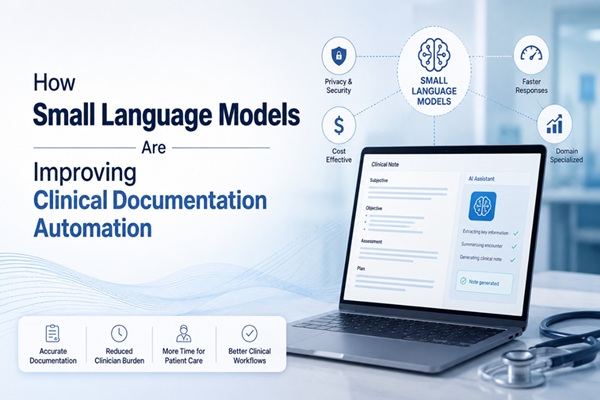
Small Language Models are gaining popularity in healthcare because they offer an optimal balance of performance, affordability, and efficiency. Unlike Large Language Models (LLMs), which require extensive computational resources and cloud infrastructure, SLMs are lightweight, faster, and easier to implement within healthcare environments.
Their streamlined architecture allows hospitals and clinics to integrate AI capabilities into existing systems without significant investments in expensive hardware or large-scale cloud services. Studies indicate that SLMs perform particularly well in healthcare settings where rapid response times and strict patient data protection are essential.
Another major advantage of SLMs is their ability to undergo domain-specific training. These models can be trained to understand medical terminology, healthcare workflows, and clinical processes, enabling them to support tasks such as medical transcription, patient note summarization, appointment documentation, and clinical coding with high accuracy.
Additionally, many SLMs can operate directly on local hospital servers, reducing reliance on external cloud systems and improving security and operational control.
How SLMs Improve Accuracy, Efficiency, and Data Privacy
SLMs are transforming clinical documentation by automating repetitive administrative tasks and significantly accelerating documentation processes. AI-powered medical scribing solutions now allow physicians to document patient interactions more efficiently without diverting excessive time away from patient care.
Modern AI scribing systems can capture consultations in real time and automatically generate structured clinical notes. This not only improves workflow efficiency but also helps reduce physician burnout and supports a healthier work-life balance for healthcare professionals. Recent healthcare technology reports also indicate rapid adoption of ambient AI scribe technologies across medical organizations.
Beyond speed improvements, SLMs also enhance the accuracy of clinical documentation. By understanding complex medical language and terminology, AI-driven coding and transcription tools can minimize errors, reduce omissions, and improve the precision of medical coding processes. Some advanced SLM-based coding systems have demonstrated strong performance in identifying accurate medical codes and even detecting previously overlooked diagnoses.
Data privacy is another important advantage of SLM implementation. Since many SLMs can function within a hospital’s internal infrastructure, sensitive patient information does not need to be transferred to external servers. This local deployment model supports compliance with healthcare data protection regulations while reducing cybersecurity risks.
Challenges in Implementing Small Language Models in Healthcare
Despite their benefits, several challenges still limit the widespread adoption of Small Language Models in healthcare environments. One of the primary concerns is the need for high-quality medical training data to ensure reliable and accurate AI outputs. Poorly trained systems may generate incomplete records, inaccurate clinical notes, or biased recommendations that could impact patient safety.
Another significant challenge involves AI hallucinations, where AI systems generate incorrect or misleading information. Because of this risk, healthcare professionals must continue to supervise and verify AI-generated documentation to ensure clinical accuracy and patient safety.
Integration with existing healthcare systems, particularly Electronic Health Record (EHR) platforms, also presents technical difficulties. Healthcare organizations must ensure seamless interoperability between AI tools and their current infrastructure.
Furthermore, compliance with healthcare regulations and data privacy laws remains a critical consideration. As AI-powered documentation systems continue to evolve, ongoing legal and ethical discussions surrounding healthcare AI adoption will play a major role in shaping future implementation strategies.
Conclusion
Small Language Models are emerging as a transformative technology in clinical documentation automation, offering significant improvements in speed, accuracy, and data security. Compared to larger AI systems, SLMs provide faster deployment, lower operational costs, and better adaptability for healthcare-specific workflows.
By automating transcription, clinical note generation, and medical coding, these models can help reduce physician workload and allow healthcare providers to focus more on patient care. Although challenges such as regulatory compliance, data quality concerns, and AI-generated errors still exist, continued advancements in healthcare AI are expected to further enhance the capabilities and adoption of Small Language Models in the medical industry.