

Physical therapy billing runs on dates. A Medicare plan of care has to be certified within a set window, recertified before it runs out, backed by progress reports at a fixed interval, and watched against an annual spending threshold. Each of these is simple on its own. Together, across a full caseload, they are a tracking job that most clinics leave to memory, spreadsheets or a calendar reminder, and claims fail when one date slips.
This article walks through the deadlines Medicare sets for outpatient therapy, what our billing data shows about where they break, and what practice management and EHR software should be doing to catch them before a claim goes out.
The deadlines that decide whether a therapy claim gets paid
Medicare’s rules for outpatient physical therapy plans of care sit in the Medicare Benefit Policy Manual (CMS, Pub. 100-02, Ch. 15, Sec. 220). The main dates are:
| Requirement | Deadline |
| Initial certification of the plan of care | Signed and dated by the physician or NPP within 30 days of the first treatment, including the evaluation |
| Verbal certification | Followed by a signature within 14 days |
| Recertification | When the plan changes significantly, or at least every 90 days after treatment starts under that plan |
| Length of a certified plan | Whatever the physician or NPP sets, to a maximum of 90 calendar days |
| Progress reports | At least once every 10 treatment days |
| KX modifier threshold | Required on claims once a patient’s yearly therapy spending passes $2,480 in 2026 |
Late certification is not automatically fatal. The manual allows delayed certification when the physician or NPP signs later with a reason for the delay, and certifications are accepted without justification for 30 days after they are due. Since January 1, 2025, Medicare also accepts a written order or referral on file, plus documentation that the plan was sent to the physician or NPP within 30 days of the initial evaluation, in place of a signature on the initial plan (CMS, CY 2025 Physician Fee Schedule final rule). Both rules reduce risk, but only if the practice can show the paperwork when a claim is reviewed.
Where the deadlines break, in billing data
Across our claim audit and billing reviews of therapy practices from January 2025 to June 2026, four problems stood out:
- 33% of therapy episodes had a coverage change mid-episode that was not caught (base: therapy episodes in our billing reviews).
- The KX modifier was missing on 21% of Medicare therapy claims past the threshold (base: claims that needed it).
- 8-minute rule unit errors appeared on 9% of therapy claims, across 4,300 claims.
- Plan of care certification was unsigned past 30 days on 7% of Medicare episodes.
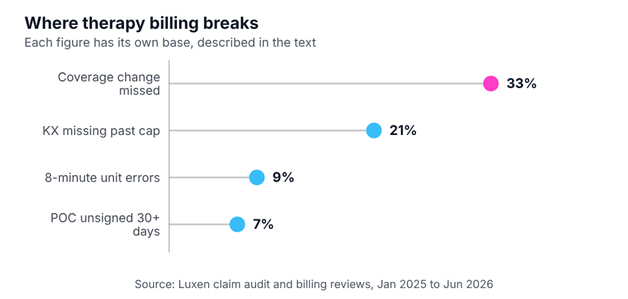
Figure 1. Where therapy billing breaks. Each figure has its own base, as listed above. Source: Luxen claim audit and billing reviews, Jan 2025 to Jun 2026.
The unsigned plans need a careful reading. Under the 2025 rule, some of those episodes may still be covered if an order was on file and the plan was sent on time. The ones without both are exposed, and they are hard to spot from the claim alone. Nothing on the claim form shows whether the certification behind it is current.
The other three figures share the same pattern. None of them is a coding judgment call. Each is a date, a count or a status that changed after the episode started and was not checked again before billing.
How these problems show up as denials
Across our full audit of 61,400 claims, eligibility and coverage errors caused 24% of denials, coding and modifier errors caused 21% of denials, and missing or invalid prior authorization caused 17% of denials. All other causes made up the remaining 38%. A missed coverage change lands in the first group. A missing KX modifier or a unit error lands in the second.
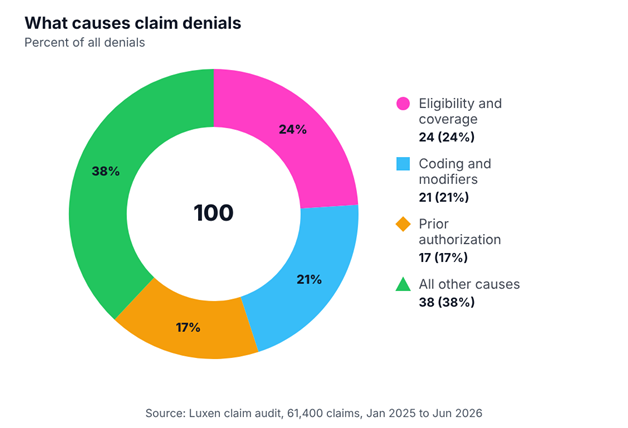
Figure 2. What causes claim denials, as a percent of all denials. Source: Luxen claim audit, 61,400 claims, Jan 2025 to Jun 2026.
Once denied, many of these claims are never corrected. In our billing reviews, 19% of denied claims were never reworked or appealed. Timely filing caused 6% of denials, and only 4% of those were recovered, so a denial that sits too long becomes a write-off. We have covered the certification rules in more depth in our research on Medicare therapy plan of care certification.
A worked example: one episode, four dates
A Medicare patient starts physical therapy on March 2 with an evaluation. The therapist writes a plan of care for 8 weeks, twice a week.
- The plan goes to the referring physician on March 3. The signed plan, or the order on file plus proof the plan was sent, needs to exist by April 1, 30 days after the evaluation.
- Progress reports. At two visits a week, the 10th treatment day falls in the fifth week, around April 2. A progress report is due by then, and again by the 20th treatment day.
- The plan covers 8 weeks, ending around April 27. If the patient needs more care, the plan must be recertified before then, well inside the 90-day limit.
- KX threshold. If the patient already had therapy earlier in the year, the running total may pass $2,480 partway through this episode. Every claim after that point needs the KX modifier and documentation of medical necessity.
Add a mid-episode change, such as the patient moving from Original Medicare to a Medicare Advantage plan, and the claims after the change need a different payer, possibly with its own authorization rules. Each of these dates is predictable from the first day of the episode. The software that holds the schedule and the notes can calculate all of them.
What practice management and EHR software should track
Most therapy EHRs store the plan of care. Fewer turn its dates into checks that stop a claim before it goes out. The features that matter most are:
- Certification status per episode. Signed, sent and awaiting signature, or covered by an order on file, with the date the plan was sent and a flag at day 30.
- Plan of care end date and recertification alerts. A warning before the certified duration runs out, tied to the schedule, not just the calendar.
- Progress report counter. A count of treatment days since the last report, visible to the therapist before the visit is signed.
- KX threshold running total. A per-patient total for the year, with the modifier applied automatically once the threshold is passed and documentation prompted.
- Unit calculation from documented minutes. Units for timed codes calculated from total timed minutes, using the counting method each payer requires.
- Eligibility checks during the episode, not only at intake. A recurring benefits check that catches a plan change before the next claim.
- Claim holds, not reports. A claim with an expired certification or a missing modifier should stop in a work queue before submission, not appear in a denial report six weeks later.
Our data on physical therapy billing points the same way: the problems that cost therapy practices the most are the ones a system could have flagged from data it already holds.
Switching systems carries its own risk
Changing software to get these features is common, and the transition costs money. In our survey of 286 practice managers, 38% had changed EHR or practice management system in the past five years. Of those, 71% said collections dipped for at least six months after the switch. That is about 27 of every 100 practice managers surveyed.
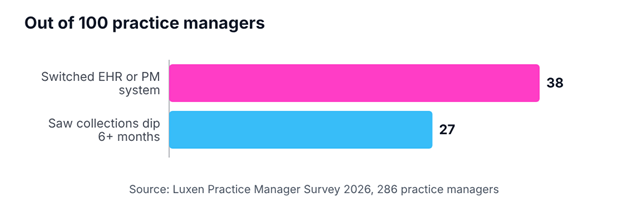
Figure 3. Out of 100 practice managers: how many switched EHR or practice management systems in the past five years, and how many saw collections dip for six months or more. Source: Luxen Practice Manager Survey 2026, 286 practice managers.
For therapy practices, a migration is also when plan of care dates are most likely to be lost. Open episodes, certification status, progress report counts and KX running totals need to move with the patient record. If they do not, the new system starts every episode at zero, and the first weeks after go-live produce exactly the denials the switch was meant to prevent.
A checklist before the next claim run
- List every open Medicare episode with its certification status and the date the plan was sent.
- Flag episodes past 30 days without a signature or an order on file with proof of sending.
- Check each plan’s end date against the schedule and send recertifications before it lapses.
- Confirm progress reports are on file at least every 10 treatment days.
- Review each patient’s KX running total and apply the modifier where needed.
- Re-verify eligibility for long episodes and after any reported plan change.
- Set the system to hold claims that fail these checks instead of sending them.
Plan of care rules have not changed much in years. What has changed is how much of the tracking a system can take over. Clinics that let software hold the dates, and stop claims that fail them, spend less time working denials that were predictable from the first visit.
About the data
Luxen claim audit: 61,400 claims audited, Jan 2025 to Jun 2026. Luxen billing reviews: 410 practice billing reviews, Jan 2025 to Jun 2026. Luxen Practice Manager Survey 2026: 286 practice managers, March 2026.
About the author
Authored by Shivam Pujara, founder of Luxen
Shivam Pujara is the founder of Luxen, a US medical billing and revenue cycle company that works with outpatient practices, including physical and occupational therapy clinics.