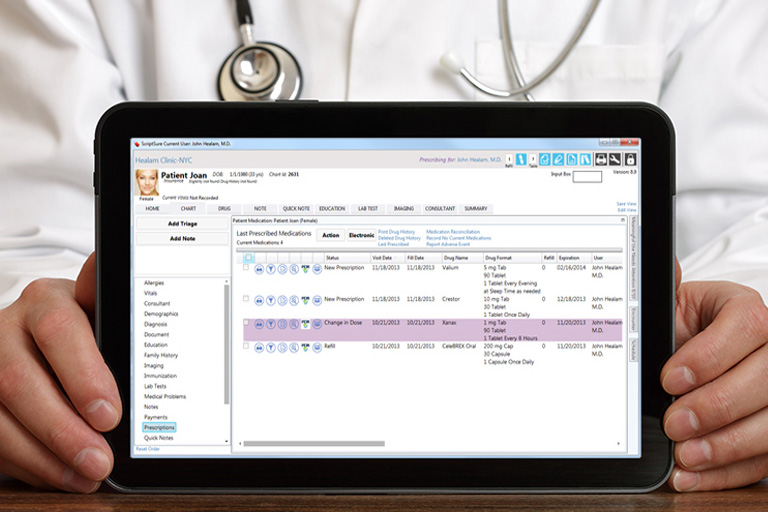

Architected by founder Fern Cowan, the EHW is a clinician-supervised AI workforce designed to carry out healthcare tasks with full accountability. It integrates with existing EHRs or operates independently, recording every action and chart entry with a verifiable audit trail.
DeepCura has unveiled its Electronic Health Workforce (EHW), a new category of clinical software designed to go beyond traditional electronic health records. The platform combines supervised AI workers—including receptionists, scribes, intake nurses, schedulers and inbox staff—to perform routine clinical and administrative tasks while documenting every action.
The EHW is the result of three years of development at DeepCura, along with a 2026 research and architecture initiative led by founder Fern Cowan, who designed its data model, supervision framework and product interfaces.
For decades, medical records have focused on storing information—first on paper and later through EHRs—primarily for payers, regulators and legal purposes. This has contributed to increasingly complex charts, repetitive documentation and workflows spread across multiple disconnected systems. Even AI-powered ambient scribes have mainly automated note creation while leaving much of the structured record to be entered manually.
DeepCura founder Fern Cowan said the company took a different approach by asking what a medical record would look like if it could actively perform work. The result is the EHW, designed as an action-oriented system that completes tasks while maintaining a verifiable record of every action.
Inspired by Finance — and Industries Built on Trusted Records
Rather than following traditional healthcare practices, Cowan studied how other high-stakes industries create trustworthy records and used those principles to rebuild DeepCura’s core foundation.
- Ledger architecture, inspired by finance. Every meaningful practice activity — from answering a call and recording a clinical fact to processing a payment or scheduling an appointment — is captured as a permanent entry on a unified timeline. Corrections are added as new entries rather than replacing existing records. The current chart, schedule, balance and dashboard are generated from this ledger, similar to how bank statements are built from transaction histories. Each action records when it occurred and when it was documented, while AI actions can be tracked as individual, measurable activities.
- Version control, inspired by software engineering. The medical chart works like a code repository, with each patient visit treated as a new version. Clinicians can quickly review what changed through concise diffs rather than rereading the entire record. Previous versions remain intact and are never overwritten.
- Credentialing, inspired by hospitals and applied to AI. Each AI staff member is assigned a distinct identity and defined permissions. Every AI worker operates under supervision, with a permanent record of its actions and reasoning. Each action can also be traced back to the conversation or event that triggered it.
- One door, inspired by cloud infrastructure. All changes to the system pass through a single, governed pathway. DeepCura also uses its own AI workforce internally, with AI agents supporting the company’s sales calls, onboarding and configuration processes.
Moving Beyond Legacy Systems
The EHW isn’t another layer added to a practice’s technology stack. Instead, it replaces multiple software categories by bringing their functions together within a single unified ledger:
- Flowsheets became Ambient Trackables. A value mentioned during a patient visit — such as an A1c of 7.2 — is automatically converted into a coded, trackable data point with its supporting evidence attached. Clinicians can create and monitor specialty-specific measures over time without relying on external standards or purchasing costly enterprise modules. Say it once. Track it forever.
- Ambient documentation became Ambient Data. Ambient notes were only the first step. While ambient documentation creates notes automatically, Ambient Data turns conversations into structured, population-level clinical data. Launched in July 2026, the system captures chart data automatically, links each value to its evidence and keeps clinicians in control of final approval.
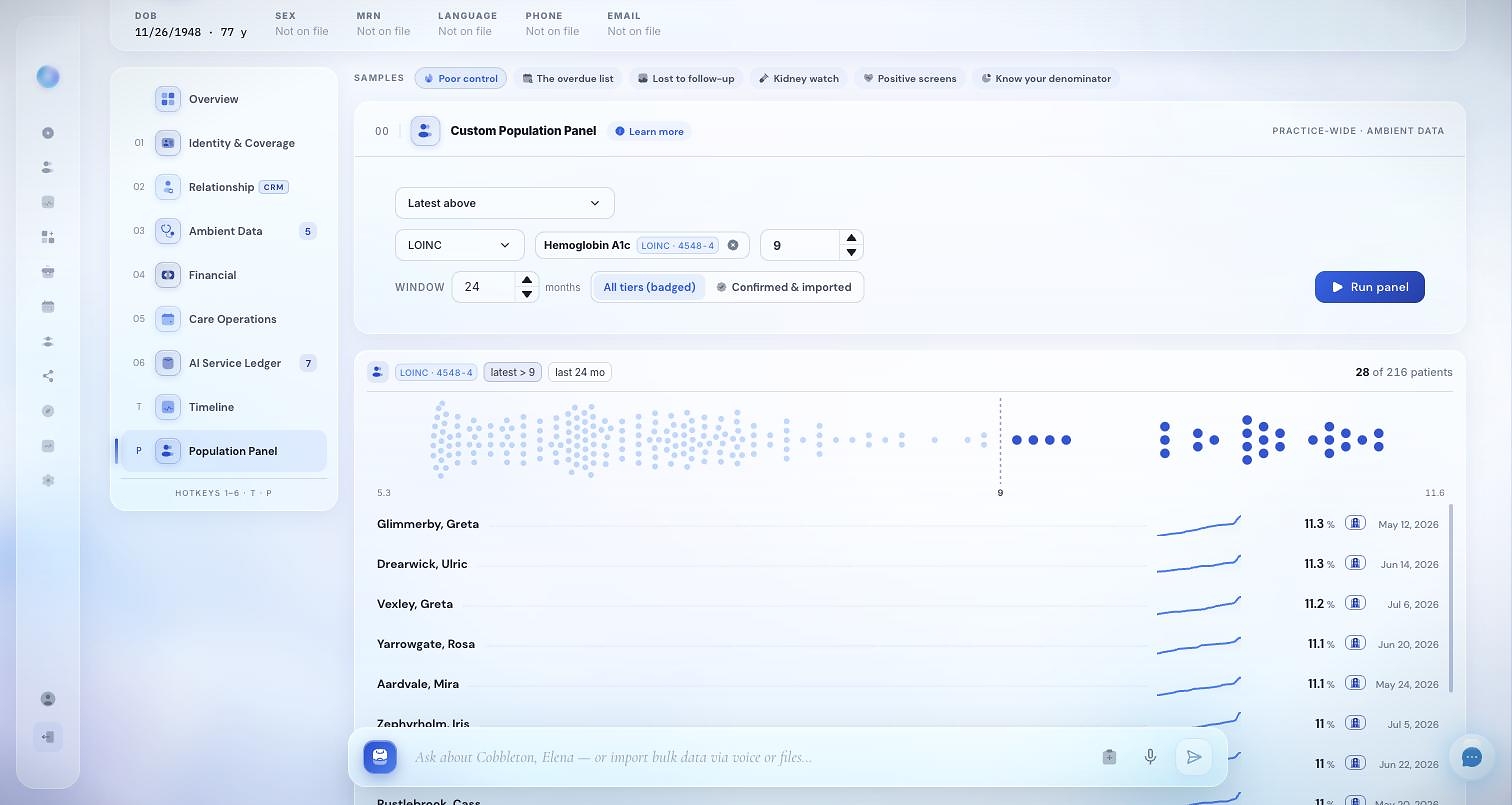
- Population-health modules became native Population Panels. Because chart data is structured and clinician-approved as it is captured, practices can instantly create patient panels based on specific conditions, track the latest values and identify care gaps for outreach. These capabilities are built directly into DeepCura rather than offered as separate premium modules.
- The inbox became an AI-staffed Inbox — evolving into Loops. Faxes, emails, calls and text messages are brought into a unified queue where AI staff can triage, draft responses and complete tasks under a preview → confirm → execute workflow. DeepCura is expanding this into Loops, which will track ongoing obligations — such as pending results, unanswered referrals or promised follow-ups — until they are completed. The inbox shows what arrived; Loops will track what still needs to happen.
- Copy-and-paste became the receipt. Every fact in the DeepCura chart records who entered or approved it, when it was added and where it originated. AI-generated information can also include the exact words that produced the fact, linked to the relevant point in a recording or the source location in a scanned document. This creates a permanent evidence trail and eliminates the need to repeatedly copy information from one note to another.
- CRM, practice management, communications and the clinical record became one unified timeline. Calls, messages, faxes, payments, appointments, notes and chart updates — whether performed by people or AI — are captured in a single record. This allows practices to understand the full patient journey without reconciling information across multiple disconnected systems.
The EHW follows a year of rapid development at DeepCura, which introduced Ambient Data, custom Population Panels, evidence-linked charting, an AI-powered Inbox, an in-house clinical terminology engine and an AI scheduling layer that mirrors EHR appointment systems. All of these capabilities were developed and operated by a company that also runs its own operations using an AI workforce.
Safety Is the Product’s Foundation
Every AI action in the EHW is reviewed before it becomes final. AI can propose responses, schedule appointments, draft content and prepare tasks, but clinical information requires clinician approval. Any unverified AI-generated data is clearly identified and never presented as clinician-confirmed information. Every AI action is also permanently recorded and linked back to the conversation that triggered it.
According to Cowan, healthcare needs AI with built-in supervision rather than unsupervised automation. The EHW makes safety a core part of its design, ensuring that no irreversible change reaches a patient’s chart without human approval and that every AI action can be fully audited.
Beyond the EHR
DeepCura designed the EHW to work alongside existing EHR systems rather than replace them outright. It integrates with leading platforms such as Epic, athenahealth, eClinicalWorks and AdvancedMD, allowing completed notes to flow directly into patient charts while syncing appointments and demographic information. For practices that prefer to move away from legacy EHRs, the EHW can also operate as a standalone primary system.
As Cowan explained, the EHR maintains the record while the EHW performs the work. Practices can keep their existing systems, add the AI workforce and allow the platform’s accumulated data and workflows to continuously improve over time.
EHW Availability
The Electronic Health Workforce (EHW) is now available through DeepCura, starting at $129 per provider per month. All plans include EHR integration and access to a free trial. DeepCura is HIPAA compliant, CASA certified and holds a 4.6/5 rating on G2.
The platform is also designed to reduce software costs by consolidating multiple tools into one system. DeepCura estimates that practices replacing their existing technology stack — including scribes, answering services, CRM, population-health, fax and intake tools — could spend up to 10 times less on software. AI services are additionally priced through usage-based credits, allowing practices to pay for the work they use rather than separate seat licenses for multiple systems.
About DeepCura Inc.
DeepCura Inc. is the company behind the Electronic Health Workforce (EHW), a supervised AI workforce that handles tasks such as reception, clinical documentation, patient intake, scheduling and inbox management. Founded in 2023 and based in Wilmington, Delaware, DeepCura is bootstrapped and profitable, with more than 6,000 clinicians using its platform across 50+ specialties.
The company says its platform has supported more than one million clinical encounters and is built around a network of AI agents that also help operate DeepCura itself.
Fern Cowan: Founder & Architect
Fern Cowan is the founder and architect of DeepCura and the researcher behind the Electronic Health Workforce. A Mexican-born technologist, Cowan spent seven years in San Francisco, where his previous company, Cowan Agency, worked with leading Silicon Valley technology firms. He later moved to Poland to tap into its engineering talent and innovation ecosystem.
Cowan designed and built DeepCura’s technology platform, including its backend, frontend, AI agents and infrastructure. He also developed the EHW’s ledger-based data model and supervision framework. A member of the Forbes Business Council, Cowan believes AI can fundamentally change how companies and medical practices operate by enabling small teams — and even individual founders — to accomplish work that once required large teams and significant venture funding.
Editor’s Notes & Glossary
- Electronic Health Workforce (EHW): A new class of software designed to go beyond the EHR. It is a supervised AI workforce that performs practice tasks while continuously documenting its actions — a system of evidenced action.
- System of evidenced action: The category represented by the EHW. Unlike a system of record, which stores information, or a system of intelligence, which provides advice, the EHW performs work while attaching evidence to every action, including who acted, when and why. For AI-generated facts, the evidence can include the exact words and timestamp that produced the information.
- The ledger: A permanent, append-only timeline that records meaningful actions performed by humans or AI. The current chart, schedule and dashboards are generated from this unified history.
- Ambient Data: The next evolution of ambient documentation. It transforms clinical conversations into structured chart data, attaches supporting evidence and keeps clinicians responsible for approving each entry.
- Ambient Trackables: DeepCura’s alternative to traditional flowsheets. Practices can define their own measures, capture them during visits and track them over time as longitudinal data.
- Population Panels: Custom patient panels and care-gap lists that can be created instantly using clinician-approved data from the practice’s own chart.
- Loops: The planned evolution of the traditional inbox. Each ongoing obligation creates a loop that is monitored until the required action or outcome is completed.
- The receipt: The provenance attached to every chart fact, showing who entered or approved it, when it was recorded and where it originated. For AI-captured information, the receipt can include the exact words and timestamp from the source recording.