
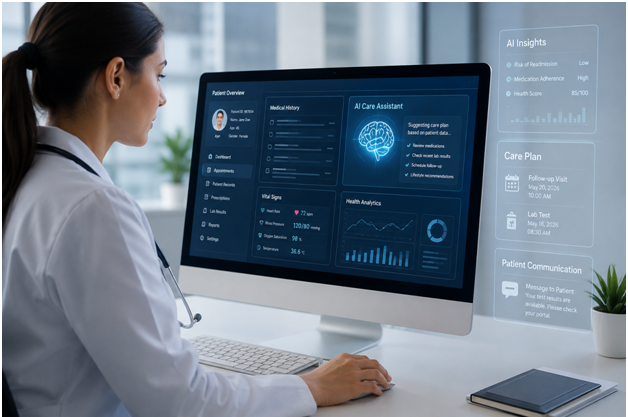
Healthcare organizations are under constant pressure to deliver better patient care while managing growing amounts of information and administrative work. Doctors and other healthcare professionals spend a significant part of their day documenting visits, reviewing records, communicating with patients and completing routine tasks.
In 2026, AI agents in healthcare are becoming an important part of the conversation around solving these workflow challenges.
Unlike traditional software that performs a fixed task, AI agents can be designed to understand information, follow instructions, complete multiple steps and support users across different stages of a workflow. When connected with appropriate healthcare systems, these tools can help automate repetitive activities while allowing clinicians to remain in control.
EMR Industry has already highlighted the growing role of AI in clinical workflows, including documentation, decision support and administrative automation.
The real opportunity is not simply to add another AI tool to a hospital or clinic. It is to use AI responsibly to make existing healthcare workflows simpler, faster and more connected.
What Are AI Agents in Healthcare?
AI agents are software systems designed to perform tasks based on information, instructions and predefined goals. In healthcare, an agent may interact with clinical data, patient communication systems, scheduling platforms or electronic health records, depending on its permissions and integration.
For example, an AI agent could help organize information from a patient interaction, prepare a draft clinical summary, identify missing information or assist with administrative follow-up.
This is different from simply asking a chatbot a question. An agent can potentially manage a sequence of related tasks rather than providing only a single response.
However, healthcare requires a higher level of caution. AI-generated information should not automatically replace clinical judgment. Human review, appropriate access controls and clear accountability remain essential.
How Are AI Agents Changing Clinical Documentation?
Clinical documentation is one of the areas where AI can have a practical impact.
Doctors often need to document patient encounters while also maintaining attention on the patient. This can make documentation time-consuming, particularly in busy clinical environments.
AI-powered documentation tools can listen to or process information from a clinical encounter and help prepare structured notes. Clinicians can then review, edit and approve the information before it becomes part of the patient’s record.
This approach can reduce repetitive documentation work and potentially give healthcare professionals more time to focus on patients.
EMR Industry has previously covered ambient AI documentation and tools designed to reduce the burden associated with clinical notes.
In 2026, the next step is moving from isolated documentation assistance toward broader workflow support.
An AI agent could potentially help with tasks such as:
- Preparing a draft patient summary
- Organizing clinical information
- Identifying incomplete documentation
- Supporting coding workflows
- Preparing follow-up information
- Routing administrative tasks to the appropriate team
The important point is that these functions should support clinicians rather than make unsupervised medical decisions.
Can AI Agents Reduce Administrative Work?
Administrative workload is another major area where healthcare organizations can benefit from intelligent automation.
Appointment scheduling, reminders, patient messages, referral coordination and routine information requests can consume considerable staff time.
AI agents can help manage some of these repetitive processes. For example, an agent could assist with appointment-related communication, collect basic information from patients or route requests to the appropriate department.
Healthcare organizations are already exploring AI agents for patient communication and administrative automation. EMR Industry recently reported on a HIPAA-compatible agentic AI solution designed to automate patient communications and administrative tasks.
When implemented correctly, this type of automation can help staff spend less time on repetitive activities and more time handling situations that require human attention.
How Can AI Agents Work With EMR and EHR Systems?
Integration is one of the most important factors in making healthcare AI useful.
A standalone AI application may provide helpful information, but its value can be limited if healthcare professionals have to manually transfer information between multiple systems.
AI agents can become more useful when they are connected with existing EMR and EHR environments through appropriate interfaces and interoperability standards.
For example, an agent may need access to relevant information from a patient’s record to prepare a summary or assist with a workflow. The system should only access information that it is authorized to use.
Interoperability is becoming increasingly important as healthcare organizations manage information across hospitals, clinics, laboratories, pharmacies and other digital platforms. EMR Industry notes that FHIR has become an important part of modern healthcare data exchange and connected care.
Better interoperability can therefore create a stronger foundation for AI-enabled workflows.
What Role Can AI Agents Play in Patient Communication?
Patient communication is another area where AI agents can provide practical support.
Healthcare organizations receive large numbers of routine questions every day. Patients may need information about appointments, preparation instructions, follow-ups, prescriptions or administrative procedures.
An AI agent can assist with certain routine interactions and provide information based on approved healthcare resources.
For example, a patient might receive an automated reminder before an appointment or assistance with a basic administrative request.
However, AI communication should have clear boundaries. If a patient describes a potentially serious medical concern, the system should not attempt to handle the situation beyond its approved scope. Instead, it should direct the patient toward an appropriate healthcare professional or service.
This balance between automation and human support is critical for maintaining patient trust.
How AI Agents Could Support Healthcare Staff
AI agents are not only relevant to doctors. Nurses, medical assistants, administrative teams, care coordinators and other healthcare workers may also benefit from workflow automation.
A well-designed system could help staff organize tasks, summarize information or identify which requests require immediate attention.
For example, a care coordination workflow could involve several steps:
- Patient information is received.
- Relevant information is organized.
- The system identifies the appropriate workflow.
- Administrative tasks are assigned.
- Staff review the generated information.
- The workflow continues after approval.
This type of assistance can reduce the amount of manual coordination required for repetitive processes.
The goal is not to remove people from the workflow. Instead, AI can handle suitable routine steps while healthcare professionals focus on tasks that require experience, empathy and judgment.
What About Healthcare Data Security?
The benefits of AI agents also come with significant responsibilities.
Healthcare systems handle highly sensitive patient information. Any AI solution connected to an EMR or EHR therefore needs strong security controls.
Organizations should consider:
- Data access permissions
- Encryption
- User authentication
- Audit trails
- Vendor security practices
- Data retention policies
- Regulatory requirements
- Human approval processes
An AI agent should not automatically receive unrestricted access to patient information.
Healthcare organizations also need to understand where information is processed, how it is stored and who can access it.
Security should be considered during the design and implementation stage rather than added after deployment.
Can AI Agents Improve Healthcare Efficiency Without Replacing Clinicians?
This is perhaps the most important question surrounding AI agents.
AI can process information quickly and automate repetitive workflows, but healthcare decisions often require context, experience and human understanding.
For that reason, the strongest approach is likely to be AI-assisted healthcare rather than AI-only healthcare.
Clinicians should remain responsible for reviewing important information and making clinical decisions. AI can help prepare information, organize tasks and highlight relevant details, but the final responsibility should remain with qualified professionals where appropriate.
EMR Industry has similarly emphasized the idea of AI acting as a partner to clinicians rather than replacing them.
What Should Healthcare Organizations Consider Before Adopting AI Agents?
Healthcare organizations should not adopt an AI agent simply because it is a new technology.
Before implementation, organizations should first identify a genuine workflow problem.
For example, if clinical staff spend too much time preparing documentation, an AI documentation solution may offer more value than a general-purpose AI assistant.
Organizations should also evaluate:
- Integration with existing EMR/EHR systems
- Data security
- Accuracy and reliability
- Regulatory requirements
- User permissions
- Human oversight
- Staff training
- Vendor support
- Total implementation cost
Starting with a specific, measurable workflow problem can make AI adoption more practical.
The Future of AI Agents in Healthcare
AI agents are likely to become more integrated into healthcare technology as organizations gain experience with automation and connected systems.
Future healthcare workflows may involve multiple AI-enabled tools working together across documentation, scheduling, patient engagement, care coordination and administrative processes.
However, successful adoption will depend on more than technical capabilities.
Healthcare organizations will need to build systems around security, interoperability, transparency and human oversight.
The healthcare industry does not simply need faster technology. It needs technology that can fit safely into real-world clinical environments.
Conclusion
AI agents are becoming an important development in healthcare technology in 2026. From clinical documentation and administrative automation to patient communication and EMR-connected workflows, they have the potential to reduce repetitive work and improve operational efficiency.
But the value of AI agents will depend on how responsibly they are implemented.
Healthcare organizations should focus on practical use cases, secure data handling, interoperability and meaningful human oversight. When these elements come together, AI agents can become useful assistants that help healthcare professionals spend less time managing routine workflows and more time focusing on patient care.
Nitesh Singh
Professional Content Writer specializing in SEO-friendly content across AI, Technology, Health, Agriculture, Tractors, Digital Marketing, and Lifestyle. He creates original, well-researched articles that inform readers and help businesses grow their online presence.