































Turning over a new leaf is doable if you get into these dietary habits.
If your goal is to eat healthier in the new year, and you’ve got your eyes on a bowl of granola for breakfast, you may want to reach for a tub of Greek yogurt instead.
While many granolas contain whole grains, they are also loaded with sugars, syrups, and honey — refined carbohydrates that can cause your blood sugar to spike, leading you to feel hungry before it’s time for lunch. Greek yogurt is a better choice since, if paired with berries and chia seeds, for example, it will keep your energy up and your tummy sated for hours thanks to a combination of fiber and protein.
“It’s important to have fiber and protein at meals and snacks because those are the things that help us feel full for longer,” says Lauren C. Kelly, MS, RD, CDN, a clinical dietitian at the Center for Advanced Digestive Care at NewYork-Presbyterian/Weill Cornell Medical Center. When it comes to large portions of carbohydrates, “even some of the healthier ones will spike the blood sugar, which inevitably drops, and then we tend to crave things to bring our blood sugar energy back up again, which is usually carbohydrates. When you build your meal around protein and fiber, these spikes and drops don’t happen as much.”
This is just one principle Kelly and colleague Alexandra Rosenstock, RD, CDN, a clinical dietitian for ambulatory adult GI at the Center for Advanced Digestive Care, suggest following if your goal is to incorporate more healthy eating into your day in the new year. Others include paying attention to macronutrients in each meal, staying hydrated, and preparing healthy food that’s easy to grab when you’re hungry. (Macronutrients are carbohydrates; protein and amino acids; fats and cholesterol; fiber; and water.)
Portion the perfect plate
Each meal should consist of 45 percent fiber-rich carbohydrates, 30 percent healthy fats, and 25 percent lean proteins, such as white-meat chicken or turkey, fish, tuna, tofu, beans, or egg whites, Rosenstock says.
“Protein will provide satiety more so than anything,” she says. “It’s helpful for maintaining muscle mass. Fiber will also provide satiety and helps keep blood sugar under control, as does protein. When you build a meal that contains both fiber and protein, you’re improving the glycemic response to the meal. You’re keeping the blood sugar more in check.”
As for fats, “we know that [eating] certain types of fat, like extra-virgin olive oil and avocado, in place of the unhealthy fats like fried foods and cookies and cakes can help reduce risk for heart disease,” says Kelly.
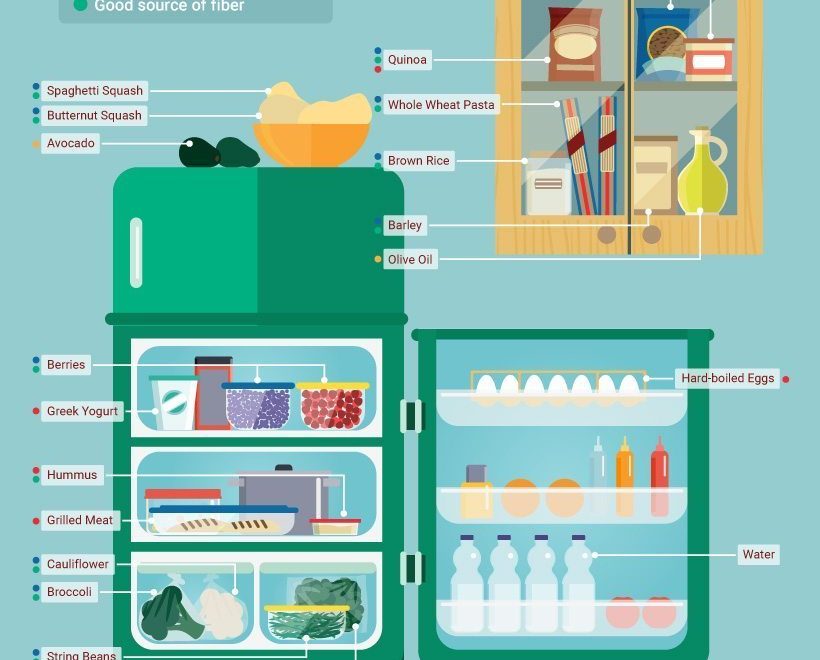
Both dietitians advise replacing white rice and white bread with brown rice, whole-wheat pasta, quinoa, and barley, and stocking up on nonstarchy vegetables like spinach, broccoli, cauliflower, and string beans instead of potatoes and corn. Nonstarchy vegetables, with their beneficial fiber, make us feel full longer and have less effect on the body’s blood sugar level.
Eat before hunger strikes
A good way to make sure you don’t end up reaching for chips or a chocolate bar when you need a snack is to eat before you feel famished.
“If somebody’s waiting too long to eat, sometimes they can go for things they weren’t planning on having just because they’re very hungry or their blood sugar is low,” says Rosenstock. “It takes a while to get into the habit where you’re actually eating every three or four hours and you’re grabbing something healthy that you have already prepared. You’ve taken the time to think about having it in the fridge or having it accessible at work.
Have healthy foods around
It may sound obvious, but, as Rosenstock advises, stocking your fridge and pantry with ready-to-eat healthy foods means you will be less likely to reach for bad stuff.
This includes vegetables like asparagus, broccoli, and cauliflower you can roast and easily toss with grilled meat or throw into a salad, says Kelly. It’s also a good idea to have “hummus in the refrigerator to be able to get in some protein. Butternut squash or spaghetti squash can be a great pasta alternative that you can throw in the oven and then have for a few days.”
Other healthy, easy options include roasted chickpeas, edamame snacks, hard-boiled eggs, plain Greek yogurt, berries, and nuts, she says.
Shop smart
Of course, it’s hard to completely part with packaged foods. But you can incorporate them into your diet if you stick with those that contain minimal ingredients, says Kelly.
She suggests “looking around the perimeter of the grocery store instead of going into the aisles,” since this is where shoppers will find more foods that are in their natural state, such as produce, dairy, and meats.
Another good rule of thumb is to avoid shopping while hungry. That’s because, Kelly says, “you tend to purchase things that maybe we wouldn’t have if we hadn’t gone there hungry.”
Drink water
Keeping yourself hydrated not only helps maintain proper kidney function and avoid dehydration, which can lead to fatigue, but it can also aid in healthier eating.
“One of the things we know is, our brain can confuse hunger and thirst,” says Kelly, “and sometimes we can overeat when we’re actually thirsty.”
A final rule, says Rosenstock, is to avoid beating yourself up if your healthy eating mission becomes derailed by a so-called bad food like a slice of pizza or a jelly doughnut.
“I tell people to not let one meal define the rest of their day or the rest of their week,” she says. “People always comment, ‘I’m going to start again on Monday’ or ‘I’m going to start tomorrow.’ I really encourage people to just forgive themselves. Then immediately start the next meal eating food that will make them feel better. I don’t like to characterize foods as ‘good’ or ‘bad’ — more like what makes them feel energized and nourished. So eat something nourishing the next meal — don’t wait until tomorrow.”


