Ask any health IT team about interoperability, and HL7 vs FHIR comes up within minutes. Many buyers assume the two standards compete. They do not. FHIR comes from the same standards body as HL7 and was designed to solve problems that older HL7 messaging handles poorly.
The real question is not which standard is better. It is which one fits the job in front of you. Picking the wrong one leads to rework, delays, and integration bills that grow every quarter.
This guide explains both standards in plain language, compares them side by side, and gives you a practical way to choose.
The Short Answer
- HL7 v2 moves event messages between internal systems, such as registration, labs, and billing.
- FHIR exposes health data through modern web APIs for apps, portals, and partners.
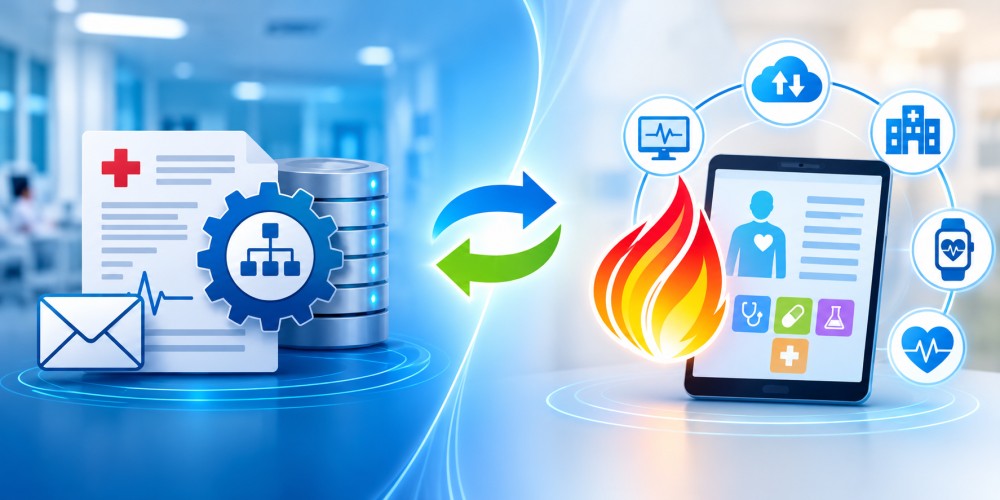
- Most organizations use both. HL7 v2 stays behind the scenes. FHIR opens the front door.
What Is HL7?
Health Level Seven International (HL7) is the non-profit organization that publishes many healthcare data standards. When people say HL7, they usually mean HL7 version 2 (v2), first released in 1987.
HL7 v2 is a messaging standard. One system sends a short, pipe-delimited text message when something happens. Another system receives it and acts on it.
Common message types include:
- ADT: admit, discharge, and transfer events
- ORM and OML: orders for labs, imaging, and procedures
- ORU: results returning to the patient chart
- SIU: scheduling updates
- DFT: financial charges
HL7 also publishes CDA and C-CDA, document standards that many US providers still use for care summaries.
Strengths of HL7 v2
- Supported by almost every hospital system and lab device
- Stable and proven over decades
- Efficient for high-volume internal feeds
Weaknesses of HL7 v2
- Flexible enough that each vendor implements it slightly differently
- Needs an interface engine and a skilled analyst to map fields
- Not designed for web or mobile applications
Two HL7 interfaces between the same pair of products can still look different, because each site customizes fields and segments. That local variation is the real cost.
What Is FHIR?
FHIR stands for Fast Healthcare Interoperability Resources and is pronounced fire. It breaks health data into small, reusable building blocks called resources, such as Patient, Encounter, Observation, and MedicationRequest.
Developers read and write these resources through standard web APIs. FHIR uses REST, JSON or XML, and OAuth 2.0 for security. Any web or mobile developer can learn it quickly.
Key facts to know:
- Version: FHIR R4, first published in late 2018 and refined in 2019, is the release that US regulation references. R5 followed in 2023.
- Apps: SMART on FHIR lets third-party apps launch securely inside an EHR.
- Regulation: The 21st Century Cures Act and the ONC certification program require certified EHRs to offer a standardized FHIR-based API. CMS rules push many payers toward FHIR APIs as well.
- Data definitions: USCDI defines the core data classes those APIs must expose.
- Bulk data: FHIR also supports bulk export, which helps analytics and population health work.
You can read the full specification on the official HL7 FHIR site and ONC guidance at HealthIT.gov.
HL7 vs FHIR: Side-by-Side Comparison
| Feature | HL7 v2 | FHIR |
| Era | 1987 onward | 2010s onward (R4 in 2018) |
| Format | Pipe-delimited text | JSON or XML |
| Exchange style | Event messages pushed between systems | Request and response through REST APIs |
| Typical use | Internal hospital feeds: ADT, orders, results | Patient apps, partner APIs, payer exchange |
| Learning curve | Needs an HL7 specialist | Familiar to web developers |
| Security | Network level: VPN, MLLP | OAuth 2.0, OpenID Connect, SMART scopes |
| Customization | High, often inconsistent | Controlled through profiles and implementation guides |
| Regulatory pull | Legacy | Required in US certification and payer rules |
The difference is less about quality and more about purpose.
Where HL7 v2 Still Fits
Do not replace a working interface just because FHIR is newer. HL7 v2 remains the better choice when:
- A lab analyzer or LIS sends results to the EMR in real time
- Registration pushes ADT events to many downstream systems
- A stable, tested interface already meets the clinical need
- Your team owns the skills and an interface engine
Replacing a stable v2 feed rarely improves patient care. It usually adds risk and cost. If you work with laboratory systems, our guide on LIS vs LIMS shows where these feeds matter most.
Where FHIR Fits Best
FHIR is the stronger choice when you build something new or open data to outside parties:
- Patient apps and portals that need on-demand record access
- Third-party apps launched from inside the EHR
- Payer and provider exchange, including prior authorization
- Analytics and population health through bulk export
- Mobile and cloud-first products, including remote patient monitoring data feeds
FHIR also helps smaller vendors. A developer can test against a public sandbox in days instead of negotiating a custom interface for months.
How the Two Work Together
Picture a specialty group that wants a patient app showing lab results and appointments.
Results already reach the EMR through HL7 v2 from the reference lab. That feed stays exactly as it is.
The app should read those results through the EMR vendor’s FHIR API, with patient authorization. A custom HL7 feed to a mobile app would be slower, harder to secure, and harder to maintain.
The outcome is a hybrid: HL7 v2 behind the scenes, FHIR at the front door. Interface engines already translate between HL7 v2, C-CDA, and FHIR, so this pattern is practical and common.
How to Choose:
- Who consumes the data? An internal system points to HL7 v2. An outside app or a patient points to FHIR.
- What does your vendor support today? Ask which FHIR resources, versions, and rate limits are live now, not planned.
- Is the exchange event-driven and continuous? Streaming internal events still suit HL7 v2.
- Does regulation require it? Certification and payer rules may mandate FHIR APIs.
- What skills do you have? HL7 analysts and web developers are different hires.
- What is the total cost? Count licensing, interface fees, testing, and ongoing support.
Security and Compliance
Both standards carry protected health information, so HIPAA applies to each.
HL7 v2 usually travels over private networks or VPN tunnels, so its security depends on network design. FHIR builds authorization into the API with OAuth 2.0 scopes, so you can limit an app to specific resources.
Either way, you need encryption in transit, audit logs, and a business associate agreement with every vendor that touches the data. Review the HHS HIPAA Security Rule with your compliance officer, and use our healthcare cybersecurity guide as a practical checklist.
Common Mistakes to Avoid
- Assuming FHIR will replace HL7 v2 soon. Both will coexist for years.
- Ignoring terminology. A perfect interface still fails when codes (LOINC, SNOMED CT, RxNorm) do not match.
- Testing with clean sample data only. Real charts are messy.
- Skipping the security review and access logging.
- Treating FHIR-enabled as a guarantee. Vendors support different resources at different depth.
What to Ask Your EMR Vendor
Before you sign, request written answers to these questions:
- Which FHIR version and resources do you support in production?
- Are APIs included in the base price, or billed per interface or per call?
- Which HL7 v2 message types do you send and receive?
- Can you share a sample implementation guide and sandbox access?
- How do you handle patient authorization and audit logging?
Start your shortlist with our EHR software guide and the EMR Industry vendor directory.
Practical Tips From Implementation Projects
- Ask for live sample messages. Written interface specs often differ from what a system actually sends.
- Keep one interface inventory. List the owner, message types, volume, and last test date for every feed.
- Test the awkward cases. Merged patients, name changes, cancelled orders, and special characters break interfaces first.
- Apply least privilege from day one. Limit each FHIR app to the resources it truly needs.
Frequently Asked Questions
1. Is FHIR replacing HL7?
No. FHIR is part of the HL7 family of standards. HL7 v2 will keep running internal hospital feeds for years, while new API work moves to FHIR.
2. Is FHIR easier than HL7 v2?
For web developers, yes. REST and JSON are familiar. Data mapping and terminology still take real effort in both standards.
3. Do I need an interface engine for FHIR?
Not always. You can call a vendor’s FHIR API directly. An engine helps when you combine several sources or translate between HL7 v2 and FHIR.
4. Is FHIR required in the US?
Certified EHR products must offer a standardized FHIR-based API, and CMS rules require certain payers to do the same. A small clinic does not build this itself, but its vendor must provide it.
5. Which FHIR version should I ask my vendor for?
Ask for R4, which US certification references. Also ask about the vendor’s plan for later releases such as R5.
Final Thoughts on HL7 vs FHIR
The HL7 vs FHIR question is really a question of fit. HL7 v2 moves internal events reliably. FHIR opens data to apps, patients, and partners.
Keep what works. Build new patient-facing and partner-facing connections on FHIR. Document every interface so the next analyst can understand it. Start with the problem, not the standard, and the right choice usually becomes clear.
Editorial note: Prepared by the EMR Industry editorial team from public HL7 and ONC documentation. It is educational, not legal or compliance advice. Standards and regulations evolve, so confirm current FHIR versions, deadlines, and vendor capabilities with your integration team before buying or building. Last reviewed November 2026 by our editorial reviewers.
Related Reading on EMR Industry