




































Across the spectrum of healthcare delivery – payor, provider, vendor, consumer, there is a land rush underway to embrace consumer-centric care. With tools like value-based care, chronic disease management, retail services, analytics, and remote patient monitoring, healthcare organizations are pivoting towards capabilities that provide a deeper understanding of patient behaviors and address the whole patient and not just the condition.
For the industry, it’s a stretch: Healthcare has traditionally been an insular sector, unaccustomed to the kind of broad based, multi-stakeholder cooperation and collaboration that the healthcare consumer increasingly expects.
But access to a complete picture of the patient – including the behavioral and environmental factors that influence daily health – is critical to realizing the shared benefits of value-based, holistic care.
The challenge extends far beyond service efficiencies that can be gleaned from the patient encounter. Consider: medical care only accounts for between 10% and 20% of health outcomes, whereas the physical environment, social determinants and behavioral factors account for 80% to 90% of outcomes.
More specifically, that 80 percent can be broken down as follows:
- Roughly 40 percent is attributed to socio-economic factors
- 10 percent to physical environment
- 30 percent to health behaviors
Collectively, these factors describe the Social Determinants of Care (“SDOH”), which the World Health Organization defines as “the conditions in which people are born, grow, work, live, and age, and the wider set of forces and systems shaping the conditions of daily life, including social, behavioral and environmental determinants of health.”
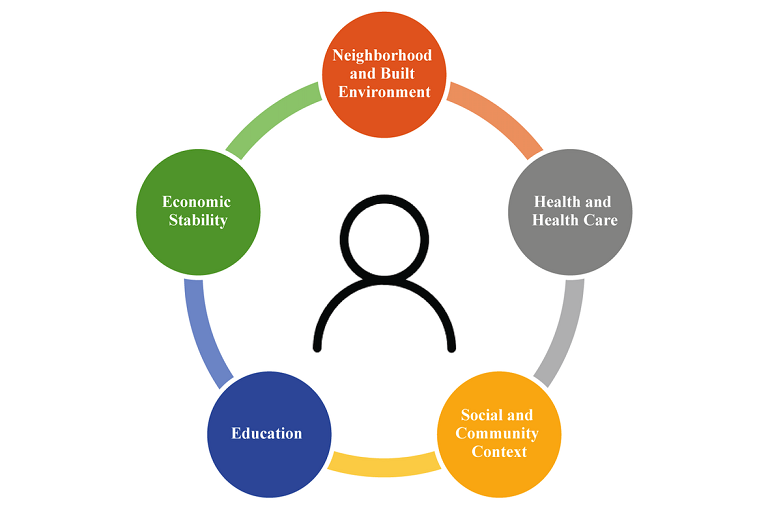
The key areas of SDOH include:
- Economic Stability
- Education
- Social and Community Context
- Health Demographics and Access to Care
- Neighborhood Environment
There is a huge opportunity to close the gaps in care and impact the healthcare outcomes of populations via SDOH – but the challenge is to engage the patient outside traditional healthcare venues. Services delivered in the home and in the community that address environmental issues like housing, income, crime, education, transportation, domestic circumstances and food insecurity have been shown to improve health outcomes and reduce the cost of care.
For example, hospitals can leverage SDOH data to proactively identify and intervene with high risk and vulnerable patients before a health event occurs. Patient engagement and intervention takes on an even greater urgency in a period of population health crisis and system stress – like a pandemic.
The key is to activate SDOH data – to incorporate unstructured, non-traditional health data into the patient record. But SDOH data is often trapped within systems that limit its access, flow and transactional value. It’s a multi-layered problem, beginning with awareness – there is an incomplete understanding of the value and catalogue of SDOH data for clinical care and population health management.
Then there is a data configuration issue -patient matching, terminologies and codes add layers of complexity to the aggregation, distillation and interpretation of SDOH data. And finally the biggest lift – coordinating, at a community level, the social inputs to daily health. That means patient data must flow freely between payers, providers, patients, and community resources.
At a foundational level, the solution set for SDOH integration into the healthcare record includes interoperability resources – that is capturing SDOH data regardless of source or format and making it actionable at the point of care.
At their best, interoperability resources establish a common data lexicon that enables the interpretation and delivery of relevant clinical information, and removes the structural, technical and cultural divisions that prevent transparent clinical data exchange among every stakeholder in the care continuum – including the community. Currently, a number of data interoperability initiatives are in play. They include:
- Fast Healthcare Interoperability Resources (FHIR), a set of HL7 sponsored standards that facilitate the exchange of health information through connected, independent systems. FHIR creates a common language where any clinical system can connect and share data.
- The Argonaut Project, a private sector initiative to advance industry adoption of modern, open (FHIR-based) interoperability standards.
- DaVinci Project, a private sector initiative working to help payers and health care providers to access and adopt FHIR data standards.
- CARIN Alliance, a multi-sector collaborative that promotes the ability of consumers and their authorized caregivers to gain digital access to their health information via open APIs.
- Blue Button, a CMS system that enables Medicare beneficiaries to view online and download their own personal health records.
Gravity Project (SIREN) seeks to identify coded data elements and associated value sets to represent social determinants of health data. The project is focused on three specific social risk domains: food insecurity, housing instability and quality, and transportation access.
Viewed strictly through the lens of technology, interoperability resources can bridge the gaps in care that are the result of insular data systems and inconsistent data formats, but to integrate community based, non-traditional environmental data into the patient record, a higher order of cross-system interoperability is required.
SDOH interoperability requires a framework to identify, measure, and activate social risk factors. To that end tools like artificial intelligence, natural language processing, patient matching and unique patient identifiers, telemedicine, remote patient monitoring and self-care, records management and algorithms can facilitate the ability to engage and track at-risk individuals across a diverse set of healthcare stakeholders and community-based touchpoints.
To be effective, an SDOH strategy must embrace a diverse array of stakeholders including health systems, public health, community-based providers, public and private payers, social services, researchers, vendors, standards organizations, and consumer advocates. And technology is not the principal feature of SDOH implementation – it’s the enabler of data sharing and activation.
The following illustration describes how data can be woven into a closed loop process of SDOH integration into the patient experience and population health.
It’s still early days for both healthcare data interoperability and SDOH, and there are formidable barriers to embedding SDOH in the patient experience. In terms of integration of SDOH data with EHR systems, and excepting the wider issues of data standards, coding and patient matching, it must be remembered that EHRs are clinical practice management systems, not architected for integration with community based social agencies.
At the front end, SDOH interoperability with EHR systems will evolve incrementally and with varying ambition among vendors. In terms of process, SDOH introduces an unfamiliar layer of workflow into provider operations. Staff will find themselves coordinating with community organizations outside the traditional scope of healthcare delivery.
Further, there is at present a lack of clear policy guidance and financial incentives to implement SDOH capabilities. But with the onset of value-based care this will change as SDOH regulation, compliance and a clear business case gain adherence.
Innovative partnerships are underway to address SDOH, in sum and in part. Ten years ago HHS launched Healthy People 2020, which has established as a goal the creation of a framework to capture SDOH in the patient experience, and Medicare Advantage plans now can test for and offer social services to qualified beneficiaries.
Payers are also establishing community partnerships that address distinct aspects of SDOH. Anthem launched a partnership program (Take Action for Health) with the National Urban League, City of Hope, and Pfizer to improve breast cancer and heart disease care in African American communities nationwide. Humana has launched the Bold Goal initiative to build community trust, establish behavior change, lower costs, and improve health in seven communities by 20 Percent in 2020, and Kaiser Permanente is advancing a “Total Health” framework to screen patients for unmet social needs and refer them to relevant resources in their communities.
Peering ahead, Frost and Sullivan estimate that by the end of 2020, 40% of the US health systems and commercial payers will utilize “social determinant” data of some type in making risk assessments, patient outreach, and business decisions. Correspondingly, Frost predicts that during 2020, interoperability will finally take a major step forward in terms of government policies, vendor acceptance and strategic focus by healthcare IT buyers.
To achieve widespread integration of SDOH data into the clinical record, much remains to be done to bridge the cultural, financial and technical hurdles that are woven into the fabric of the industry. But payers and providers realize that partnerships with community organizations can yield a higher order of service to patients, and ultimately deliver better outcomes.
SDOH data is the key to unlocking the value of those partnerships, to establish coordinated interventions outside of clinical care to improve value-based population health, and interoperability is the catalyst to activate that data with “the right person, in the right context, at the right time.”
Source: https://www.healthcareitnews.com/blog/addressing-social-determinants-health-data-interoperability


