




















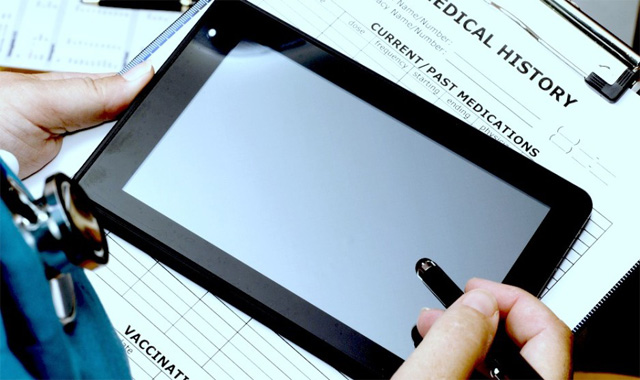





















- The problem: Our health care system is lagging behind other industries in its use of electronic data-sharing practices
- The technology solution: Using electronic health records can share data across providers and settings, saving time and money for patients and the health care system
- Case study—Electronic health records (EHRs) in practice: How using EHRs can lead to decline in emergency room use and hospitalization for health care consumers
- Considerations for consumers: Electronic health records must be able to share patient data easily across providers:
The problem: Our health care system is lagging behind other industries in its use of electronic data-sharing practices
In sectors from banking to car maintenance, immediate electronic access to data is the industry standard. The health care sector is different. Old-fashioned paper records are still the norm in most doctors’ practices across the country, and the adoption of electronic health records (EHRs) has been slow even in hospitals.
The health care sector’s reliance on paper charts makes it difficult for health care providers to track patient information over time and share this information with other providers. It also makes administrative tasks such as billing more challenging. As a result, the system isn’t as safe, efficient, or effective as it could be.
The technology solution: Using electronic health records can share data across providers and settings, saving time and money for patients and the health care system
At the simplest level, an electronic health record is exactly what it sounds like—an electronic version of the paper record that a health care provider uses to track patient care. When integrated into the health system, however, an electronic health record is a much more powerful tool. The ultimate goal is to have electronic health records communicate and share data across health providers and care settings (interoperable), giving ready access to all of a patient’s health information—from medical histories and lab results to medication lists, regardless of where a provider is located or whether he has seen a patient before.
By getting accurate, up-to-date health information into the hands of each provider who treats a patient, health care is delivered more efficiently, cost-effectively, and safely. For example, electronic health records make it less likely that tests like CT scans and blood work will be repeatedly unnecessarily. They also increase awareness and prevention of drug allergies and potential adverse drug interactions. In addition, electronic health records lay the foundation upon which the health care field can build other technological advances in how health care is delivered, such as prescribing prescription drugs electronically and using web-based and mobile applications to improve care monitoring.
Case study—Electronic health records (EHRs) in practice: How using EHRs can lead to decline in emergency room use and hospitalization for health care consumers
Kaiser Permanente of Northern California (KPNC), a health maintenance organization (HMO) that insures 3.4 million people, completed the implementation of a fully interoperable electronic health record system in 2008. Because KPNC is an integrated health care system that serves both the insurance and health care delivery functions for its members, it made practical and economic sense for KPNC to invest in an electronic health record system that shares data across care settings and providers.
Evidence suggests that KPNC’s electronic health record system is improving the health care that it delivers to members and is helping to cut back on unnecessary use of health services. For example, a recent study published in JAMA found that the implementation of KPNC’s electronic health records was associated with a drop in emergency room use and hospitalizations among patients with diabetes. In addition, the KPNC electronic health record system has paved the way for the integration of many other technology-based innovations in the delivery of health care services, such as remote visits with providers, tools to help providers diagnose and treat conditions (known as decision support tools), and a mobile app to remind patients about appointments for preventive screenings and other care.
Considerations for consumers: Electronic health records must be able to share patient data easily across providers:
While the implementation and use of electronic health record systems has increased rapidly in recent years, its widespread adoption has yet to occur.
Between 2008 and 2012, the proportion of primary care practices using at least a basic electronic health record system more than doubled, rising from 20 percent to 44 percent. In 2012, electronic health record use in hospitals increased at an even faster rate, with 56 percent of hospitals reporting that they used at least a basic electronic health record, compared to only 13 percent in 2008.
Moreover, the proportion of health care providers that have electronic health records systems that are able to communicate and share data with the electronic health record systems of other providers, thus achieving the goal of interoperability, is much smaller.
While even basic electronic health records are a substantial improvement over old fashioned paper records, the full potential for electronic health records to improve the safety, quality, and efficiency of health care will not be achieved until electronic health records are fully interoperable and patient data can be shared easily across providers. We’ll explore how to achieve that in future posts.


