



































Nurse informaticists are applying their clinical and analytics skills to EHR optimization tasks, population health management, and other big data projects.
Nurse informaticists often work behind the scenes of the healthcare big data analytics landscape, fine-tuning electronic health records, overseeing data reporting tools, and training nurses and other staff members to use data to its fullest potential.

A strong clinical background and a penchant for computers often propels these data-minded nurses to the forefront of technology optimization and implementation projects, while advanced academic degrees prepare them for the intricacies of complex healthcare data science projects.
Nurses are often the heaviest users of EHR technologies and are frequently tasked with completing day-to-day population health management tasks, clinical quality reporting, and other projects that require a familiarity with the growing number of health IT applications available in the clinical setting.
While EHR optimization and big data analytics projects have tended to focus on the workflows of physicians, a new cadre of Chief Nursing Informatics Officers are making sure that nurses have the tools, strategies, and competencies they need to remain an essential pillar of any organization.
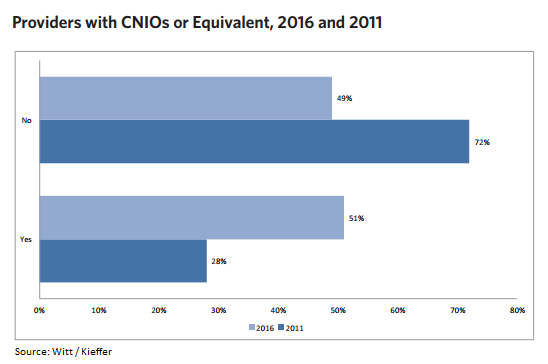
A new survey from executive search firm Witt/Kieffer shows that the Chief Nursing Informatics Officer (CNIO) is becoming a fixture in the healthcare industry. Since 2011, the number of CNIOs has increased by 250 percent.
About half of the 100 organizations included in the poll already have a chief nurse informaticist, and a quarter of respondents without a CNIO in place are planning to hire one in the near future. Respondents included representatives from academic medical centers, integrated delivery systems, independent hospitals, and health systems.
The CNIO role is both technical and strategic, although the proportions vary according to each organization’s needs. Seventy-eight percent of respondents said that the CNIO position includes EHR and clinical IT systems implementations as well as planning nursing strategies.
“The unique sensibilities and abilities of today’s CNIO can guide organizations in creating IT solutions that can maximize nursing productivity and work for the patient,” says the survey. “As the primary liaison between IT and nursing, the CNIO can help strategically identify, apply, and oversee all necessary resources: time, financial, and human.”
Sixty-nine percent of CNIOs engage in direct collaboration with the Chief Medical Information Officer on clinical IT issues, while 68 percent oversee organizational educational initiatives.
Other tasks for CNIOs include training other nurse informaticists, project management, taking charge of meaningful use and regulatory programs, or conducting change management activities across the organization.
“These responsibilities combine to create a powerful force for ensuring user acceptance and the adoption of EHR as well as other emerging technologies,” the report says. “In effect, the CNIO bridges the organizational interests of nursing and technology.”
Nurse informaticists with an eye on an executive position should have skills in a variety of areas, including data science and IT system implementation, business and finance, process improvement, and change management. Fellow executives also value problem solving, collaboration, and creative skills, as well as familiarity with common technologies, the survey shows.
But even CNIOs with a full complement of executive and clinical skills may not receive the respect they desire. Fifty-seven percent of respondents said that the CNIO role is not understood or respected within their organization.
CNIOs most often report to either the Chief Nursing Officer or the CIO, but in some organizations, the CNIO is placed under an IT Director, VP of Nursing, or other position that is not directly within the traditional C-suite.
Survey respondents were optimistic that nurse informaticists can prove their value, however, especially as organizations move beyond basic EHR implementations into more complex big data analytics to support population health management and value-based care initiatives.
“This emerging role, if managed correctly, can go a long way to providing tools and processes that would enhance patient safety; boost nursing, patient, and physician satisfaction; and improve nursing retention,” said one participant.
Another noted that the CNIO “is an essential role to ensure that the driver of technology is the context of care and not the technology itself.”
The survey follows several industry polls by HIMSS that also lend credence to the idea that the nurse informaticist role is on the rise. In 2014, HIMSS surveyed 1000 nurse informatics specialists, eighty-one percent of whom expressed high satisfaction with their jobs. Participants were often very highly educated, with 60 percent holding a master’s degree or PhD. Forty-three percent have advanced degrees specifically related to nursing.
The following year, sixty percent of respondents said that nurse informaticists have a direct positive influence on care quality, and more than three-quarters thought that informaticists are crucial for streamlining workflows, generating clinical buy-in for new IT systems, and maintaining high levels of patient safety.
Close to 25 percent of organizations participating in the 2015 poll said nurse informaticists had been part of their roster since before 2000, and the majority of organizations had adopted a CNIO position during that time. Projects on the docket since then have included predictive analytics, data warehousing, patient engagement, medical device integration, and EHR alert optimization, as well as data integrity and information governance initiatives.
All three surveys combine to paint a positive picture for nurse informaticists, who are becoming increasingly valuable assets for providers. Their combination of clinical experience and big data savvy position them as expert resources for health IT implementation and optimization tasks, and can help to prepare organizations for a heavily data-driven future.


