


















In the fifth episode of the HIMSS APAC Digital Dialogue Series hosted by Dr Charles Alessi, HIMSS Chief Clinical Officer, guest speakers Professor Tomohiro Kuroda, CIO, Kyoto University Hospital (KUHP), Japan and Kazumi Nishikawa, Director, Healthcare Industries Division, Industry Policy Group, Ministry of Economy, Trade and Industry (METI), Japan shared their respective experiences in the response of tackling the COVID-19 pandemic in the country.
KUHP’s experience in combating COVID-19
In the fight against COVID-19, Japan declared a state of emergency from April 7 to 24 May to curb infection rates – people were requested to restrain themselves and minimize movement, particularly during the busy Golden Week Holiday period in early May. A cluster-based approach was taken to identify clusters of potentially infected COVID-19 patients derived from epidemiological simulations and actively isolate infected persons to prevent further disease transmission.
KHUP’s approach to minimize nosocomial infection is very much like other hospitals’ in countries like South Korea and Taiwan: conducting outpatient screening for COVID-19 symptoms, setting up triage stations to separate patients with fever and from abroad and administering rehabilitation at the ICUs with proper personal protective equipment (PPE).
Professor Kuroda explained that the main approach was keeping staff connected without having contact. This is done in a number of ways such as through web conferencing platforms such as CISCO Webex for staff communication, the use of telemedicine for outpatient appointments (within the guidelines set by the Ministry of Health,Labour and Welfare) and setting up ICU rooms with remote communication and monitoring capabilities.
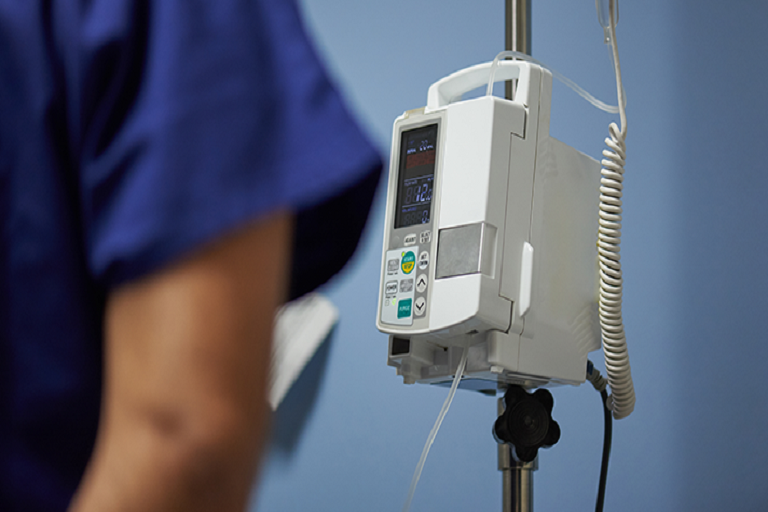
One of the most interesting innovations at KUHP is its remote assisted infusion pump, in which the rate of injection can be computer controlled and was developed in-house at KHUP with the support of Terumo, a Japanese medical device company.
A coordinated approach in dealing with medical supply/equipment shortages
Nishikawa said that one of the unique ways in which Japan dealt with the COVID-19 pandemic was understanding the supply chain and logistics in medical supply/equipment. Equipment such as PPEs and ventilators come from overseas markets and it was difficult for Japan to import these materials compared to usual periods.
“We therefore put our efforts to increase domestic production (of medical supply/equipment). Ordinarily speaking, medical equipment companies which produce face masks and ventilators in Japan are relatively small. For instance, domestic face mask production is dominated by four or five SMEs in Japan. So we try to match small medical SMEs with big, global manufacturing companies.”
“For example, the global Japanese electric company Sharp located in Osaka, they started to produce face masks using SMEs’ or foreign companies’ technologies to successfully produce face masks for medical professionals and ordinary citizens,” said Nishikawa. Sony, a global entertainment company, is supporting Acoma, a small Japanese medical equipment company to rapidly scale up their production of ventilators.
Preparing for the second wave of the COVID-19 pandemic
In the first wave of relative success in dealing with the COVID-19 outbreak in Japan, Professor Kuroda mentioned that at KUPH and other hospitals in Kyoto that he is working with, there is a mutual understanding between different hospital directors to share roles and resources in dealing with increased patient loads. With a potential second wave of the outbreak occurring, Nishikawa said that they will continue to take a cautious approach and listen to the voices of local hospitals in terms of responding to their PPEs and ventilators needs.
“Before the flu and summer season, we have to do more to provide and disseminate these materials to hospitals and those in the medical professions. We should be mindful to think about emergency/business continuity plans (BCPs) and learnings from the rest of world,” he said. “We already noticed that the (lack of) PPE is going to be a big problem in the middle of February. So most of the university hospitals in Kyoto and others tried to save the PPE consumption, maybe from the beginning of March. That really worked well. The preparation really worked well and the support from the government really helped,” added Professor Kuroda.


