





















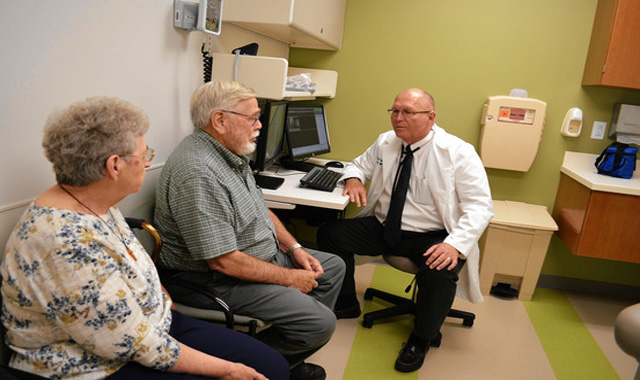






when Regina Harrell, physician and assistant professor in the College of Community Health Sciences, enters the scene of a house call, the first thing she does is pick out a spot to kneel on the floor, practically at the feet of her patient.
After some conversation, she pulls out a palm-sized device from her bag and introduces it to her patient as a new toy. The patient puts their fingers on either end and lowers it into their lap. Harrell pulls out her iPhone. The device, relatively new to Harrell, allows for on-the-fly electrocardiograms, which she can receive and download directly onto her phone. After the reading and visit are complete, she closes her bag and leaves, never having touched the bulky laptop she uses for compiling and updating electronic medical records.
Harrell recently found herself on the front page of NPR’s website after writing a column expressing her frustration with electronic medical records, which have abruptly become a part of health care nationwide through federal mandate. Harrell’s column “Why a Patient’s Story Matters More Than a Computer Checklist” was published on Pulse, an online health care magazine, and began generating above-average traffic before it was featured on NPR.
“You have things happen, and you’re frustrated about them … Writing them down can help congeal the thoughts in your head,” she said.
Harrell said the health care industry is currently working to meet standards of care while still working with patients on an individual basis.
“There’s a real challenge in health care to nationally prove that people are meeting standards of safety and quality while also providing appropriate individualized care for each individual person,” Harrell said. “I think that’s the crux of where we’re stuck right now.”
Harrell said electronic medical records (EMRs), which are meant to streamline and connect a patient’s various health care providers, have become polarizing because they often force physicians to choose between detracting from the quality of in- person visits or adding hours of unpaid, frustrating work to their day.
“Every physician has a strong opinion on computerization of the health care system. Some of them love it, some of them hate it, but everyone has a strong opinion,” Harrell said. “They’re asking us to do more and get paid less in a way that’s very unfulfilling … That’s what’s making so many physicians frustrated.”
Brian Wilhite, a physician with Internal Medicine Associates, is currently in transition. He said some aspects of EMRs do help ease the process of retrieving records, but for doctors like him who deal with multiple issues per visit, EMRs can also slow the process down.
“Currently, many of the EMRs are not yet integrated with other systems. So what you get can be dangerous, an incomplete chart,” Wilhite said. “Sometimes no chart is better than an incomplete chart because you can potentially have a chart that can give you a false sense of security of completeness.”
Wilhite said stipends have not realistically compensated for the expenses EMRs have generated. He has opted out of using scribes for cost and confidentiality reasons but has seen negative impacts on efficiency.
“Throughout the training period, I was frustrated with the EMR system, often commenting, ‘But that’s not really important’ or ‘That’s not really how we do it’ or ‘Why don’t they do it this way?,’ as it is obvious that many of the current systems were not developed by physicians. Yet I expect in time this will improve greatly as doctors that are getting burned out and retiring physicians are now occasionally acting as consultants to assist developing EMRs,” Wilhite said.


