








































“It used to be, if you were having a heart attack, you called your doctor and he met you at the hospital,” a respected physician told me recently. “The primary physician determined what was wrong with you and sent you to a specialist to fix it. Today, the primary’s main job is to funnel patients into the system’s network of specialists.”
Some physicians must now make a special effort even to look patients in the face, because they spend so much of the time-limited appointments clicking boxes on a computer screen.
“One doctor I know is employing someone to sit in the corner to take notes for him, so that long-time patients can see that he’s looking and listening and not being rude,” another physician, a specialist, told me. “That’s not going to cut costs.”
When I was a little boy, my father had an operation, and the family physician, whose office was in his home a few blocks away, came by to check on him. I remember house calls. I’m old.
Many Long Island doctors are selling their practices to the mega-hospital groups, and sole practitioners are disappearing, often because of the cost and hassle of dealing with insurance companies and upgrading technology. For a lot of them, life on the assembly line has been a bitter experience. For most, it certainly hasn’t streamlined administration or improved the delivery of actual care to patients. Paperwork and redundancies have skyrocketed.
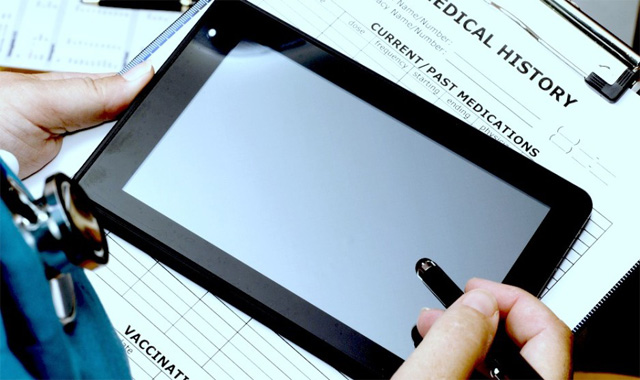
Are you a new patient, or have you not been here in a while? Please come 15 minutes early for paperwork. If you’ve had to fill out the same patient history questionnaire twice in the same day, in the same building, you know how frustrating it all is. Each time patients fill out the same paperwork, the chance of errors increases substantially. At one of Long Island’s hospital networks, patient data still can’t be shared digitally between offices. Doctors are walking around clicking and tapping at expensive tablet computers, but to send the information to the doctor on the third floor, they print it out and use the fax machine.
Insurance companies demand the paperwork because their systems are designed to weed out procedures.
While the federal health care reforms didn’t cause all this, it won’t fix much and it will probably make a lot of it worse for patients and conscientious health care professionals.
Consider these EMRs. The Affordable Care Act (“Obamacare”) provides incentives to hospitals, labs, clinic and doctors to set up Emergency Medical Record systems, which can share digital medical histories. A boom industry has emerged in setting up the hardware, software, staff training and ongoing administration of EMR systems, which can cost between $15,000 and $70,000 per doctor and hundreds of millions for a hospital system.
Doctors tap away at their screens. Billions of dollars have already been paid to providers demonstrating “meaningful use” of DMR. The gag is that the incentives are based on receiving digital files, but not opening and understanding them. One of my doctor buddies says this: “EMR is a farce.”
Some parts of the private sector are making a mint off health care reform, a lot of it under the radar screen. This is what happens when every point along the line of health care delivery must be monetized and profitable, and when foxes design the chicken coop.
Much of the hysteria over Obamacare has been exaggerated or presented out of context. Some real problems have been lost in the noise. Obamacare is seriously flawed because it is not significant reform. It’s an adjustment, based around maintaining an insurance system that America outgrew


