












The “e-patient” movement seems to be accelerating. At the beginning of 2013, patient advocacy group the Society for Participatory Medicine hired its first-ever executive director. As the year draws to a close, a new book shows how engaged and empowered patients have been successful in “care hacking” the convoluted healthcare system and suggests how developers of digital technologies can prosper in the future.
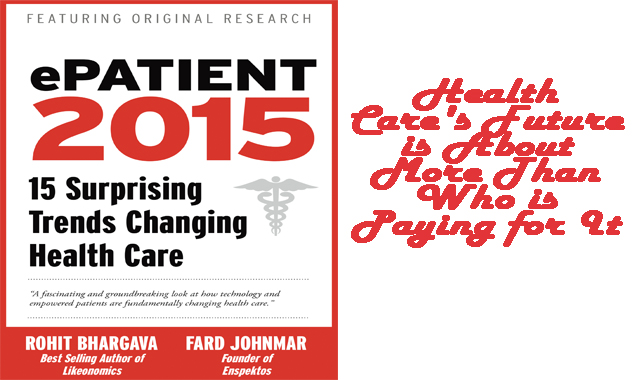
The book, ePatient 2015: 15 Surprising Trends Changing Health Care (IdeaPress Publishing), shares individual patient stories as a way to illustrate the future of healthcare, according to co-author Fard Johnmar, founder and president of New York-based digital health consulting firm Enspektos.
“Our aim is to offer a big picture, people-oriented overview of what’s next in health care,” Johnmar wrote with his co-author, marketing consultant Rohit Bhargava, who also penned, “Likeonomics: The Unexpected Truth Behind Earning Trust, Influencing Behavior, and Inspiring Action.”
Instead of concentrating on technology, the authors examined how they believe new technologies will prompt to think and act differently when dealing with health and healthcare. “We look at things that are out there today and will be accelerating rapidly in the near future,” Johnmar explained to MobiHealthNews.
Enspektos surveyed about 400 e-patients in the U.S., based on a definition from Pew Research Center: those who have searched online for health content for themselves or on behalf of another person. (The “e,” according to one of the best-known such patients, cancer survivor “E-Patient” Dave deBronkart, can stand for equipped, engaged, empowered or enabled.) The authors also conducted interviews with “pioneers of the health technology movement.”
The survey, according to Johnmar, revealed that consumers have started to show an interest in such things as privacy, access to digital technologies and living where health opportunities and services are plentiful. “These are things that people are going to be talking about more and more,” he said.
The book opens with two versions of a hypothetical tale of a kid with a fever, one set in 2013 and the other in 2015. In just two short years, the authors predicted, the child’s mother will go from inaccurate temperature readings, guessing the dosage of an over-the-counter remedy and a late-night call to an uninformed doctor to continuous monitoring of the child’s vital signs that prompted an automated text to the mom’s cell phone, leading to a quick video chat with a physician who had access to the youngster’s electronic medical record. Both mother and daughter got a good night’s sleep.
Another hypothetical patient receives a devastating cancer diagnosis. Today, he leaves the hospital with some printed educational material and a follow-up appointment, then goes home to find all sorts of frightening and confusing information about his condition on the Internet. But in 2015, the doctor will be able, with the patient’s permission, to analyze his medical record and those of several relatives to offer specific recommendations for treating that type of cancer. The physician also would prescribe a mobile app to track his health and treatment, as well as connect with others who have the same condition.
From their research, the authors identified 15 trends in three categories: health “hyper-efficiency,” which they titled, “From Human-Like Computer Interfaces to Data-Powered Oracles”; the personalized health movement; and digital peer-to-peer healthcare for support, knowledge and research.
Trends “naturally aligned” around the challenges of escalating healthcare costs, standardization that leads to the practice of “generic medicine” and the difficulty patients often have in finding social support when confronted with serious health issues, the authors wrote.
Under health hyper-efficiency, they categorized: empathetic interfaces, unhealthy surveillance, and predictive psychohistory.
The personalized health movement, Johnmar and Bhargava wrote, will see: augmented nutrition, medical genealogy, the over-quantified self, the device divide, multicultural misalignment, healthy real estate, neuro-influence mapping, natural medicine, and microhealth rewards.
In terms of peer-to-peer digital healthcare, the authors expect people harness the social web for what they called: virtual counseling, care hacking, and accelerated trial-sourcing.
The “over-quantified self” reflects a concern that that new technologies will churn out a flood of data, much of which will not be particularly useful or relevant, according to the book.
Johnmar said he has seen a “disconnect” in turning data into action. He mentioned Validic, a startup supported by billionaire entrepreneur Mark Cuban, as one company that is responding to over-quantification by not distributing all the data it collects to end users. “Validic believes data needs to be actionable,” Johnmar said.
Johnmar also has noticed a “multicultural misalignment” that is related to what he termed the “device divide.” In other words, he explained, “Innovators may not have the ability to look at the world from the eyes of disadvantaged communities.” They will have to overcome this, in no small part because the survey found that African American e-patients were twice as likely as their white counterparts to say it was “very important” for digital health tools to “fit their background and culture.” Source