





























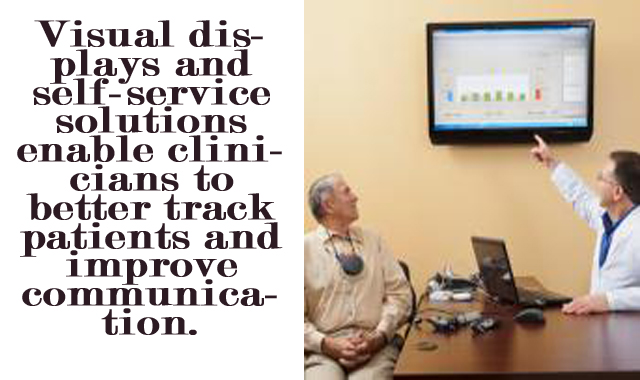
Visual displays and self-service solutions enable clinicians to better track patients and improve communication.
Many hospitals are currently using digital signage and kiosks to communicate wayfaring, patient directories and other needed information for visitors. Now newer, more complex types of visual displays and kiosks are all about improving the broad communication that takes place among clinical staff and with their patients – and family members.
Sometimes referred to generally as patient tracking solutions because they convey a patient’s whereabouts, clinical status and next steps, they also enable clinicians to move patients as efficiently and effectively as possible through the care protocol and process.
Most importantly, these visual displays deliver key information at the point of care in a way that improves clinicians’ ability to make decisions, coordinate care during patient handoff and be as efficient as possible with their time and steps.
“It’s all about workflow,” says Mary Griskewicz, senior director of Healthcare Information Services for the Healthcare Information and Management Systems Society (HIMSS). “Having information in an easy-to-view, heads-up display makes everything more effective, more efficient and less stressful for all involved.”
The Possibilities for Display Technology in Healthcare
Digital visual patient tracking solutions can be integrated with key clinical and logistical systems like electronic health records (EHRs), barcode tracking systems, patient admissions, operating room scheduling, radiology, housekeeping and transport.
The resulting information can then be programmed to display in myriad ways and on different platforms. These include a public or clinical display, command center monitor, kiosk or mobile device, depending on the audience, the sensitivity of the information and the application.
Brian Sykes, director of marketing for Meridian Kiosks, notes that by relying on kiosks and large displays, healthcare organizations are able to translate dense data into easily understood graphics and actionable information. For example, in labor and delivery, a solution combining radio frequency identification (RFID) badges and visual displays can enable nurses to pinpoint the location of on-duty obstetricians using a floor map and icons.
“They know immediately if a physician is on campus yet, where they are and how quickly they can get to a patient,” Sykes continues. “And so we’re at a point where you can do almost anything to simplify data and make it easy to access, easy to understand and easy to use. You’re really limited only by the imagination.”
Among the possibilities that are fast becoming popular within healthcare organizations are the following:
- Admissions. Many healthcare organizations are using kiosks to allow patients to self-register when they first arrive. Others are starting to tie these applications in with the larger admissions solution including a patient’s health record, scheduling and room availability systems, so key information can be automatically extended to the clinical area. A display monitor, for example, can automatically – and in real-time – inform nurses that a patient has arrived, along with the scheduled physician or surgeon, the assigned room number and any health or priority alerts.
- Emergency Room. Clinicians used to rely on erasable whiteboards to keep track of patients, their triage status and location and physician schedules. But it was hard to keep up-to-date and sometimes contained input errors. Now they are able to use large-display digital formats that provide clinicians with a number of need-to-know details, including patient priority, triage report, health or priority alerts, room number, scheduled physician and patient whereabouts.For example, if a patient is sent to radiology for a CT scan, a physician who has that patient in their exam queue can know that and adjust accordingly. “They can really guard against wasting their time going to see a patient who’s not back in the exam room yet or asking around to find out where that patient is,” says Stan Swiderski, business development manager for medical and professional displays at NEC Displays. “It’s really all about gaining that time efficiency, which is so critical during an emergency situation.”
- Operating Room. Tied in with an operating room scheduling system, visual displays can be used in one of two ways. The first is to keep the surgical staff informed of the up-to-date specifics needed to effectively manage their cases. The second is to keep family members sitting in the waiting room apprised of where their loved one is as they move through the process from pre-op to surgery to recovery and then back to their room. The two applications, though they rely on many of the same inputs, display very differently, as the waiting room information will include for privacy reasons, only a patient code, rather than a name or any other personally identifiable information.
- Continuity of Care. Many hospitals are utilizing large- format displays to increase the ability of care teams, as well as different clinical specialists, to consult more easily and more effectively on specific cases. Rather than huddle around a desk and a small computer monitor, they can easily view case details, along with supplementary information, such as radiographs or lab results, in the ER or other clinical care area or in a command center.
- Patient Logistics. By integrating visual displays with patient health records into logistics applications, everyone can remain fully apprised of the current and next steps in the process. For example, when radiology is ready for a patient — or when the ER is sending a high-priority patient to radiology — the hospital’s system can communicate that on visual displays in the ER, nursing stations and the radiology department so everyone is on the same schedule and wait times are minimized, if not completely eliminated. When a patient is discharged, housekeeping is automatically tipped off that a room is now vacant and in need of cleaning. And physicians can leverage a patient’s EHR and logistics solution to send a message to a patient’s in-room infotainment system to let them know arrival time for a follow-up visit.
Digital Signage Is the Holy Grail of Healthcare IT
For healthcare organizations, an investment in visual digital solutions will have both immediate, tangible payoffs, as well as long-term benefits.
Very quickly, for example, digital visual patient tracking solutions will result in better clinician and patient communication, new time and cost efficiencies, improved staff productivity and smoother patient hand-offs, according to Swiderski.
As a result, healthcare organizations are likely to enjoy major impacts on the total patient experience, with improvements in quality of care outcomes and patient safety and patient satisfaction scores. Increases in these measures will enable hospitals to achieve Meaningful Use Stage 2 and high Hospital Consumer Assessment of Healthcare Providers and Systems (HCAHPS) scores — both of which are tied to revenue reimbursements.
“It’s really the Holy Grail for clinicians,” says Griskewicz. “They need information at the time of care, as close to real time as possible, so they can do their analysis, their triage and their care coordination.”
At the same time, visual patient tracking solutions help hospitals fully understand bed control and patient flow, from admittance to discharge, she says. “It allows them to facilitate the safe, smooth flow of patients into hospital rooms from the ER, the surgical areas and other areas of the hospital,” Griskewicz adds. Source


