




















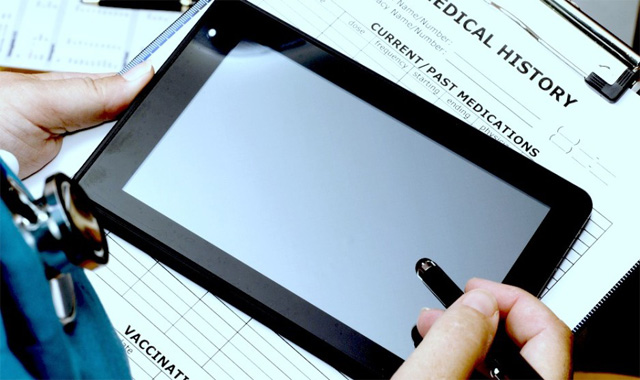




















Are electronic medical records largely to blame for the growing crisis of physician burnout?
One of the most enjoyable parts of my job is meeting new medical students every year. I invariably find myself not only impressed by their talent and intelligence, but also struck by their optimism and idealism. They want to become doctors because they want to help people—not in the abstract or in general, but in real ways that translate to tangible patient outcomes.
Sadly, the realities of modern medical practice are turning too much of the idealism into despair. Each year, our school produces almost 100 new doctors eager to make a difference, and in that same period, many thousands of physicians around the country become emotionally exhausted and detached. In all, according to the annual Medscape Lifestyle Report, more than half the practitioners in many specialties—including primary care doctors and especially emergency physicians—experience burnout. We have to get to the bottom of this growing crisis.
One major culprit is something that was supposed to make health care work better—the electronic medical record (EMR). In my conversations with physicians around the country, I hear a constant frustration about the ways in which the now-ubiquitous tool has become a barrier to providing the kind of personalized attention and care that we want to give our patients. In fact, improving EMRs was at the top of a list of ideas to transform health care in a recent STAT news survey of 425 practicing physicians and health care leaders.
Together with the compressed time of office visits, EMRs conspire to turn medical practice into a regimented, one-size-fits-all endeavor, just when science and technology are giving us more ability than ever to treat our patients as the individuals they are.
For all the promise that digital records hold for making the system more efficient—and the very real benefit these records have already brought in areas like preventing medication errors—EMRs aren’t working on the whole. They’re time consuming, prioritize billing codes over patient care, and too often force physicians to focus on digital recordkeeping rather than the patient in front of them.
We could use technology to do so much more, and get so much closer to practicing better medicine. EMRs could, for example, incorporate basic diagnostic support functions that simplify physicians’ jobs, enabling them to focus more acutely on treating the whole patient. Today’s search engines are better at helping doctors diagnose disease than our EMRs.
We need a major revamp of EMR design, with doctors taking a leading role in the process. These doctors need to engage with technologists to develop new systems that harness the digital revolution in ways that serve both our patients and caregivers, taking advantage of technologies like voice recognition. Our smart phones and devices already have this technology—why can’t it also be applied to EMRs to help free physicians from the keyboard?
At the same time, we need to restore humanity to the office visit. Technology can help here as well. We must be able to use telemedicine, secure email, and other remote interactions to handle enough routine matters that we’re able to free up time to make better use of our in-person encounters, when we can fully engage with our patients.
We can also consider adjustments to other steps in the process: for example, Stanford Medicine’s new Primary Care 2.0 program employs a med tech who accompanies the doctor during clinic visits and inputs data into the EMR. The cost of the staff person is offset by freeing up more physician time.
On these and other issues, what’s good for the doctor is good for the patient. Advances in genomics, data science, and other fields have given us tools to better understand each patient’s individual biology. We’re learning more every year about how to take advantage of that knowledge to not only tailor care for individuals, but to prevent them from getting sick altogether. That kind of care—Precision Health—will be revolutionary for patients and doctors alike.
By addressing the core issues that lead to physician burnout, we’ll make health care better, and ultimately help patients lead healthier lives. We owe it to our patients—and to all of our physicians, who’ve dedicated their lives to making a difference.


