


















































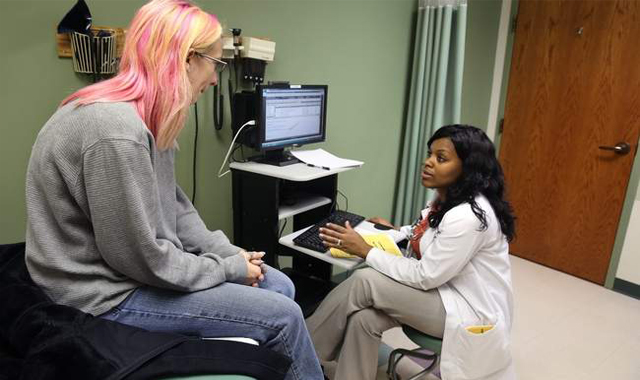
The growth of electronic health records gives doctors access to more information quickly but can distract them and actually reduce communication with patients in the examination room, according to a recent study by Northwestern University.
By Dean Olsen
The growth of electronic health records gives doctors access to more information quickly but can distract them and actually reduce communication with patients in the examination room, according to a recent study by Northwestern University.
Springfield doctors say this potential downside of electronic records is no secret in the medical community locally and nationally, but the problems are possible to overcome through training.
Regardless, they said computerized records, prevalent in Springfield and becoming more popular nationwide because of technology and the federal payments that reward “meaningful use” of those records, have tremendous potential for reducing medical errors and making care more efficient.
“The benefits certainly outweigh the deficits, and the benefits really are significant,” said Dr. David Graham, a family physician who is senior vice president and chief information officer for Springfield-based Memorial Health System.
Dr. Lauri Lopp, health information technology director for the family medicine department at Southern Illinois University School of Medicine, agreed with Graham on the benefits of electronic records. However, she said it’s not always easy for doctors to incorporate computers seamlessly in patient care.
“There are ways that, if done well, the computer should be a tool — something to enhance the relationship between the doctor and patient, not detract from it,” she said.
The Northwestern study, involving 100 patients and 10 doctors at primary care practices throughout the Midwest — but not in Springfield — found that doctors who used electronic health records during visits with patients spent, on average, one-third of their time during the visit looking at a computer screen.
That’s more time than doctors usually spend looking at paper records during a visit, said Northwestern industrial engineer Enid Montague, an author of the study in the journal Medical Informatics.
“When doctors spend that much time looking at the computer, it can be difficult for patients to get their attention,” she said. “It’s likely that the ability to listen, problem-solve and think creatively is not optimal when physicians’ eyes are glued to the screen.”
When doctors were typing, they “weren’t able to really listen very well,” she said.
There has been relatively little research on the way electronic records affect doctor-patient communication, Montague said.
It’s not known whether their potential interference with that communication results in bad care or negative consequences for patients, she said.
“There are a lot of potential consequences,” she said, especially when it comes to the primary care specialties of family medicine, pediatrics and general internal medicine, where it’s important for doctors to build long-term relationships with patients.
Good relationships can help doctors spot health problems and better manage chronic conditions, she said.
The study, which examined “eye-gaze patterns,” could help companies develop better designs for electronic health records so the systems don’t require doctors to spend so much time checking boxes and performing other distracting tasks that may not enhance patient care, Montague said.
“I don’t think electronic health records are a bad idea,” she said. “Certain aspects of patient care are improved.”
Federal investment
The federal government is providing $27 billion in incentive payments to health care providers that expand the use of electronic records and expand online access to health records for patients by 2021.
Springfield-area providers have received millions of dollars already and are farther along in adopting electronic records than many parts of the country, Graham said.
About half of all doctors’ practices in the United States have replaced paper charts with electronic versions. That figure was 20 percent only a few years ago, said Graham and Dr. Gerald Suchomski, medical director of quality programs for Memorial Physician Services.
All of Memorial’s primary care physicians were using electronic records in spring 2011 after beginning the conversion from paper in late 2009.
Memorial Medical Center and St. John’s Hospital both have reached the so-called “gold standard” for electronic records: Physicians use computers, rather than fill out pieces of paper, to issue medical orders for patients hospitalized at either facility.
Springfield Clinic put electronic records in all of its locations in Springfield and outlying communities in 2005.
And most of the 240 doctors at SIU HealthCare, the group practice of doctors associated with the medical school, have converted to electronic records after the process began with primary care offices in 2007.
Electronic etiquette
SIU may be at the forefront of training future and new doctors on how to incorporate electronic records without disrupting communication with patients.
The medical school created a half-hour online video training program that offers tips for proper etiquette while using electronic records and other “key concepts” to keep in mind in the exam room.
The school began offering the program two years ago to second-year medical students and to doctors at their start of their SIU family medicine residency. The program was developed by Lopp, SIU technology specialist Heeyoung Han, and Theresa Waters, a registered nurse who educates medical students on how to make the best use of health information technology.
“We give video examples of positives and negatives that they would want to avoid in their interactions,” Lopp said.
For example, medical students and doctors are encouraged to give patients their undivided attention at the beginning of each visit and not use the computer at all, then to position the computer so it doesn’t block lines of sight.
The video makes it clear that doctors should take their hands away from the keyboard and make eye contact with the patient if a sensitive issue comes up, Lopp said.
An article about the SIU video will be published soon in a major journal on medical education, she said.
“I think there will be growing educational efforts in medical schools and residency programs to help providers know how to do this very delicate skill of positively interacting with the computer system while you’re interacting with the patient, and knowing at what moments to focus on the patient only and what moments you can use the computer to aid in the relationship,” Lopp said.
All SIU doctors have been trained on how to use electronic records — to plug in and retrieve data — but it’s a challenge to reach all of them with the finer points of “EHR communication skills” described in the SIU training program, she said.
A major expansion of electronic records in American medical practices has occurred over the past 10 years, Lopp said.
“We’re in a big transition in medicine,” she said.
The potential problems pointed out in the Northwestern study didn’t surprise Graham, who said early adopters of electronic records may have been more enthusiastic about using them than the broader population of doctors who may not have as many computer skills.
A Lincoln doctor employed by Memorial who had problems adapting to electronic records was placed on administrative leave in late 2011. Dr. Steven Kottemann, 63 at the time, retired the next year.
Memorial doctors “receive good instruction” on electronic records, Graham said.
Suchomski said Memorial tries to provide as many tips and as much in-person help as possible, but “there’s always room to improve.”
He doesn’t view electronic records as any more of a barrier to communication than paper charts, which also can get in the way if doctors aren’t careful.
Electronic records allow doctors to print out and hand patients a summary of their visit before they leave. Doctors rarely hear criticisms from patients about the computer in the room, Suchomski said.
“Most of them are awestruck at our ability to pull stuff up,” he said.
Exam rooms now are being constructed with electronic records in mind, Graham said. Examples of this include the recently completed physician office building that Memorial Health System built next to Jacksonville’s Passavant Area Hospital, the Springfield Clinic 1st “900 Building” now under construction, and physician office buildings next to Taylorville Memorial and Abraham Lincoln Memorial hospitals, according to Memorial officials.
Contact Dean Olsen: 788-1543, dean.olsen@sj-r.com, twitter.com/DeanOlsenSJR


