






























Exclusive at EMRIndustry.com
By Dr. Donald Voltz, MD, Aultman Hospital, Department of Anesthesiology, Medical Director of the Main Operating Room, Assistant Professor of Anesthesiology, Case Western Reserve University and Northeast Ohio Medical University.
Board-certified in anesthesiology and clinical informatics, Dr. Voltz is a researcher, medical educator, and entrepreneur. With more than 15 years of experience in healthcare, Dr. Voltz has been involved with many facets of medicine. He has performed basic science and clinical research and has experience in the translation of ideas into viable medical systems and devices.
Thanh Tran, CEO of Zoeticx, Inc. also contributed.
It is strange to discuss disrupting EHRs since their widespread adoption began only five years ago with the HITECH Act of 2009. In the last five years, there have been hospital and EHR adoption rate increases of almost 50 percent and 26 percent, according to the 2014 Report to Congress on Health IT Adoption.
Given the hurdles involved with selecting, implementing, and developing new provider workflows, and in some cases, ripping and replacing an initial install, why further disrupt Health IT?
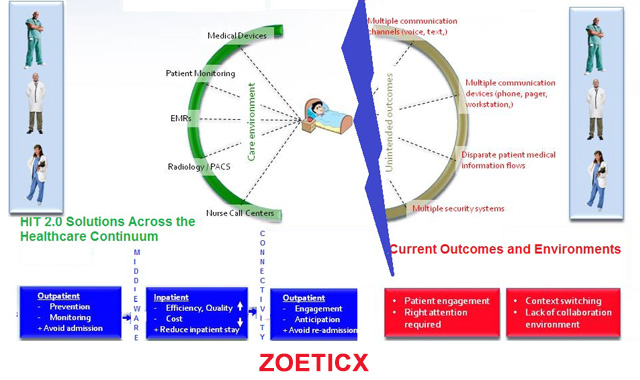
New social media-based technologies, software design, methodologies and investment trends will soon be causing significant disruption to hospital EHRs. With the advent of digital, mobile, and open medical IT environments, EHRs need to adapt to these new technologies. Middleware connectivity, single platform data views and new medical applications that transform patient data into workflows that deliver data where it is needed, when it is needed, are already available from healthcare 2.0 vendors like Zoeticx.
The widespread implementation of EHR systems less than a decade ago with 748 Health IT vendors supplying certified EHR applications to more than 400,000 healthcare providers in CMS and ONC incentive programs. Many of the current, commercially available EHR applications have been in use for more than 30 years in academic medical centers, hospitals, physicians’ offices and government, but varied greatly in functionality.
In healthcare, with the support of the HITECH Act, the Department of Health and Human Services allocated $35 billion over ten years to support EHR adoption. With the HITECH Act, existing EHR technology became valuable as hospitals implemented systems to receive the incentives and avoid penalties. In 2013, the US Senate released REBOOT, an initiative to re-examine the health IT implementation strategy, identifying areas of concern with HIT and propose potential solutions to improve the success of the initiative that began with the HITECH Act.
Changing EHRs to Meet Healthcare 2.0
There is no paucity of safety concerns, changes in provider workflow, patient engagement with EHR data, and the increased costs to hospitals to maintain and upgrade current EHR applications as the regulatory, compliance, provider and patient needs change with EHR implementation into healthcare 2.0. The challenge is not to overcome resistance to the technology, but to engage participants across the healthcare continuum on a path that addresses the healthcare needs of our nation.
Health IT needs to be HIPPA compliant with a middleware driven free-flow of health data between care providers. This is even more critical as our healthcare system changes paradigms, moving from a centralized, single-provider model to a decentralized, care-team approach of delivery. Medical pros are already being presented with a great deal of patient data being stored in multiple formats and across many geographically dispersed data centers generated from different EHR systems with no interoperability.
Technology is not slowing down. Innovative applications are being developed, new business models, and a continual fall in the cost of computer power are resulting in a disruption of all business sectors, including healthcare.
Traditional EHR software applications are updated infrequently. Rapidly responding to safety issues, addressing issues with provider workflows or evolving data visualization to better care for patients is a challenge. EHR customers are being forced to adopt processes and strategies around this old technology instead of being able to optimize care delivery by exploiting innovations.
How then does disruption lead to improvements in Health IT and ultimately translate into higher quality, more valued care delivery capable of evolving with the changing patterns medicine?
Less code, More SaaS
Some of the small, but profound steps hospitals can take to foster healthcare 2.0 innovations are to move from code to platforms, and from locally installed corporate applications to distributed software as a service. Patient health data becomes managed by service providers and software development occurs on the top of a standardized platform. This enables rapid, custom, user-focused tools to deliver data, allowing for communications between providers, patients and regulatory bodies needing assurance of value-based reimbursements.
Zoeticx is already offering these capabilities with its Care Suite which turns passive medical data into an active environment, creating a dynamic workflow that enables the right information to get to the right care providers at the right time for the best patient outcomes. It also consolidates data through a single screen view so medical professionals across the healthcare continuum can more easily concur on treatment. Meanwhile, Zoeticx’s Patient-Clarity software uses a patient-centric middleware platform to enable information to flow from diverse EHR sources, transforming passive patient medical data into actionable information.
This model does not eliminate EHRs, nor does it prevent the collection and storage of patient health information, but it enables distribution of workflow data to healthcare providers. Gateways residing between EHR systems and healthcare databases allow for seamless workflow. They also foster the development of algorithms, business logic, and messaging between legacies and emerging applications.
Apple, Google, Twitter and Facebook have all adopted this model and their initial disruption can be repeated in healthcare. The key is to facilitate the interest of providers without requiring them to become experts in data entry, technology stacks or changing the workflow they are accustomed to which stems from the original nurses’ sheets.
Most physicians and other healthcare providers are open to the use of technology, provided it meets their needs. A cloud platform for customized interaction with EHRs is likely to be welcomed by physicians restricted to searching for information with limited access as they transition between care locations.
Venture Capital Leading EHR Disruption
However, moving EHR’s to the cloud will not cause a disruption to occur, but the venture capital investment in health IT will. Venture funding more than doubled in 2014 with $4.7 billion invested according to Mercon Capital Group. EHR disruption has lead to the development of new industries including data analytics, clinical decision support, telehealth and personal health and fitness apps and devices.
The only missing piece of the puzzle is the framework connecting all of the data with the applications. Central to the health IT strategy is connecting the various EHR systems and HIE data warehouses. With the implementation of such a platform, health tools that impact personal and population health will advance. Health IT as a service, being supported by a middleware platform, can disrupt healthcare in a cost effective, scalable manner.


