
















Fraunhofer technology revolutionises 3D printing of prosthetic eyes
Moorfields Eye Hospital London… the first ever patient in the world to be supplied with a fully digital 3D printed prosthetic eye…
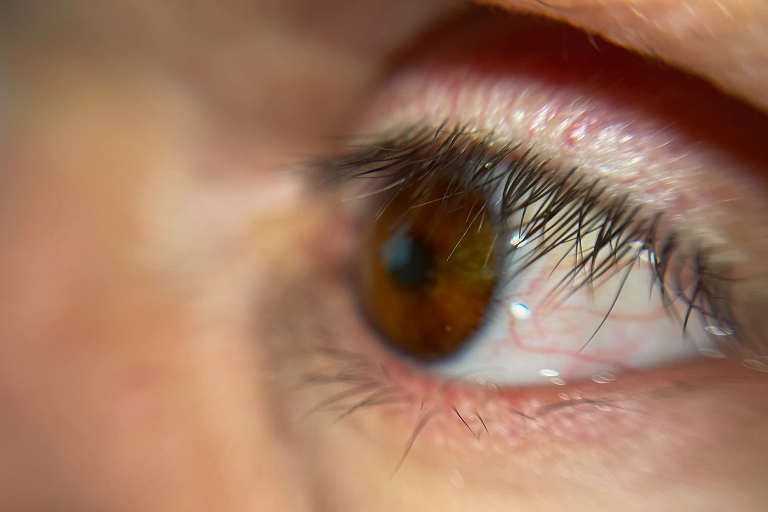
Prosthetic eye replacements will be manufactured by 3D printers in the future. Fraunhofer IGD has developed a number of technologies that supersedes the current and entirely manual production of individual prostheses. Fraunhofer’s Cuttlefish:Eye software utilises a 3D scan of the eye socket and a colour-calibrated photo of the healthy eye, to create the prosthetic eye`s 3D model. Fraunhofer’s Cuttlefish® 3D printing driver is used to print the model on a multicolor, multimaterial 3D printer.
Not only is a 3D-printed prosthetic eye produced in a fraction of the time taken by the conventional process, but the resulting prosthesis also looks more realistic. This is made possible by the algorithms of Cuttlefish:Eye, a software solution from the Fraunhofer Institute for Computer Graphics Research IGD. Working in close collaboration with the British company Ocupeye Ltd. The research team in Darmstadt have developed a unique process to create a virtual model from a scan of the eye socket together with a photo of the healthy eye. This serves as a reliable digital platform for 3D printing. The breakthrough technology to produce prostheses will now be fitted in patients for the first time in a clinical trial to be held at Moorfields Eye Hospital London.
Professor Mandeep Sagoo, consultant ophthalmologist at Moorfields, added:
“We are excited about the potential for this fully digital eye. This has been a culmination of 4 years of development of sophisticated technology between Moorfields Eye Hospital, UCL Institute of Ophthalmology, Ocupeye Ltd and Fraunhofer. We hope the forthcoming clinical trial will provide us with robust evidence about the value of this new technology, showing what a difference it makes for patients. It clearly has the potential to reduce waiting lists.”
Ocular prostheses become necessary whenever an eye has had to be surgically removed for health reasons, e.g. as a result of a serious injury or a life-threatening disease such as eye cancer. Conditions that afflict around three quarters of a million people in Europe and over eight million worldwide. The method of individually measuring the eye socket and manufacturing the prostheses has remained largely unchanged for many decades. The invasive moulding can be uncomfortable and in children a distressing experience which often requires a general anaesthetic. The subsequent, hand crafted, time-consuming manufacturing process leads to several months of waiting, thereby exacerbating what is already a stressful time for the patient. Utilising leading edge 3D printing technologies, the new process significantly speeds up production and provides patients with a quicker, better and an overall more comfortable experience.
The patient’s 3D prothesis initial appointment begins with a 2.4 second, non invasive, non ionising scan from a specially modified Optical Coherence Tomography ophthalmic scanner, which is manufactured by TOMEY Japan. The medical scanner is routinely used in a hospital environment. The resultant scan of the eye socket and colour-calibrated image of the healthy eye is seamlessly and digitally transferred to Fraunhofer IGD. Tomey has optimised its capability such that the socket of the removed eye is precisely measured and additionally a colour-calibrated photo of the healthy eye is produced. Cuttlefish:Eye creates a 3D print model from this data in an equally short time. The printers are controlled by the Cuttlefish® universal 3D printer driver, which is characterised by its colour consistency as well as realistic representation of even transparent materials. Fraunhofer IGD technology is used worldwide with many different types of printers. The 3D prostheses are printed by Lupburg based Fit AG which has many years of experience in additive manufacturing, especially in the field of medical technology. Once printed, the prostheses are inspected and given final polishing by a team of experienced ocularists. With a single 3D printer, Ocupeye can potentially fulfil the annual requirement of around 10,000 prostheses required for the UK market.
Gordon Bott CEO Ocupeye Ltd added:
Together with Fraunhofer, we have achieved the very first in human 3D printed prosthetic eye. There now exists a complete technology that truly has the potential to reimagine prosthetic eye patients expectations.
Every step of the new manufacturing procedure has been subjected to strict quality controls. For example, the Cuttlefish:Eye software is certified as a Class 1 medical device. Extensive and exhaustive biocompatibility tests were performed on the 3D printing materials, before the UK Medicines and Healthcare products Regulatory Agency -MHRA- provided a letter of approval for a clinical trial. The clinical trial will recruit around 40 patients to receive a 3D-printed ocular prosthesis; they will be examined several times by qualified clinical staff over the course of a year and be asked to report back on their experiences.
An important step that is bringing the project partners closer to fulfilling their vision. Namely to have the ability to routinely provide a realistic medical product to patients who require a prosthetic eye. This is made possible by a highly “disruptive” innovative process that begins with an optical coherence tomography medical device, manufactured by Tomey Japan and with their European HQ in Nürnberg. From the learnings already gained during the research and development phase, Tomey has adopted the enhanced functionality as standard and applied the enhancements to their next generation devices.
Potentially with just one device per clinic and the deployment of a small number of geographically deployed 3D printers, the estimated global market demand for eight million people – approximately 0.1 percent of the world’s population – could be met.
For more information:
More information about 3D printer driver Cuttlefish®
More information about 3D printing research at Fraunhofer IGD
About Fraunhofer IGD
Founded in 1987, the Fraunhofer Institute for Computer Graphics Research IGD is the world’s leading institute for applied research in visual computing-computer science based on images and 3D models. We turn information into images and images into information. Keywords are human-machine interaction, virtual and augmented reality, artificial intelligence, interactive simulation, modeling, 3D printing and 3D scanning. Around 180 researchers at three locations in Darmstadt, Rostock and Kiel in Germany develop new technology solutions and prototypes for industry 4.0, digital healthcare and the smart city. In cooperation with its sister institutes in Graz, Austria and in Singapore, they also take on international relevance. With an annual research volume of €21 million, we use applied research to help in the strategic development of industry and the economy.