

























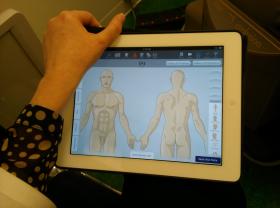
South Florida’s diverse Hispanic community requires some extra attention when it comes to electronic health records.
Over the last few years, doctor’s offices, clinics and hospitals have been getting federal funding through the HITECH Act to go paperless.
That means more patients have access to their medical records online.
Spanish speakers may have the option to get their records in Spanish, but understanding those records can be complicated.
Lorena’s Story
Lorena Roldan is originally from Colombia and has lived in South Florida for about eight months.
She battles with an unknown immune disorder that causes her skin to itch on her face and body.
Lorena goes to a local dermatologist three times a week for treatment. She can view her medical records online to monitor her progress but prefers to read them in Spanish.
This is where Lorena runs into problems.
“Sometimes the words are completely different for a person from Cuba and a person from Colombia, or for an Argentinean and a Mexican,” she said.
Neutral Spanish
Doctor Kenneth Goodman , director of the bioethics program at the University of Miami, suggested that as medical records continue to go paperless, we could see a wave of different languages and dialects in healthcare applications.
“Sometimes the words are used quite differently. Sometimes accents are different in ways that might actually be significant,” he said. “One might imagine that in the future that will provide market opportunities for people to develop dialect-specific apps for patients.”
Maria Giambroni has been a Spanish translator in South Florida for about twenty years.
She doesn’t think multiple Spanish options for electronic medical records would work. There are just too many different dialects to cover them all.
To Giambroni, neutral Spanish is the key.
“Neutral Spanish is Spanish that can be understood by everybody- someone from Peru, Colombia, Puerto Rico, Nicaragua,” she said. “The idea is to avoid using regional terms.”
That’s something Lorena Roldan said she would appreciate.
“I’m not trying to judge or anything. It’s just hard for me to understand these people sometimes,” she said. “We all speak Spanish, but the words have a different meaning.”
Misunderstood Words
We asked members of the Public Insight Network, an online community of people who have agreed to share their thoughts with WLRN-Miami Herald News, for examples of Spanish words which are often misunderstood.
Here are few we received:
Bicho – bug/insect, or male private part
Papaya – type of fruit, or female private part
Coger – to grab, or to have sex with
Ahorita – later, or right now
Fregar – to wash, or to make fun of
Berraco – to be silly/stupid, or to be brave
Mona/Mono – monkey, or blonde person
Gwagwa – bus, or child


