






















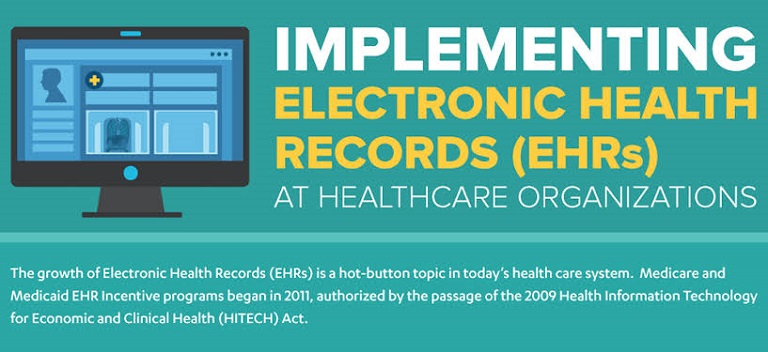
The benefits of electronic health records have been well-documented, such as improved care coordination and efficiency. However, regulations involving their use have made them the subject of controversy in today’s health information landscape.
This continued controversy highlights the importance of establishing a plan for implementation. To assist providers on their efforts, the Health Resources and Services Administration (or HRSA) outlined nine steps for implementation, which you’ll find illustrated in the infographic below created by the Master’s of Health Administration Program by Ohio University.
Despite their rapidly spreading use since the turn of the millennium, medical staff have expressed confusion with using EHR technology, while health administrators have agonized over regulations (such as the “meaningful use” initiative under the Medicare and Medicaid EHR Incentive Program.)
One of the greatest concerns among healthcare organizations is the risk of financial penalty. As of 2015, Medicare eligible professionals who do not adopt EHR technology and demonstrate meaningful use will be fined, and this fee is due to increase annually to prod more healthcare providers to implementing an EHR.
Despite all of the financial incentives to make the change, nearly seven out of ten physicians believe that EHR systems haven’t been worth the effort, citing soaring costs and lower efficiency. While the government has awarded millions of dollars to aid organizations adopting EHRs, the benefit from incentive programs rarely covers the increasing costs of training and hardware, not to mention licensing fees.
On top of this, physicians often have difficulty using these systems due to problems with cumbersome interfaces, lacking hardware, and other issues with usability. Nearly a third of providers with an EHR hope to replace their system due to these wide range of issues – and having to replace systems hardly helps with already staggering costs.
Whether a provider is replacing their system or just making the transition, the steps offered by the HRSA will help ensure that the organization considers all aspects of the project to ensure successful implementation, including planning, budgeting, training, and ongoing optimization. Although making the change can be a costly process, the benefit to patients, medical staff, and the community makes a thorough plan an essential part of successfully implementing EHRs.


