































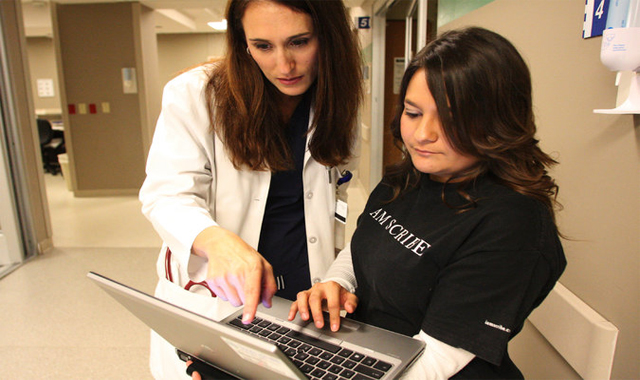
Amid the controlled chaos that defines an average afternoon in an urban emergency department, Dr. Marian Bednar, an emergency room physician in Dallas, entered the exam room of an older woman who had fallen while walking her dog. Like any doctor, she asked questions, conducted an exam and gave a diagnosis — in this case, a fractured hand — while also doing something many physicians in today’s computerized world are no longer free to do: She gave the patient her full attention.
Standing a few feet away, tapping quickly and quietly at a laptop computer cradled in the crook of her left arm, was Amanda Nieto, 27, Dr. Bednar’s scribe and constant shadow. While Ms. Nieto updated the patient’s electronic chart, Dr. Bednar spoke to the woman, losing eye contact only to focus on the injured hand.
“With a scribe, I can think medically instead of clerically,” said Dr. Bednar, 40, who works at Texas Health Presbyterian Hospital Dallas.
Without much fanfare or planning, scribes have entered the scene in hundreds of clinics and emergency rooms. Physicians who use them say they feel liberated from the constant note-taking that modern electronic health records systems demand. Indeed, many of those doctors say that scribes have helped restore joy in the practice of medicine, which has been transformed — for good and for bad — by digital record-keeping.
“Having the scribe has been life-changing,” said Dr. Jennifer Sewing, a family medicine practitioner in St. Louis, who used to spend late nights at her computer finishing electronic patient charts. Now, she can relax with her family or go to bed instead.
Dr. Michael Murphy, the chief executive of ScribeAmerica, a company based in Aventura, Fla., that supplies scribes to hospitals and medical practices, estimates that there are nearly 10,000 scribes working in hospitals and medical practices around the country, with demand rising quickly. At his company alone, the number of scribes deployed to clinics and emergency departments has risen to 3,500 from 1,000 in the past three years. Many of them are people like Ms. Nieto, who works for PhysAssist, a company based in Fort Worth. Training typically takes between 15 and 21 days, and is done by the companies themselves. She plans to enter a master’s program to become a physician assistant.
For decades, physicians pinned their hopes on computers to help them manage the overwhelming demands of office visits. Instead, electronic health records have become a disease in need of a cure, as physicians do their best to diagnose and treat patients while continuously feeding the data-hungry computer. Five years ago, only 10 percent of hospitals and doctors’ offices used electronic health records. But now the adoption rate is nearly 70 percent, thanks to tens of billions of dollars of federal incentive payments. And on the heels of electronic records has come the growing popularity of scribes.
A study published jointly in October by the American Medical Association and RAND Corporation found that electronic health records were a major contributor to physician dissatisfaction, as doctors negotiate a cranky truce between talking to and examining the patient, and the ceaseless demands of the computer. And a recent article in the journal Health Affairs concluded that two-thirds of a primary care physician’s day was spent on clerical work that could be done by someone else; among the recommended solutions was the hiring of scribes.
“Making physicians into secretaries is not a winning proposition,” said Dr. Christine Sinsky, a primary care physician at Medical Associates Clinic and Health Plans, in Dubuque, Iowa, who also researches physician dissatisfaction.
Dr. Sinsky, who was an author of the article in Health Affairs, has visited more than 50 primary care practices over the past five years, in the course of studying ways to stem high rates of physician burnout. She has found that physicians who use scribes are more satisfied with their work and choice of careers.
The inconsistency isn’t lost on health care experts. In most industries, automation leads to increased efficiency, even employee layoffs. In health care, it seems, the computer has created the need for an extra human in the exam room.
The scribes, Dr. Sinsky said, offer “a triple win.”
“The patients get undivided attention from the physicians,” she said. “The scribes are continuously learning while making an important contribution, and the physician gets the satisfaction of doing the work they went into medicine for in the first place.”
Not everyone is sold. Some physicians are concerned about the privacy implications of introducing a third person to the examining room. According to one study of scribes in clinical settings, roughly 10 percent of patients were uncomfortable with having the scribe present.
The cost of hiring a scribe, borne largely by the physicians themselves, is also a concern. Companies typically charge $20 to $25 per hour for scribes, who in turn are paid $8 to $16 per hour. Yet physicians who use scribes say they come out even, or ahead, financially, as they can see up to four extra patients a day.
Medical transcriptionists are not new. Since the 1960s, physicians have dictated their notes into a tape recorder and given them to transcriptionists to convert into written reports, interpreting medical terminology and abbreviations as they worked. The notes appeared on paper charts hours, sometimes even days, later. Scribes simply speed up the process, entering data as it is gathered so that records can be viewed and assessed instantly. Dr. David Reuben, a geriatrician at the University of California, Los Angeles, uses “physician partners,” who do the work of scribes, with expanded responsibilities such as scheduling appointments, filling out test requisitions and completing the checkout process. Preliminary results from a six-month study Dr. Reuben conducted of geriatricians and general internists suggest that the physicians saved an average of three minutes per visit by using the scribes. Just as important, the physician partners or scribes dramatically reduced the amount of work for the doctor to do at the end of the day. And a vast majority of patients said they thought the assistants helped the visit run smoothly.
Dr. Reuben said that working with physician partners had transformed his work. “Do it once, and you’re hooked,” he said.
Dr. Sewing, 42, feels the same way. It used to be that every night, following a long day at work, after seeing to dinner, homework and baths for her two children, she would return to the computer for several hours to finish up electronic patient charts. Chronically exhausted and feeling enslaved to the computer, she began to wonder why she had entered medicine in the first place.
But since she started working with scribes two years ago, Dr. Sewing has found that she can focus on patients instead of the machine. In her practice of five physicians, she and another doctor use scribes full-time, with a third now using a scribe one day a week. As for the two holdouts, she said, “I wonder how long that’s going to last.” Source


