








































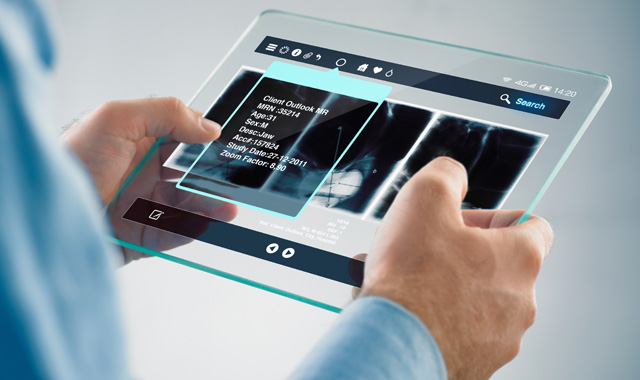
A large study of electronic health records systems, which includes automation of ancillary services such as clinical data repository, pharmacy, and laboratories, shows that they save money for third-party payers and patients, but not necessarily for hospitals.
 Abby Kazley Abby Kazley |
A sweeping examination of more than 5 million inpatient records at 550 hospitals during 2009 identified savings averaging 9.6% per patient – or $731 – from the 19% of hospitals that used advanced electronic health records when compared with hospitals that did not.
The findings from researchers at the Medical University of South Carolina in Charleston were published in the most recent issue of the American Journal of Managed Care. Abby Swanson Kazley, an associate professor at MUSC’s college of Health Professions, and a lead author of the study, spoke with HealthLeaders Media Tuesday.
HLM: Were you surprised by these findings?
ASK: I was surprised it was so high. Yes. We had done a similar study in the pediatric population and found there was not cost savings. So we were surprised it was so different in the adult population.
HLM: What was your base measure for cost per patient?
ASK: We looked at the mean cost per patient admission at hospitals—the mean overall total costs for patients with various conditions. The mean overall cost per admission for hospitals without EHRs was $10,790 and with advanced EHRs it was $10,203.
HLM: How did you define “advanced EHR?”

ASK: We wanted to pick a level that would be most consistent with the first requirements of Meaningful Use. It had to have automation of the ancillary services like the clinical data repository, pharmacy, laboratory, and radiology information systems, plus automation of nursing work flow with electronic nursing documentation, medication administration records, and also (Computerized Provider Order Entry).
HLM: Where is the savings coming from?
ASK: We don’t have the granularity in the data to answer that but we can speculate. Maybe it’s that the automation makes the care more efficient or maybe it is a better charge capture or a more accurate reflection of the care that is received and that patients aren’t being potentially overcharged. Or maybe hospitals are more efficient because they have them.
HLM: Why did you need to examine 5 million records?
ASK: We wanted to be as inclusive as possible. There are differences in the types of systems that are used and there is a lot of hope and belief that electronic health records are going to be the magic bullet to increase quality and decrease cost but there haven’t been many national studies that have looked at such a large sample of the population to really determine if that is true. We wanted to do our best to figure out whether or not they could save money.
HLM: Why did you limit the study to hospital inpatients?
ASK: We only looked at hospitals and the care that patients got during their stay in the hospital. The only way to really measure outside of the hospital would be if there were quite a few interoperable electronic health records and there aren’t.
Right now it’s entirely possible that patients are treated by their primary care physician or at a specialty clinic and that electronic health record may or may not communicate with the one in the hospital. It would be virtually impossible based on patient privacy and things like that to link those records together.
That is one of the problems we are facing with the implementation of EHR anyway. The different systems don’t necessarily talk to each other. This was a group that we knew we could have control over the care that they had during their time in the hospital.
HLM: What does this say about the competitive advantages with EHR?
ASK: That is what the real implication is from this study. The almost 10% isn’t necessarily money saved by the hospital. It is money saved by the third-party payers and patients. If they are interested in the cost of care, and I would certainly expect third-party payers are, and a certain number of patients that are informed of probably are too, to the extent that they can select hospitals that have automated electronic health records they may do so to save themselves that 10%, especially if you are talking about a patient who is going to pay for a procedure out of pocket.
Certainly anyone would want to save money on it if they believed the quality is the same or better, and many hypothesize that the quality is going to be better with these automated system but that was not something we considered in this particular study.
HLM: Your findings are from 2009. Do you expect savings to be greater as more providers adopt EHR and the systems become more sophisticated and interoperable?
ASK: It will be significantly higher when we have EHR systems that can communicate with one another and be interoperable. I suspect right now there is a lot of duplication and redundancy of care when you go to a couple of providers and have the same thing done.
So I think we are going to realize even more cost savings. You certainly would think as the people who work in hospitals become more comfortable with these systems we are going to see some true gains there.
HLM: How do you think ICD-10 will affect savings?
ASK: It is going to depend upon how well prepared the hospitals are and how smooth the transition is with the EHR systems. In some ways that makes it more complex for these EHRs. I didn’t necessarily consider that in this study but I could see how it presents an additional challenge, especially for hospitals that are trying to implement and adopt and then make another change because of ICD-10.
HLM: What is the next big question to answer about EHR?
AKS: We need to continue to look at the cost and the quality of the care associated with EHR and we need to look at individual organizations and do system evaluations to see how well the EHRs themselves are working.
We need to look at a national sample which has been unusual in the research to date. That is why there has been so much interest in this study. A lot of studies out there just look at single hospitals and that doesn’t tell you much, especially when this is such a national issue.


