































Events Calendar

Mon
Tue
Wed
Thu
Fri
Sat
Sun
M
T
W
T
F
S
S
1
2
3
4
5
6
7
8
10
11
12
13
14
15
16
19
11:00 AM - Charmalot 2025
20
21
22
23
24
25
26
27
29
1
2
3
4
5
Oracle Health and Life Sciences Summit 2025
2025-09-09 - 2025-09-11    
12:00 am
The largest gathering of Oracle Health (Formerly Cerner) users. It seems like Oracle Health has learned that it’s not enough for healthcare users to be [...]
MEDITECH Live 2025
2025-09-17 - 2025-09-19    
8:00 am - 4:30 pm
This is the MEDITECH user conference hosted at the amazing MEDITECH conference venue in Foxborough (just outside Boston). We’ll be covering all of the latest [...]
AI Leadership Strategy Summit
2025-09-18 - 2025-09-19    
12:00 am
AI is reshaping healthcare, but for executive leaders, adoption is only part of the equation. Success also requires making informed investments, establishing strong governance, and [...]
OMD Educates: Digital Health Conference 2025
2025-09-18 - 2025-09-19    
7:00 am - 5:00 pm
Why Attend? This is a one-of-a-kind opportunity to get tips from experts and colleagues on how to use your EMR and other innovative health technology [...]
Charmalot 2025
2025-09-19 - 2025-09-21    
11:00 am - 9:00 pm
This is the CharmHealth annual user conference which also includes the CharmHealth Innovation Challenge. We enjoyed the event last year and we’re excited to be [...]
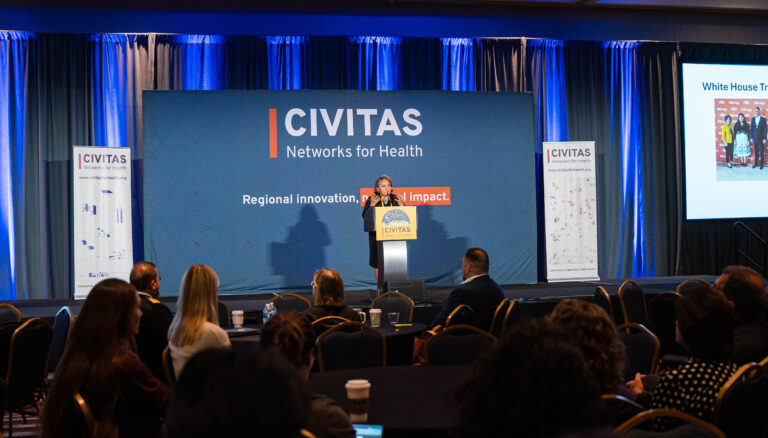
Civitas 2025 Annual Conference
2025-09-28 - 2025-09-30    
8:00 am
Civitas Networks for Health 2025 Annual Conference: From Data to Doing Civitas’ Annual Conference convenes hundreds of industry leaders, decision-makers, and innovators to explore interoperability, [...]
TigerConnect + eVideon Unite Healthcare Communications
2025-09-30    
10:00 am
TigerConnect’s acquisition of eVideon represents a significant step forward in our mission to unify healthcare communications. By combining smart room technology with advanced clinical collaboration [...]
Pathology Visions 2025
2025-10-05 - 2025-10-07    
8:00 am - 5:00 pm
Elevate Patient Care: Discover the Power of DP & AI Pathology Visions unites 800+ digital pathology experts and peers tackling today's challenges and shaping tomorrow's [...]
Events on 2025-09-09
Events on 2025-09-17
MEDITECH Live 2025
17 Sep 25
MA
Events on 2025-09-18
OMD Educates: Digital Health Conference 2025
18 Sep 25
Toronto Congress Centre
Events on 2025-09-19
Charmalot 2025
19 Sep 25
CA
Events on 2025-09-28
Civitas 2025 Annual Conference
28 Sep 25
California
Events on 2025-10-05
Articles

Jul 14 : Epidemic surveillance using an EMR

hipaa compliance
Read More

Abstract

BACKGROUNDS:

Electronic medical records (EMR) form a rich repository of information that could benefit public health. We asked how structured and free-text narrative EMR data should be combined to improve epidemic surveillance for acute respiratory infections (ARI).

METHODS:

Eight previously characterized ARI case detection algorithms (CDA) were applied to historical EMR entries to create authentic time series of daily ARI case counts (background). An epidemic model simulated influenza cases (injection). From the time of the injection, cluster-detection statistics were applied daily on paired background+injection (combined) and background-only time series. This cycle was then repeated with the injection shifted to each week of the evaluation year. We computed: a) the time from injection to the first statistical alarm uniquely found in the combined dataset (Detection Delay); b) how often alarms originated in the background-only dataset (false-alarm rate, or FAR); and c) the number of cases found within these false alarms (Caseload). For each CDA, we plotted the Detection Delay as a function of FAR or Caseload, over a broad range of alarm thresholds.

RESULTS:

CDAs that combined text analyses seeking ARI symptoms in clinical notes with provider-assigned diagnostic codes in order to maximize the precision rather than the sensitivity of case-detection lowered Detection Delay at any given FAR or Caseload.

CONCLUSION:

An empiric approach can guide the integration of EMR data into case-detection methods that improve both the timeliness and efficiency of epidemic detection.


Source
