



















Events Calendar

Mon
Tue
Wed
Thu
Fri
Sat
Sun
M
T
W
T
F
S
S
29
30
1
2
3
4
5
7
8
10
11
12
13
14
15
16
17
18
20
22
23
24
25
26
27
28
29
30
31
1
C.D. Howe Institute Roundtable Luncheon
2014-04-28    
12:00 pm - 1:30 pm
Navigating the Healthcare System: The Patient’s Perspective Please join us for this Roundtable Luncheon at the C.D. Howe Institute with Richard Alvarez, Chief Executive Officer, [...]
DoD / VA EHR and HIT Summit
DSI announces the 6th iteration of our DoD/VA iEHR & HIE Summit, now titled “DoD/VA EHR & HIT Summit”. This slight change in title is to help [...]
Electronic Medical Records: A Conversation
2014-05-09    
1:00 pm - 3:30 pm
WID, the Holtz Center for Science & Technology Studies and the UW–Madison Office of University Relations are offering a free public dialogue exploring electronic medical records (EMRs), a rapidly disseminating technology [...]
The National Conference on Managing Electronic Records (MER) - 2014
2014-05-19    
All Day
" OUTSTANDING QUALITY – Every year, for over 10 years, 98% of the MER’s attendees said they would recommend the MER! RENOWNED SPEAKERS – delivering timely, accurate information as well as an abundance of practical ideas. 27 SESSIONS AND 11 TOPIC-FOCUSED THEMES – addressing your organization’s needs. FULL RANGE OF TOPICS – with sessions focusing on “getting started”, “how to”, and “cutting-edge”, to “thought leadership”. INCISIVE CASE STUDIES – from those responsible for significant implementations and integrations, learn how they overcame problems and achieved success. GREAT NETWORKING – by interacting with peer professionals, renowned authorities, and leading solution providers, you can fast-track solving your organization’s problems. 22 PREMIER EXHIBITORS – in productive 1:1 private meetings, learn how the MER 2014 exhibitors are able to address your organization’s problems. "
Chicago 2014 National Conference for Medical Office Professionals
2014-05-21    
12:00 am
3 Full Days of Training Focused on Optimizing Medical Office Staff Productivity, Profitability and Compliance at the Sheraton Chicago Hotel & Towers Featuring Keynote Presentation [...]
Events on 2014-04-28
Events on 2014-05-06
DoD / VA EHR and HIT Summit
6 May 14
Alexandria
Events on 2014-05-09
Latest News

Jul 22 : LinkedIn for patient communities expands to U.S.

patient communities

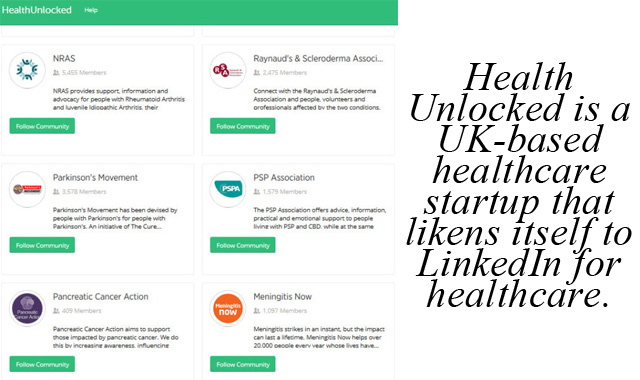
The rise of patient communities that have taken root on the borderless geography of the Internet. But there are so many that some companies have spotted an opportunity to organize them to better direct would-be users. HealthUnlocked is a UK-based healthcare startup that likens itself to LinkedIn for healthcare. It’s successfully attracted users in the U.S., so much so that it has expanded to include partnerships with U.S.-based patient groups, according to a company statement.

Chief Medical Officer and Co-Founder Matt Jameson Evans told MedCity News the move follows a strong response it received at Health Datapalooza and the reality that its U.S. audience is about to outstrip its UK user base, in an emailed response to questions.

To underscore his point, Evans called up this link to a community about Parkinson’s disease.

“Content is mostly about day-to-day management of the real issues of chronic illness,” Evans said. “It’s been remarkable that this type of content serves US citizens so well even when it’s not often from US patients. It took us by surprise!”

 US-based patient group partnerships are what this launch is all about, Evans said. It is looking for U.S. patient advocacy groups and non profits for its mobile health social network platform.

Evans said the company distinguishes itself with “semantic intelligence” and profiles readers’ interests so they can easily navigate through topics that appeal to them. Users can also list their own interests so the company can personalize content.

Patient communities like PatientsLikeMe, Feelalike.com, and SmartPatients, a cancer patient community started by Dr Roni Zeiger who was once Google’s chief health strategist, have thrived as people increasingly seek out peers on social networks who can provide insights about their condition in ways that nurses and physicians can’t.


