













































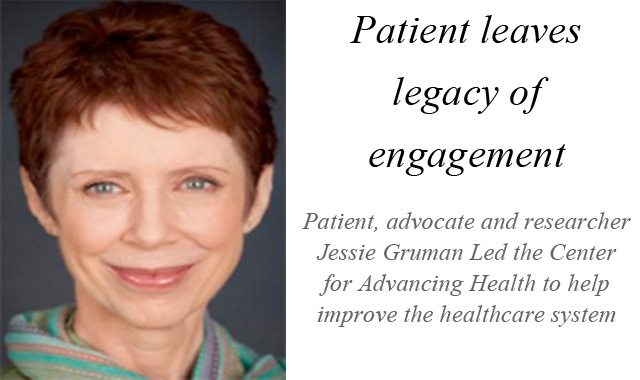
Patient advocate and researcher Jessie Gruman died July 14 at the age of 60, after living with cancer for the better part of her life and turning her struggle into frameworks for progress.
In 1992, after a decade-plus spent working in substance abuse counseling and public health, Gruman helped launch and lead the Center for Advancing Health to help improve the healthcare system for patients after two decades navigating modern medicine herself — and just as the nation’s first (and unsuccessful) bout with health reform was getting underway.
A native of Berea, Kentucky, Gruman was diagnosed with stage three Hodgkin’s lymphoma at the age of 20. She survived it with high-dose radiation treatment that ultimately contributed to more cancer later in life — cervical cancer at 30, colon cancer at 50, stomach cancer at 57 and lung cancer at 59.
While medical advances and ongoing treatment played a large role in Gruman’s ability to live 40 years with cancer on and off, her own contributions were probably a part of it too. They included examining the evidence for herself and sometimes challenging doctors’ opinions.
“Whether we are sick or well, we will not benefit from the expertise of health professionals and the technologies they deploy unless we participate actively and knowledgably in our own care,” Gruman wrote.
In her time leading the Center for Advancing Health, Gruman worked at the forefront of studying patient decision-making processes and championing patient empowerment. She also offered skepticism and criticism — for instance, highlighting some missed promises of digital health and pointing out the tension between population-based care and personalized medicine.
“Self-monitoring health IT falls short of providing the information we need,” Gruman argued this past April. “What makes anyone think that lots of us are going to demand inconvenient and intrusive monitors to measure every flick of our physiology that will in turn flood doctors like (New York Presbyterian’s Dr. Fred) Pelzman with useless information, especially when most of us really just want a quick resolution to our symptoms so that we can resume walking the dog, cooking dinner and watching Game of Thrones?”
She continued: “In fact, most of us are not demanding self-monitoring devices, nor are most clinicians prescribing them for their patients, for similar reasons. With a few noted exceptions, such devices produce too much — and much too general — data to be truly useful to guide either changes in our behavior or changes in our treatment.”
Gruman’s analyses and approaches to healthcare innovation and policy were usually grounded in the practical. While she anticipated that “tools and apps will be developed to monitor critical health variables at critical times… through successive approximation and the aging of the HIT workforce,” she argued that digital health today needs to rethink its focus in order to evolve.
“I don’t crave the calorie count of nine Wheat Thins, but I sure as heck want to know how my doctor handles after-hours care when my kid has spiked a fever, has a rash and can’t stop vomiting. I don’t need to know my average resting heart rate, but I really want to know who to call so I can get some personalized advice when my new prescription medication is making me itch like crazy. I don’t want to track what I eat or how many steps I take, but I would place a high premium on having a clinician on my health care team take the time to explain just what is most important for someone of my age and condition to eat and to do. I don’t feel like tracking my moods or energy levels pre- and post-chemotherapy, but I am very curious about the signs that would show that a clinical intervention might improve one or both.”
Likewise, Gruman saw great promise in personalized medicine, especially in treatment for diseases like cancer, but grew skeptical of “individually directed solutions” being sold without a lot of backing evidence for chronic conditions like diabetes.
“Far be it from me to criticize any effort to listen to patients and to respond to our individual needs,” Gruman wrote in May. “But it makes me slightly anxious to watch consulting firms pump out new personality indices that predict medication compliance; promote the latest tailored, peer-led diabetes management approaches; market highly personalized apps and reminders and advocate for a new crop of semi-professionals to deliver them to all of us having carefully assessed our needs and preferences.”
Before committing to such large-scale investments, Gruman argued, healthcare leaders should consider lower-hanging fruit, such as training for evidence-based approaches to medication prescribing, electronic health records “that are truly interoperable,” and health literacy reviews of provider and insurer documents.
Much progress in individualized medicine has already been made at hands of individuals, thanks in large part to the Internet revolution, Gruman noted. The “potential of health care to improve individual and population health in the future rests increasingly in the hands of individuals,” she wrote.
Participation, just as much as engagement, was Gruman’s motto — she helped found the Society of Participatory Medicine — and that can mean patients taking on greater autonomy in decision-making.
In her most recent treatment, Gruman “demanded a course of care that her doctor didn’t support since he felt it wasn’t likely to be effective,” recounted Vikas Siani, MD, president of the Lown Institute, a think tank dedicated to reducing overtreatment and medical harm. “But it was right for her because at that moment what she clearly wanted was every last possibility for every last bit of time.”


