

































By Christopher Snowbeck
csnowbeck@pioneerpress.com
When Ron Meyer visits his doctor, there’s always a third person in the room.
Last week, it was Allyson Untiedt, 24, of Minneapolis, who is one of the small but growing number of “scribes” working in medical clinics and hospitals across the Twin Cities.

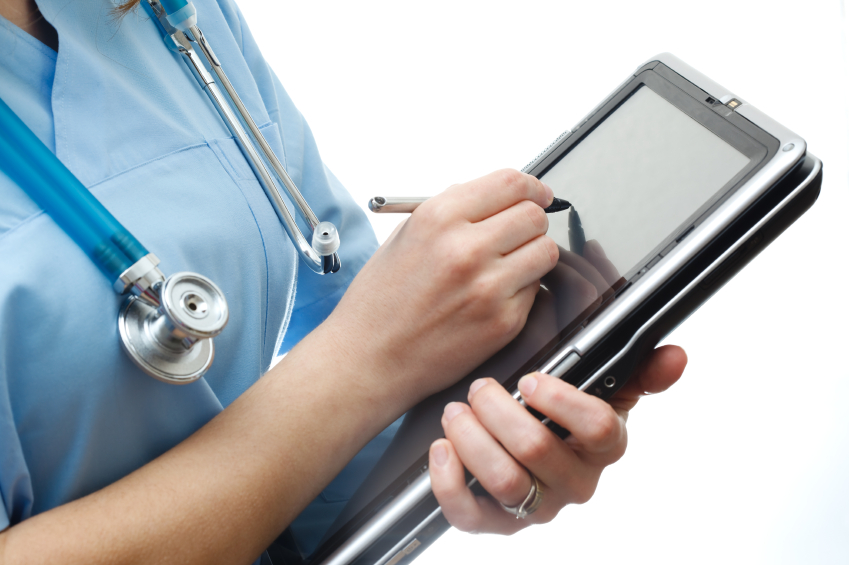
Scribes accompany physicians in exam rooms and help document what happens during a patient’s visit. They tend to a patient’s chart before the exam — so doctors can quickly find the lab and test results they need — and help physicians complete documentation chores afterward.
“For somebody who is interested in the medical profession, it’s an excellent opportunity,” said Untiedt, a scribe at the HealthEast Midway Clinic in St. Paul who plans to attend medical school in August.
With a scribe in the room, Dr. William Brombach says, he can focus on patients such as Meyer rather than computerized medical charts. Clinic administrators should like it, Brombach adds, because scribes help make sure the clinic submits a bill for all services provided.
And patients?
“I’m very open to a scribe sitting there and listening to everything, because that’s the way they learn,” said Meyer, 77, of New Brighton.
Not everyone is a believer.
Clinics pay anywhere from $10 to $25 per hour for a scribe, and can’t bill insurance companies for their work. So, some clinic administrators question whether doctors with scribes truly generate productivity gains that cover the extra expense.
At HealthEast, some believe scribes won’t be necessary, Brombach said, once the health system adopts a new electronic medical record system this year.
Dr. Donald Gehrig, a St Paul physician in private practice, said doctors working with scribes likely feel pressure to see more patients in order to cover the cost of a scribe.
Patients might be reluctant to talk about issues ranging from sexual health issues and marital problems to abuse in the home when there’s a scribe in the room, Gehrig said. Many physicians are willing to accept scribes, he added, because they’re struggling to handle increased demands for documentation created by electronic health record systems.
“It’s a perverse adaptation of electronic recordkeeping required for billable, code-able health care, which is not medical care,” Gehrig said. “Doctors like it better than having to go home and type notes until 10 p.m.”
Patients can always ask scribes to leave the room if they want privacy with their physician, said Marcin Kubiak, the operations director with Elite Medical Scribes, a Bloomington company that employs more than 500 scribes. But he says it “very rarely happens” because patients tend to be happier when a scribe is around, since they have the doctor’s attention.

Founded in 2008, Elite Medical Scribes has about 90 programs spread across 19 states. Another company that offers scribes for hire is ScribeAmerica, a Florida-based company that claims 430 practice locations in 41 states.
“We have about 3,900 scribes working for our company,” said Dr. Michael Murphy, chief executive of ScribeAmerica. “In 2011, we probably had 800 to 1,000 scribes working for us.”
In the Twin Cities, scribes started making appearances in the emergency room at Abbott Northwestern Hospital in Minneapolis around 2006. A few years later, scribes also started accompanying some ER doctors at United Hospital in St. Paul.
Now, all patients in the United emergency room will encounter a scribe, said Dr. Joseph Westwater, medical director of the scribe program with Emergency Care Consultants, a group of about 40 ER doctors. The group employs about 100 scribes who work in a number of emergency rooms and some clinics, too.
The federal government has provided incentives for the adoption of electronic health records by hospitals and clinics. Use of the computer systems has clearly generated some of the interest in scribes, Westwater said, particularly among older physicians who aren’t always as computer-savvy as younger peers.
Scribes help doctors cope with keyboarding load, Westwater said, and comply with checklists that detail best practices for medical care.
“They’re actually helping us become a little bit more like the airline industry in making sure that certain quality checklists get done for our patients,” he said.
“I sit on the rolly stool in the room, and I couldn’t do that if I were on the computer,” Westwater said. “I’m freed from worrying about pulling things up on the computer, or worried about getting it down on the computer.”
At the United Heart and Vascular Clinic in St. Paul, Dr. Alan Banks launched a pilot study of scribes more than two years ago. In 2013, he published results of a study that compared physician productivity, patient satisfaction and revenue for doctors working with and without scribes.
The typical visit for a new patient in the clinic is 40 minutes, and 20 minutes for a follow-up, Bank said. In the study, visits to doctors with scribes were shortened to 30 minutes and 15 minutes.
The results: Physicians with scribes saw more patients per hour; they generated more revenue for the clinic; and patient satisfaction wasn’t diminished.
“You spend less time with the patient, less time preparing for the visit and less time after documenting what you have to document,” Bank said. “But the patients actually like it. You’re sitting there looking at them, and not scrounging around with the computer.”
At the HealthEast clinic in St. Paul, Brombach credits scribes with helping him improve his bedside manner. Physicians in clinics often don’t get direct feedback on how well they relate to patients, Brombach said, so he asked scribes for input on why some of his patient satisfaction scores weren’t as high as another physician’s in the clinic.
The answer: He needed to work on soft skills like making eye contact and acknowledging everyone in the room.
“If you’re really open to a constant evolution of your practice, somebody in the room who is given permission to critique you is amazing,” Brombach said.
Scribes learn a lot, too, he added, noting that four or five scribes from the HealthEast clinic either have gone or are in the process of going to medical school. They might end up returning to primary care.
“Everybody kind of goes into medicine, conceptually, wanting to be an ER doctor or to be a surgeon,” Brombach said. “Nobody ever says, ‘Oh, it would be great to sit in the office and treat high-blood pressure.’ ”
After working as a scribe, future doctors see that primary care is “really complicated, really tricky (and) looks like it’s rewarding. This is not just a cast-off backwater of medicine; this is where it’s at.”


