




















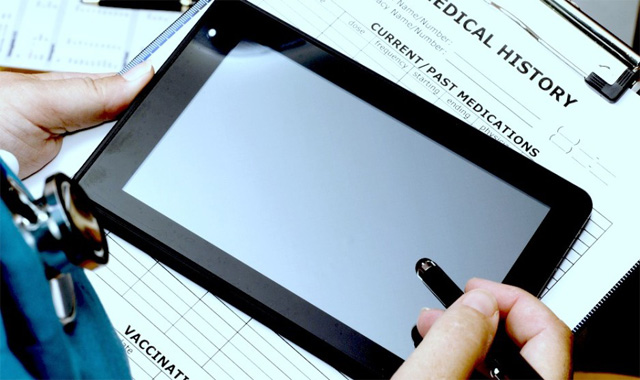





















Dallas—Ambulatory care pharmacists need increased access to electronic medical records (EMRs) and health information exchange networks, according to presenters at the inaugural American Society of Health-System Pharmacists (ASHP) Ambulatory Care Conference and Summit.
“Pharmacists need to have access to all information … across the care continuum, if we are to support safe, efficient and effective medication use,” said Kelly Epplen, PharmD, BCACP, an assistant professor in the Department of Clinical Pharmacy Practice and Administrative Sciences at the University of Cincinnati’s James L. Winkle College of Pharmacy, in Ohio.
Spotty EMR Connectivity
Dr. Epplen, who spoke at the ASHP Conference and Summit, said that at the moment, pharmacists practicing in ambulatory care settings “absolutely do not” have the type of information technology (IT) infrastructure they need to provide optimal services. The sentiment was echoed by Mary Ann Kliethermes, BS, PharmD, the vice chair of ambulatory care and associate professor at the Chicago College of Pharmacy at Midwestern University, in Downers Grove, Ill. “While connectivity between pharmacists and other providers is very good in some practices, in others it is not,” said Dr. Kliethermes, who also spoke at the ASHP’s Conference and Summit.
Dr. Kliethermes said that even pharmacists who do have access to EMRs might find the process of extracting the information they need to provide appropriate care and then generating a note at the end of a clinical encounter to be “very time-consuming.”
Quick Data Sharing
The good news for those with EMR access is that the technology to enable more efficient sharing of patient information exists. Furthermore, such technology is being adopted increasingly, according to Rachelle “Shelly” Spiro, RPh, FASCP, the executive director of the Pharmacy Health Information Technology (HIT) Collaborative, a national nonprofit organization that advocates on behalf of the pharmacy profession’s IT needs.
Ms. Spiro explained that a growing segment of health care providers, including pharmacists with EMR access, now can electronically update a patient’s clinical information and send data to other health care team members or to patients themselves. The ability to do this comes from electronic documents that employ clinical document architecture (CDA), Ms. Spiro said.
“There are several structured document templates that use CDA, including discharge summaries, progress notes and care plans,” she explained. “Each structured document has the capability to incorporate standardized clinical terms from the EMR, such as information on new health problems, medication-related information and allergies. After providers add their own patient encounter notes, the document’s programming code translates the notes into standardized terminology and shares it in a way that is similar to email exchange.”
A growing number of health IT providers are adding CDA-sharing functionality into their systems, Ms. Spiro said. For example, commercial health care exchange vendors that have joined the nonprofit DirectTrust network (www.directtrust.org) collectively provide CDA-sharing capabilities to more than 4,000 health care organizations and 100,000 individuals (see a partial list of vendors, page 19).
Ensuring that pharmacists can access and update EMRs and share patient information just as other providers do will require pharmacy management systems vendors to revamp their products, Ms. Spiro noted. “The pharmacy management systems used by most community pharmacies, including the large chains, are focused on the workflow of the dispensing process, but on the whole, we don’t have systems that manage the workflow of clinical processes,” she said. “However, as community care pharmacists, we’re going to need to be part of the exchange of clinical information—and that includes collecting information, documenting our interventions, and exchanging our information with other providers or patients themselves.”
‘Define and Articulate’ Value
The fluid nature of information sharing that CDAs are set to facilitate will improve pharmacist care and, in turn, patient outcomes, according to Gloria Sachdev, PharmD, a clinical assistant professor of primary care at Purdue University’s College of Pharmacy, in West Lafayette, Ind., and adjunct assistant professor at Indiana University School of Medicine, in Indianapolis. “Progress notes written by pharmacists who practice in community pharmacies in particular are often faxed to physicians and thus their assessments and plans are not integrated into the usual workflow physicians follow when they use EMRs to guide patient care,” said Dr. Sachdev, who also spoke at the ASHP’s Ambulatory Care Conference and Summit. “At best, these progress notes are scanned in as PDFs and filed under a miscellaneous tab.”
Pharmacist access to EMRs is absolutely necessary if they are to “document how our interventions affect clinical and cost outcomes and define and articulate a value proposition that justifies including us on health care teams,” Dr. Sachdev said. “We need the outcomes data [in patients’ EMRs] to show that our services yield a positive return on investment.”
Dr. Epplen agreed, adding that some health care stakeholders do not fully appreciate the role pharmacists can play in bettering patient outcomes and lowering health care resource utilization. However, she suggested, there is a Catch-22: Until other stakeholders place a higher value on ambulatory pharmacist care, some pharmacists practicing in these settings may continue to find themselves receiving spotty access to patient data.
“We need funding to build and implement appropriate IT infrastructure in the pharmacy setting,” Dr. Epplen said, “but this will not occur unless ambulatory care pharmacists and ambulatory care pharmacy services are viewed as an essential component of care delivery.”


