























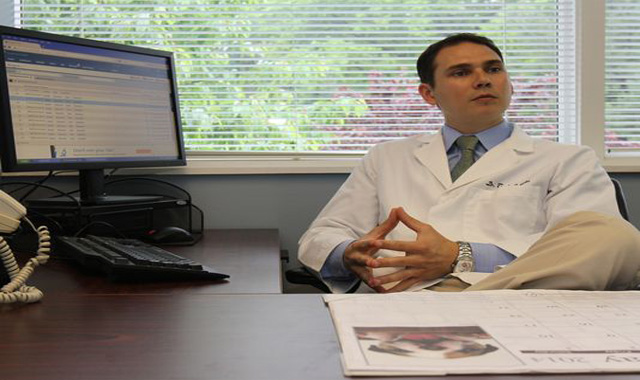
Job: Podiatric surgeon, New Jersey Foot and Ankle Specialists
Location: Chilton Medical Center, Pompton Plains
“I spend a lot of time seeing patients in the hospital, so I can tell you firsthand that transitioning to electronic health records has been a constant struggle and a huge stress, especially for doctors who have been keeping paper records for 20 or 30 years. The hospital has a set of staff just to train these doctors and still maintains a support staff. It’s very common, too, for private practices to hire consultants to help with the training of their office staff, medical assistants, receptionists, and doctors.
“Built into each electronic medical record is a set of protocols that we doctors must follow. Each year we don’t follow them, we get cut by another percentage point as far as our reimbursements from any government-sponsored plan. Documentation is huge, especially now because you know the government is watching like hawks.”
Back story:
Before starting New Jersey Foot and Ankle Specialists two years ago, Ted Roberto worked with a medical practice still keeping paper records. Since he has a computer science background, he led the charge there to transition to electronic health records (EHR), a mammoth effort. Conversion to EHRs has rolled out under several laws, including the Affordable Care Act, which requires doctors to use the Physician Quality Reporting System and, starting in 2015, reduces Medicare payments for doctors who do not comply.
Current scenario:
• A few hours every night, Roberto works on his electronic health records at home so he can maximize time with patients in his office during the day.
• To alleviate this situation, he is experimenting with using a medical scribe in his office. A scribe transcribes on a tablet what a doctor says as he interviews and examines a patient. To employ one is an added cost, Roberto said, but it allows a doctor to be a doctor. The only other option is to type on the computer while he is talking to a patient, which he doesn’t want to do.
• Everyone in the medical world is walking on eggshells, including patients nervous about seeking medical care because they’re leery of their new high deductibles and unsure what their new health care plans cover.
• Roberto has chosen to be an out-of-network doctor for many insurance companies because the reimbursement rate is higher. That means he can spend a lot more time with patients, which makes him and them happy. If he accepted only in-network patients, he said, he’d had to see two-and-a-half times as many people in a day—50 or 60—to make the same money.
A look ahead:
As the reality of the Affordable Care Act settles in the years ahead, Roberto fears government plans will cut their reimbursements rates even more and health care providers will have no voice in negotiating. Consequently, he predicts, the volume of patients doctors will have to see, just to run their businesses, will have to rise. “Obviously, that means less patient contact time because you can only see so many people in a day,” he said. “Then you’ve got to go do your notes. It’s intimidating.”


