








































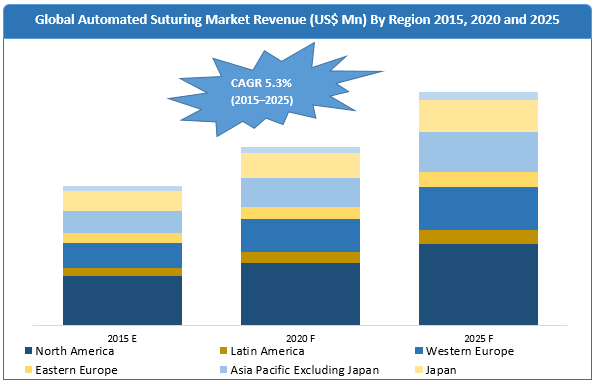
Adoption of automated suturing devices is directly influenced by growing incidences of trauma cases and spike in the number of surgical procedures in the recent years. Growing government funding for innovative product coupled with technological advancements are generating the demand for automated suturing devices. Rising need for advanced tools in healthcare sector in response to increasing geriatric demographic and cases for obesity led to surge in the adoption of these devices. Automated suturing devices are the medical devices used for sealing tissue after surgery of a wound. Surgeons across the globe are showing swift inclination towards the use of disposable and reusable types of automated suturing devices over conventional methods.
Automated suturing devices find applications for various surgical procedures in ophthalmology, gynecology, orthopedic, laparoscopy, and other specialties in healthcare industry. Increasing need to prevent surgical site infection along with growing emphasis on patients’ safety and quality assurance and control are the factors influencing the demand for automated suturing devices. In addition, these devices are labelled under ‘green products’, have low impact on the environment, and thereby gaining increasing popularity among the healthcare professionals.
Advantages of Automated Suturing Devices over Conventional Hand Suturing
Rapid penetration of new technology in medical industry gave rise to the development of suturing devices that could provide a new alternative to hand stitching in surgical procedures. Suturing by hand is often associated with risk of needle stick injuries where the needle may pierce the protective clothing as well as the skin of a medical practitioner. Such injuries have negative impact on health systems and clinical staff which in turn propel the adoption of automated devices. Wound closure devices promote efficient healing of the wounds while providing support and turgidity to the specific type of tissue or function.
Request Report Sample@ https://www.futuremarketinsights.com/reports/sample/rep-gb-579
Both in technique and duration, hand suturing is categorized as a challenge for minimally invasive surgeries, which increases the need for easily manageable devices that secure visceral synthesis. According to Covidien, a leading global healthcare products provider, using EndoStitch ™ automated suturing devices is found to reduce operating room time and hospital costs during a laparoscopic surgery.
Automated suturing devices have also greatly simplified advanced laparoscopic gynecologic surgical procedures and allow even less-experienced surgeons to perform suturing and knot trying. Unlike traditional suturing methods, automated devices enable surgeons to conduct operation in tight spaces and can reach tissue in their normal anatomical location instead of pulling and manipulating the tissue into the device. As these devices eliminates needle stick injuries, there are no risks of contracting HIV or Hepatitis B within healthcare practitioners or surgeons. Other factors favoring the adoption of automated suturing devices over suturing by hand include quicker, safer, and more accurate.
Different Types of Automated Suturing Devices
Disposable Automated Suturing Devices: These devices allow surgeons to perform efficient suturing without the need for robotic assistance or using needle drivers. They are used for single use and need to be disposed as medical waste after the completion of a single procedure. According to several studies, use of disposable automated suturing devices is significantly cost-effective than the use of traditional surgical techniques. They provide high precision suturing for layered as well as tubular structures and twice as fast as the conventional method. Faster suturing further delivers more benefits to the patients in reducing the risk of complications.
Reusable Automated Suturing Devices: They are used in various surgeries and do not need to be disposed as medical waste after the completion of a single procedure. Reusable automated suturing devices involves curved needles which replicate the surgical style of manual stitching. These curved needles enable the surgeon to suture various types of tissues including flat surfaces with minimal tissue manipulation, resulting into less trauma.
Although the adoption of automated suturing devices is growing at a significant rate, low product availability will possibly confine its demand. Lack of high skilled surgeons and limited awareness of new medical devices in various region of the globe are likely to restraining determinant of the overall adoption of automated suturing devices.
Request to view Table of Content @: https://www.futuremarketinsights.com/askus/rep-gb-579


