






























Events Calendar

Mon
Tue
Wed
Thu
Fri
Sat
Sun
M
T
W
T
F
S
S
27
28
29
30
1
3
5
6
8
9
10
11
12
14
15
16
17
18
20
21
22
23
24
25
27
28
29
30
63rd ACOG ANNUAL MEETING - Annual Clinical and Scientific Meeting
2015-05-02 - 2015-05-06    
All Day
The 2015 Annual Meeting: Something for Every Ob-Gyn The New Year is a time for change! ACOG’s 2015 Annual Clinical and Scientific Meeting, May 2–6, [...]
Third Annual Medical Informatics World Conference 2015
2015-05-04 - 2015-05-05    
All Day
About the Conference Held each year in Boston, Medical Informatics World connects more than 400 healthcare, biomedical science, health informatics, and IT leaders to navigate [...]
Health IT Marketing &PR Conference
2015-05-07 - 2015-05-08    
All Day
The Health IT Marketing and PR Conference (HITMC) is organized by HealthcareScene.com and InfluentialNetworks.com. Healthcare Scene is a network of influential Healthcare IT blogs and health IT career [...]
Becker's Hospital Review 6th Annual Meeting
2015-05-07 - 2015-05-09    
All Day
This ​exclusive ​conference ​brings ​together ​hospital ​business ​and ​strategy ​leaders ​to ​discuss ​how ​to ​improve ​your ​hospital ​and ​its ​bottom ​line ​in ​these ​challenging ​but ​opportunity-filled ​times. The ​best ​minds ​in ​the ​hospital ​field ​will ​discuss ​opportunities ​for ​hospitals ​plus ​provide ​practical ​and ​immediately ​useful ​guidance ​on ​ACOs, ​physician-hospital ​integration, ​improving ​profitability ​and ​key ​specialties. Cancellation ​Policy: ​Written ​cancellation ​requests ​must ​be ​received ​within ​120 ​days ​of ​transaction ​or ​by ​March ​1, ​2015, ​whichever ​is ​first. ​ ​Refunds ​are ​subject ​to ​a ​$100 ​processing ​fee. ​Refunds ​will ​not ​be ​made ​after ​this ​date. Click Here to Register
Big Data & Analytics in Healthcare Summit
2015-05-13 - 2015-05-14    
All Day
Big Data & Analytics in Healthcare Summit "Improve Outcomes with Big Data" May 13–14 Philadelphia, 2015 Why Attend This Summit will bring together healthcare executives [...]
iHT2 Health IT Summit in Boston
2015-05-19 - 2015-05-20    
All Day
iHT2 [eye-h-tee-squared]: 1. an awe-inspiring summit featuring some of the world.s best and brightest. 2. great food for thought that will leave you begging for more. 3. [...]
2015 Convergence Summit
2015-05-26 - 2015-05-28    
All Day
The Convergence Summit is WLSA’s annual flagship event where healthcare, technology and wireless health communication leaders tackle key issues facing the connected health community. WLSA designs [...]
eHealth 2015: Making Connections
2015-05-31    
All Day
e-Health 2015: Making Connections Canada's ONLY National e-Health Conference and Tradeshow WE LOOK FORWARD TO SEEING YOU IN TORONTO! Hotel accommodation The e-Health 2015 Organizing [...]
Events on 2015-05-04
Events on 2015-05-07
Events on 2015-05-13
Events on 2015-05-19
Events on 2015-05-26
2015 Convergence Summit
26 May 15
San Diego
Events on 2015-05-31
Articles

Large models identify social determinants in records

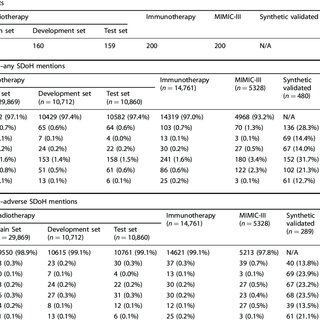
Social determinants of health (SDoH) significantly influence patient outcomes, yet their documentation is frequently incomplete or absent in the structured data of electronic health records (EHRs). The utilization of large language models (LLMs) holds promise in efficiently extracting SDoH from EHRs, contributing to both research and clinical care. However, challenges such as class imbalance and data limitations arise when handling this sparsely documented yet vital information.

In our investigation, we explored effective approaches to leverage LLMs for extracting six distinct SDoH categories from narrative EHR text. The standout performers included the fine-tuned Flan-T5 XL, achieving a macro-F1 of 0.71 for any SDoH mentions, and Flan-T5 XXL, attaining a macro-F1 of 0.70 for adverse SDoH mentions. The incorporation of LLM-generated synthetic data during training had varying effects across models and architectures but notably improved the performance of smaller Flan-T5 models (delta F1 + 0.12 to +0.23).

Our best-fine-tuned models outperformed zero- and few-shot performance of ChatGPT-family models in their respective settings, except for GPT4 with 10-shot prompting for adverse SDoH. These fine-tuned models exhibited a reduced likelihood of changing predictions when race/ethnicity and gender descriptors were introduced to the text, indicating diminished algorithmic bias (p < 0.05). Notably, our models identified 93.8% of patients with adverse SDoH, a significant improvement compared to the mere 2.0% captured by ICD-10 codes. These results highlight the potential of LLMs in enhancing real-world evidence related to SDoH and in identifying patients who could benefit from additional resource support.


