



















Tan Tock Seng Hospital (TTSH) is the largest hospital under the National Healthcare Group (NHG) with 1600 beds located in the central part of Singapore. Co-located at TTSH is the National Centre for Infectious Diseases (NCID), a 14-storey, 330-bed purpose-built facility set up by the Ministry of Health to enhance infectious disease outbreak management and public health preparedness for the nation In the second episode of the HIMSS APAC Digital Dialogue Series hosted by Dr Charles Alessi, HIMSS Chief Clinical Officer, guest speaker Dr Tan Cher Heng, Assistant Chairman Medical Board (Clinical Research and Innovation), TTSH provided insights on how his hospital made use of digital technologies in managing COVID-19 cases. They are joined with Barry Chaiken, Clinical Lead, Healthcare, Tableau, who is the supporting partner of the episode
CHALLENGES POSED BY COVID-19
When Singapore entered DORSCON Orange on 7 February, one of TTSH’s key challenges was to ensure that visitors and patients were adequately screened for infection, to prevent transmission to the hospital’s patients. 24/7 surveillance checkpoints were established at all entrances in the campus, which were manned by the hospital’s administrative staff who volunteered to step out of the comfort of their offices.
To ensure the well-being of its 9,000 strong work-force, TTSH adopted the Staff Surveillance System (S3), a one-stop database to track and respond to declarations of healthcare workers’ immunization, sickness, travel, and infection control records. The system has also been enhanced to facilitate daily temperature self-monitoring.
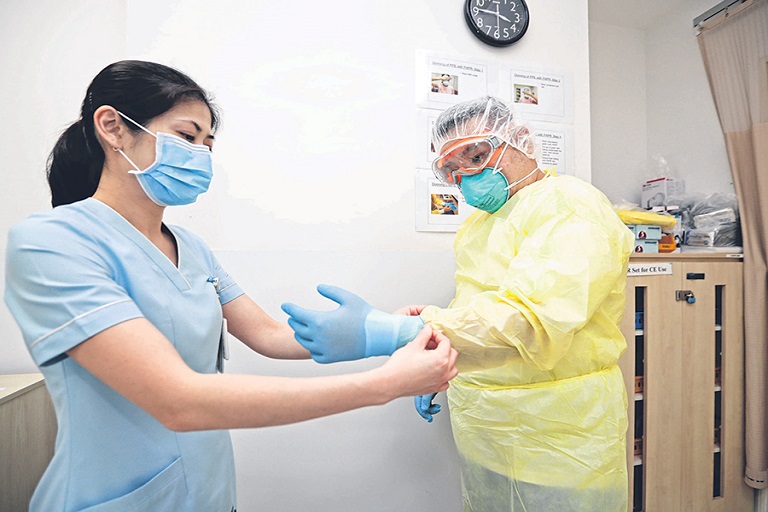
Given the severity of the COVID-19 pandemic worldwide, there has been a rapid increase in demand for personal protective equipment (PPE). TTSH fortunately had an adequate supply of PPE but commercially available PPE can be uncomfortable and fog up easily. A design team from the hospital’s Centre for Healthcare Innovation worked with clinicians to develop a low-cost, robust, disposable face shield within 3 weeks of the outbreak. The first 150,000 pieces have been produced and is being used locally. The design of the face shield is made open source and shared with the EU Trade Commission.
Like many other healthcare providers around the globe, one of the most important and greatest challenge faced by TTSH was the need to ramp up capacity to deal with the sudden surge in patient load. For instance, the Screening Centre at NCID has a capacity of 200. Since the outbreak, a newly built set of tentages has been added to double its capacity for receiving, screening and discharging patients.
During this outbreak, more isolation beds have been required. To meet demand, TTSH’s Facilities Engineering team converted standard cohort wards cubicles to isolation rooms by way of a pre-fabricated mountable wall. What would have normally taken 10 days per ward was achieved within a week. In April, when the number of cases in Singapore spiked tremendously, and NCID was reaching capacity, the main hospital at TTSH lent additional wards, while still ensuring that the non-COVID patients were adequately taken care of safely.
EFFORTS TO COMBAT COVID-19
One of the innovations that has come into play during this pandemic is the real time location system (RTLS), which incorporates various locating technologies in wearable tags. All patients, visitors and staff are provided with an RTLS tag for contact tracing. Hand sanitizers are equipped with pressure sensors and RTLS tags to monitor and remind staff on hand hygiene. The same technology is deployed to track equipment in real-time.
TTSH’s Command, Control and Communications (C3) system which went live progressively from the third quarter of 2019, is a stackable solution that can sense, think and respond to optimize patient flow and care delivery. The C3 acts as the “brain” of the hospital and provides hospital management with real-time visibility to make effective decisions on flow management and resource optimization.
Together with the national HIT agency IHiS, TTSH accelerated the module’s enhancement to incorporate the RTLS and video-monitor human traffic. This put the hospital in good stead to handle the surge at NCID where attendances tripled overnight.
The same team that developed the SARS-CoV kit in 2003 also developed the new Fortitude SARS-CoV-2 kits, which was designed, optimized and implemented rapidly in January this year. The product has since been produced at scale and sold worldwide. Ongoing checks are being made for emerging virus mutations, and new versions are anticipated.
To enhance the adaptability of hospital staff with just-in-time training, staff can access bite-sized micro learning modules on the ULeap platform. These modules include ‘Training of frontline staff in the use of PPE and swab technique’ and ‘Equipping Welfare Officers to manage psychological difficulties of fellow workers’. This method of learning increased efficiency for staff who had to cope with evolving guidelines, updates and new duties.
INTO THE NEW NORMAL
As the pandemic is going to be prolonged, video-consultation sessions starting with TTSH’s psychiatry unit have been implemented to ensure that patients get their care without coming to hospital. A larger scale project is currently being conceptualized to enable point of care testing, home monitoring, and remote tele-consult with backend integrated data capture.
Another goal of TTSH is to observe even greater assimilation of mobile technology into care delivery. To that end, the PillDeliver app and appointment system was developed by the Pharmacy department to enhance user experience, streamline workflows and increase efficiency.


