






















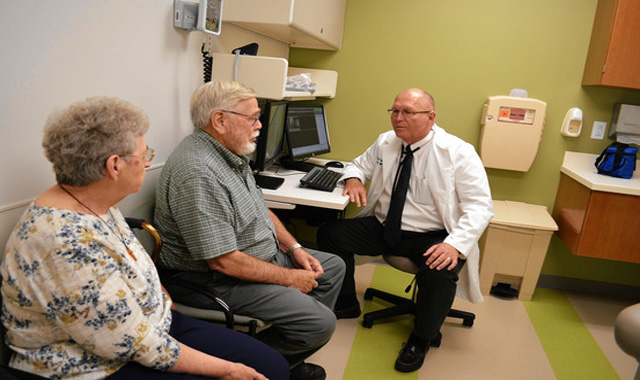







If you walk into any Central Utah Clinic, you’ll see physicians and staff using electronic health records, or EHRs. Instead of the paper charts of yesterday, doctors are analyzing your health data on an iPad or computer screen. Central Utah Clinic, the largest independent physician group in the state of Utah, served 411,000 patients last year using this system and has received numerous national awards for the successful implementation of EHRs.
But a Feb. 10 study in “Medical Economics” revealed that many physicians nationwide are frustrated with the cost, functionality and resources needed to operate EHRs — with 45 percent of doctors indicating that the patient care is worse.
So why has Central Utah Clinic succeeded where others have failed?
Amy sat down with Scott Barlow, CEO of Central Utah Clinic, to discuss electronic health records.
“Scott, you’ve seen the results of the Medical Economic survey. Are EHRs really leading physicians to provide worse patient care?”
“Absolutely not,” was his response.
“How, then, has Central Utah been successful? And what’s really going on?”
The brutal statistics are that before EHRs, physicians did not have access to hardcopy charts 31 percent of time. Maybe the chart was missing in the billing department, or it was lost, or it was simply in the front office under a stack of papers. Whatever the reason, physicians were flying blind a third of the time. Now, doctors, hospitals and skilled nursing facilities are starting to build super-portals that allow physicians to securely share information to avoid unnecessary repetition of tests and provide better patient care.
In five-star-rated skilled nursing facilities like Orchard Park of Orem (for whom Amy advocates), for example, the average patient has three or more chronic illnesses and is being treated by five or more physicians. In Utah, at least one of the doctors works in a separate healthcare system 77 percent of the time. With EHRs, it is now possible for all doctors — such as cardiologists, internists and neurologists — to see the same data and provide the same recommendations to avoid conflicting advice and create an integrated plan for patient care. Further, many systems have a portal where patients can access their own information, allowing themselves and their families to take a more active role in their medical care.
Scott’s passion for the integration of EHRs is illustrated by a personal experience. A few years ago, he and his family took a trip to Northern California to see the University of Utah play in a bowl game. While he was there, his back went out. Scott has recurring back problems, and all he needs is a $75 doctor visit and a muscle relaxant shot to alleviate the problem. But because he was in California rather than Utah, the doctors didn’t have access to his records.
First, he lay on the ground for five days while he tried to have his back spasms release. When that proved to be ultimately unsuccessful, Scott spent eight hours in the emergency room until he was able to be seen by a physician. Then, because they needed to confirm that he wasn’t a drug user complaining of a bad back, they did lab work and an MRI to assess the problem. He was exposed to unnecessarily invasive procedures, wasted the time of the healthcare professionals, incurred an extra $6,000 dollars in healthcare costs, and even missed the football game that he came to California for — all because the Utah and California health systems couldn’t talk to each other.
So why the negative results in the “Medical Economics” study? The Obama administration’s meaningful use incentive program drove many physicians to rapidly adopt and implement the systems without sufficient knowledge and preparation. In addition, the huge influx of users has maxed out EHR companies’ resources, resulting in a virtual freeze in technology development as they have been struggling to manage the increased workload. But, as can be seen with Central Utah Clinic’s results, correct implementation can provide better patient care and save everyone a lot of money in the process.
“If you want to be part of the future of healthcare, you need to implement electronic health records,” Scott said. “We are stewards of data, and we have the obligation and opportunity to create a patient-centric world.”
A world where patients come first and physicians have the tools they need to collaborate effectively? We’re onboard.
Amy and Greg’s Recommendation: Encourage your doctor to use an electronic health record, so both you and your other doctors can access your results, make better plans and ensure that mistakes aren’t made.
• Dr. Greg Osmond and Dr. Amy Osmond Cook are independent healthcare professionals, and their opinions do not necessarily represent the opinions of each other or the Daily Herald. This column is for entertainment purposes and should not be viewed as professional healthcare advice. If you are experiencing health problems, please contact your local physician or healthcare provider.


