





















































It isn’t often that a doctor is mistaken about how many feet his patient has.
But that’s the mistake this young doctor made by relying too heavily on an erroneous electronic medical record. According to Dr. Richard Gunderman:
An intern recently presented a newly admitted patient on morning rounds, reporting that the patient was “status post BKA (below the knee amputation).” “How do you know?” the attending physician inquired. “It has been noted on each of the patient’s prior three discharge notes,” replied the intern, looking up from his computer screen. “Okay,” responded the attending physician. “Let’s go see the patient.”
When the team arrived in the patient’s room, they made a surprising discovery. The patient had two feet and ten toes. Where did the history of BKA come from? It turned out that four hospitalizations ago, the voice recognition dictation system had misunderstood DKA (diabetic ketoacidosis) as BKA, and none of the physicians who reviewed the chart had detected the error. It had now become a permanent part of the electronic medical record — as if written in stone.
Fortunately, this error could be easily corrected. But the intern’s mistake highlights a growing problem with government-mandated electronic medical records. Doctors are spending more time in front of computer screens and less time with actual patients. This affects how doctors interact with patients. Inevitably, errors creep into their patients’ charts. Prudent patients should be aware of this trend and take steps to ensure the accuracy of their medical records.
The HITECH (Health Information Technology for Economic and Clinical Health) Act of 2009 essentially mandates that physicians and hospitals adopt electronic records by 2014, or face penalties in the form of reduced Medicare/Medicaid payments.
At first glance, adopting electronic medical records (EMRs) would seem a no-brainer for doctors and hospitals. After all, electronic records are the norm for many successful businesses, assisting with sales, inventory, and billing. In theory, electronic medical records should allow doctors to work more efficiently. But in practice, many doctors are finding that EMRs hinder their ability to practice good medicine.
A recent study from Northwestern University found that, “physicians with [EMRs] in their exam rooms spend one-third of their time looking at computer screens, compared with physicians who use paper charts who only spent about 9% of their time looking at them.” According to Enid Montague, PhD, first author of the study, “When doctors spend that much time looking at the computer, it can be difficult for patients to get their attention… It’s likely that the ability to listen, problem-solve and think creatively is not optimal when physicians’ eyes are glued to the screen.”
New York Times health writer Dr. Pauline Chen similarly described that young doctors in training are so busy filling out obligatory electronic forms, they spend only 8 minutes per patient each day. As a result, they cut corners:
When finally in a room with patients, they try to [rush through interviews] by limiting or eliminating altogether gestures like sitting down to talk, posing open-ended questions, encouraging family discussions or even fully introducing themselves.
As Dr. Chen noted, the bad habits they learn in training will carry over to when they become independent practitioners.
(Some doctors are coping with this problem by hiring “scribes” — additional clerical people to enter data into the computer, while the physician converses with the patient. But this requires physicians or hospitals to hire additional personnel. As the New York Times noted, “In most industries, automation leads to increased efficiency, even employee layoffs. In health care, it seems, the computer has created the need for an extra human in the exam room.” The “solution” of scribes doesn’t eliminate the inefficiency caused by electronic medical records — it merely shifts the problem elsewhere.)
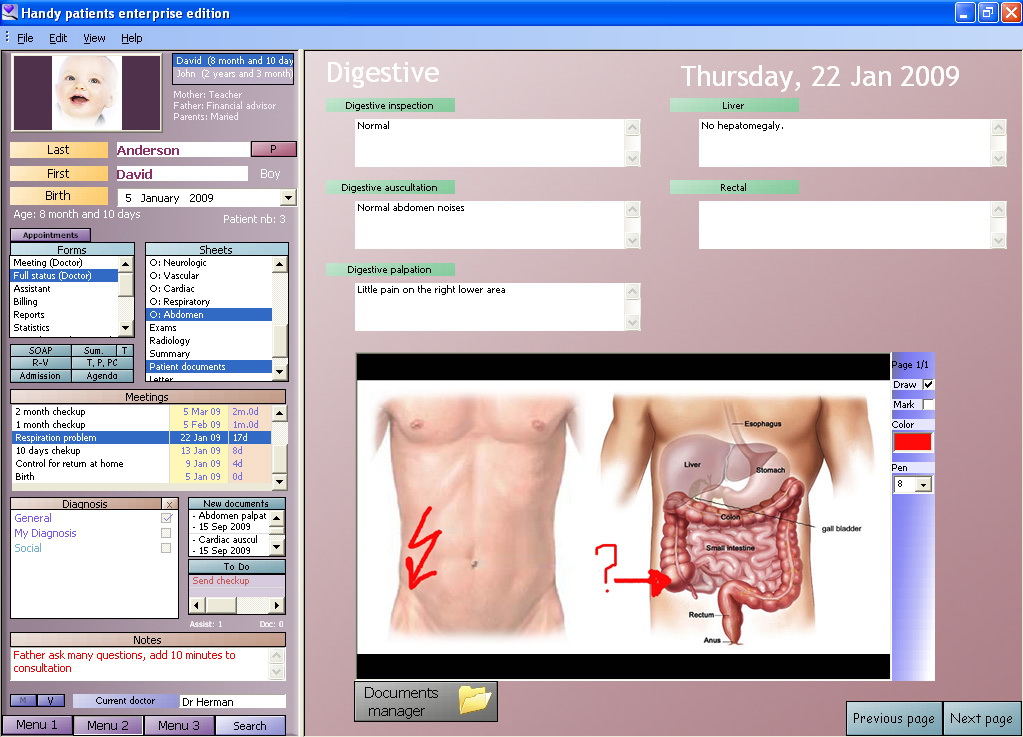 Electronic medical record (courtesy Wikimedia Commons).
One source of error in electronic medical records is when doctors spend insufficient time with patients. According to Dr. Elizabeth Toll, another source of errors is perverse payment incentives coupled with physician sloppiness. In her words, “The records are full of lies”:
The EMR was designed to demonstrate the pieces of the record that you have to attend to in order to bill at a certain level. If you just enter a few questions and you only enter part of the exam, and you only add medicines and you only do this or that, you can only be reimbursed a certain amount. But if you asked about, for instance, the family history, the surgical history and the social history, then you have all the elements to charge more. So there’s an incredible temptation to just push, push, push and bring forward everything from the previous notes without re-asking the questions.
This creates a huge problem: The records are full of lies. They’re full of things that [physicians] have said they’ve done but truly haven’t. The patient has been in eighth grade for three years. The patients are divorced, but in the record they’re still married. The patient used to work as a nurse and now works as a librarian, but it hasn’t been changed in the record because people are giving quick, push-button answers to save time, and they don’t update the info. You can see this as you go through small things in the social history but also in [clinical histories]. Yesterday, someone sent me a letter about an amputee patient he sent to a podiatrist. He got a report back on both the patient’s feet. This patient only has one foot.
Even when doctors are conscientious, EMRs don’t eliminate medical errors. They merely change the kinds of errors made. For example, EMRs eliminate the problem of doctors’ illegible handwriting on prescriptions. Instead, physicians might (and sometimes do) accidentally click on the wrong medication on the menu.
(Note: EMRs are not inherently bad. A well-designed EMR can add tremendous value to many medical practices. But the choice of whether and when to purchase an EMR should be left up to each individual hospital and medical group. The government should not be pressuring doctors into adopting EMRs any more than it should pressure citizens into purchasing smartphones they might not need. But that’s a topic worthy of a separate column.)
So how can patients protect themselves from errors in their electronic medical records? I recommend four simple steps:
1) Get a copy of your own medical records at regular intervals and review it thoroughly. This is especially important if you’ve had recent major surgery or developed a serious new medical condition (such as a new diagnosis of cancer). If you find an error, contact the appropriate hospital or doctor’s office and ask that it be corrected.
2) Make sure you understand all your prescription medications. The most common errors in electronic medical records involve patient medications (either a wrong medication or a wrong dose). Discuss each medication with your doctor and/or pharmacist until you understand why you are taking it, the proper dose, how often, for how long, and what side effects to look out for.
3) Whenever you undergo laboratory or radiology testing, request a copy of the results for your own personal files. Most radiology offices will gladly burn a CD of your radiology imaging tests for you (either for free or for a small fee). That way, you can review the results at your leisure or seek second opinions at your discretion.
4) Whenever you have a doctor’s appointment, consider bringing a small voice recorder to record any discussions. (Many smartphones also have a voice recorder app.) Most doctors are glad to let patients record their conversations, so they can replay them when they get home or go over them with family members unable to attend.
Electronic medical records can be powerful tools when designed properly and used wisely. And errors certainly occurred in the era of paper records. But electronic medical records can create new risks for patients. Prudent patients will want to ensure their own records are accurate. Someday, your life may depend on your diligence.


