
























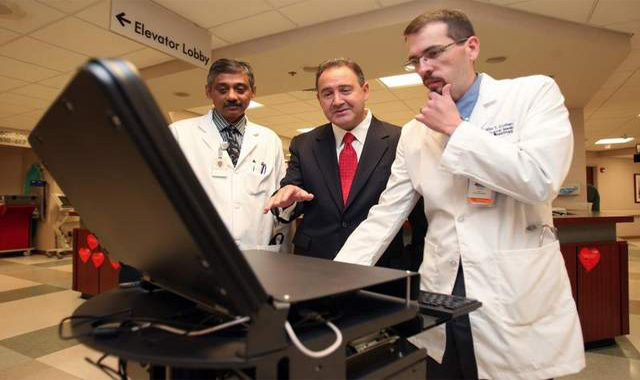
Have you noticed one (or more) of your doctors carrying around an iPad through the office? It might be because electronic health records are beginning to revolutionize the field of medicine.
Medical records in paper form are gradually being showed the front door as electronic health records are becoming more useful for physicians in all fields. Medical filing is tedious work; a doctor needs to trust his workers to not misplace or lose important information regarding their patients. Additionally, files can get lost in the mix, which poses a problem for the records.

A new study conducted by doctors and professors across the country unveiled the true advantages of electronic health records. “In Emergency Departments, Radiologists’ Access To EHRs May Influence Interpretations And Medical Management,” was published this month in Health Affairs.
The researchers sought to demonstrate the effectiveness of electronic health records in emergent neuroradiologic interpretations, where three neuroradiologists at Froedtert & the Medical College Froedtert Hospital analyzed 2,000 head CT scans. The radiologists found that additional data was provided in the electronic records that would significantly impact interpretations of the head CT scans.
More specifically, “In 6.1 percent of the head CT exams, the neuroradiologists reached consensus-meaning two out of three agreed-that the additional clinical data derived from the EHR was “very likely” to influence radiological interpretations and that the lack of that data would have adversely affected medical management in those patients,” reads the study’s abstract.
The study’s corresponding author, John L. Ulmer, MS and professor of radiology and chief of neuroradiology at the Medical College of Wisconsin insists that health care providers consider the investment of switching to electronic health records for a variety of reasons, but the most important being the fact that it could be difference between life and death in some cases.


