























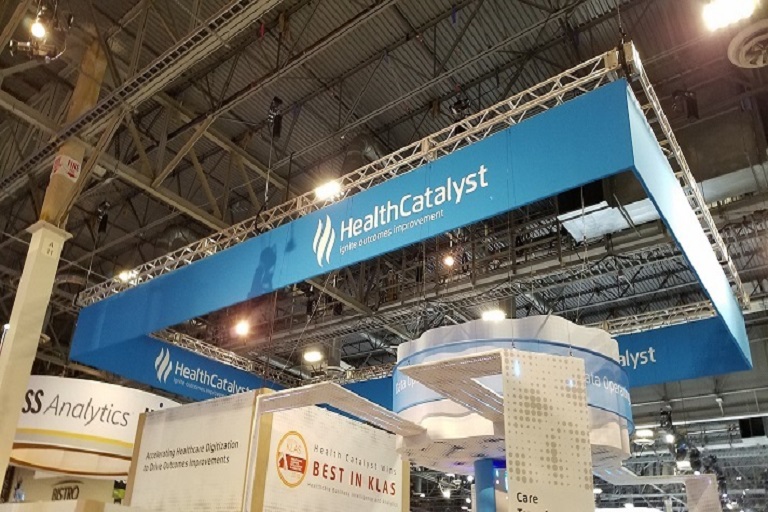
The COVID-19 crisis has exemplified the importance of anticipating hospital resource needs around the country. The team at analytics vendor Health Catalyst created its Capacity Planning Tool as a way for hospitals to determine when and where they will reach capacity as large numbers of patients continue to enter their system.
The tool, which is based on Penn Medicine’s CHIME epidemic model and free to use for any health system, predicts future availability of supplies such as beds, ventilators, staffing and personal protective equipment. “Essentially, what we’re trying to do for you here is to create some time,” said John Hansmann, senior vice president for professional services at Health Catalyst, during a HIMSS20 Digital demonstration of the product.
“To give you the ability now to look forward: When will the surge affect you? What day are you anticipating that you will start to run into bed problems?” COVID-19 task force members, hospital incident command centers, executive teams and other decision-makers can use that lead time to plan for shortages or obtain additional materials.
Users supply parameters, including total regional population, a hospital’s market share of that region, available supplies for COVID-19 patients, the estimated incremental impact of social distancing and the date of the first hospitalized case in order to predict when a site is likely to reach its peak of COVID-19 patients.
They can also include measures of severity, or what percentage of infected patients will end up needing hospitalization, critical care or a ventilator. “These [numbers] are highly local, in part because the testing rates are highly local at this point,” noted Health Catalyst Chief Data Science Officer Jason Jones during the presentation, COVID-19 Capacity Planning Tool Demo and Q&A.
Users can create scenarios based on best-case and worst-case numbers and compare them to each other or to actual patient numbers once time has passed. The files are saved locally, rather than to Health Catalyst’s server, in the interest of security. “You’re right, it’s a lot of stuff to input,” Jones acknowledged. “The hope was that we’ve made it easy for you to see how COVID-19 admissions, lengths of stay and your available capacity are all related to each other.”
The Capacity Planning Tool can be used in a variety of geographical locations. Although population numbers and social distancing impact will vary, “the underlying theory behind the model should work equally well anywhere in the world,” Jones said. Jones noted that hospitals can use the tool to determine how adding more beds and PPE can help them stay below capacity.
Since the tool’s initial release, the Health Catalyst team has added more functionality, breaking down PPE numbers into gloves, mask type, face shields, and gowns, and incorporating staff availability based on position and shift length. The team is in the process of creating resources for financial-impact planning, and will potentially incorporate more historical data into the tool as numbers become available.
“The truth is that this model, as opposed to the empirically based prediction model, relies very heavily on your assumptions,” said Jones. “The utility of the model depends on the accuracy of your assumptions. We’ve tried to make that as easy as possible to assess so you can adjust your assumptions.”


