




























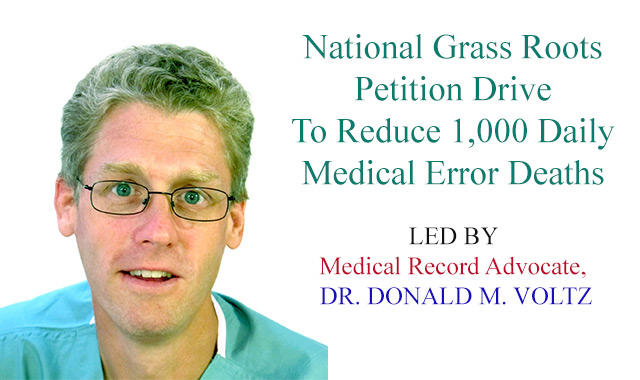
NATIONAL GRASS ROOTS PETITION DRIVE TO REDUCE 1,000 DAILY MEDICAL ERROR DEATHS
LED BY MEDICAL RECORD ADVOCATE DR. DONALD M. VOLTZ
Campaign Launched Targeting Government and Medical Industry to Improve Patient Survival Rates and Overall Outcomes with Better Healthcare Communications Systems
(March 23,2015; Twinsburg, OH) – A national grass roots campaign launches today to reduce the medical miscommunications in healthcare systems that cause almost 1,000 deaths a day in the U.S. This campaign seeks to forge a government and industry solution in solving this lapse in electronic healthcare communications, a cornerstone of Obamacare.
The campaign is headed by Dr. Donald Voltz, an anesthesiologist at a non-profit hospital in Canton, OH and an Assistant Professor of Anesthesiology at Case Western Reserve University in Cleveland and Northeast Ohio Medical University.
Voltz petition on Change.org demands that the government and medical industry implement a solution to end what is a very easy problem to fix. Once signed by 25,000 U.S. residents age 18 and older, the petition will be sent to the White House for review and a specific, timely action plan.
This is an issue that affects every American who has ever needed to go to the doctor or hospital. A flaw in current medical communications technology, compounded by government and industry inaction, is resulting in misinformation and missing medical data being presented to health care workers when they need it most. Every American needs to be aware of this issue to speak up to protect themselves and their families from this almost entirely avoidable situation.
“We don’t care if this is done through an executive order, a law passed by Congress or industry initiative, as long as it is done. By signing the petition, we are telling the President and Congress that we need a direct path of communication between all healthcare systems through a specific and comprehensive set of requirements to end interoperability. Solutions are there, but no one has an incentive to implement them,” says Voltz.
Why do we need government intervention?
- There has been no improvement in patients’ health information flow in medical communications systems and no support for sharing this crucial data flow among care providers since the transition from paper to electronic medical records. The result is the high number of medical errors leading to death will remain unchanged without government intervention.
- Hospital boards have no incentive to adopt technology to solve the problem because inaction costs less money than fixing it. The result? Hospitals are not actively looking for a solution, unless it is mandated as part of a government intervention, similar to the same intervention to transition from paper to electronic medical records.
- Most of healthcare vendors, notably electronic health record (EHR) vendors, have no incentive to address these issues in order to push for their own product solutions. This leaves the lack of EHR interoperability, the most critical area to reduce medical errors leading to death, with no near term improvement.
- Existing government bodies are in place, but the focus and timetable are not aligned with the urgency for improving patient outcomes, which claim US lives on a daily basis.
Approximately 400,000 Americans die every year because of industry self interests, slow pace of government oversight and care providers stuck in the middle. In the end, patients are the customers, yet they are bearing the brunt of this disservice.
Sixth in the U.S. for Deaths
If the Center for Disease Control reported a category for erroneous medical deaths, it would rank 6th in the U.S. And the cost? A cool trillion dollars a year. Sadly, this figure is not too far from similar statistics found 15 years ago.
By implementing a connectivity solution, hospitals and medical professionals would save billions in lower insurance premiums as there will be fewer medical death and error lawsuits. These actions will lower medical costs and will benefit everyone.
“The medical industry has had many opportunities to bring about interoperability like the January 2009 passage of the Health Information Technology for Economic and Clinical Health Act (HITECH), a $30 billion effort to transform healthcare delivery through widespread use of EHR technology. Also, the ‘meaningful use’ EHR Incentive Program requirements have helped to create greater commonality in basic EHR functions across systems at a much faster pace than would have otherwise occurred,” said Voltz. “But despite all of these initiatives, we still don’t have a solution.”
In addition to his medial and academic affiliations, Dr. Voltz is an author who writes for medical publications and is board-certified in clinical informatics. He is also a researcher, medical educator, and entrepreneur. With more than 15 years of experience in healthcare, Dr. Voltz has been involved with many facets of medicine. He has performed basic science and clinical research and has experience in the translation of ideas into viable medical systems and devices.
For additional information contact William Madaras 408-390-3160 William@glasslanternpr.com


