



















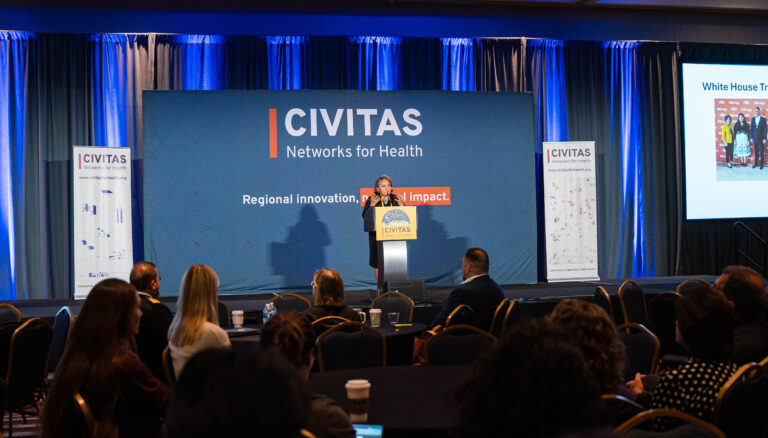







“We want to showcase the roadmap for us – and lessons learned and recommendations for others,” said Sabina Zak, VP of community health and health services research at Northwell. Integrating SDOH data into clinical systems has been key, she said, “because ultimately that’s the hub of data. Getting it accurate and able to make it actionable is really what’s important.” Understandably, many hospitals and health systems are “very wary of taking on this challenge: integrating into clinical workflows, being afraid to rock the boat when it comes to clinical staff,” said Zak northwell health
But Northwell’s successes so far having done some serious thinking about “what matters on the clinical side, the hospital side, the patient side and what partnerships you have to engage in,” has shown that having SDOH insights can drive better care outcomes and boost operational efficiencies, she said. Northwell Health is a longtime innovator with population health management, and at HIMSS20, Zak – along with her colleague, Population Health Informatics Lead Simita Mishra – will show how it’s using analytics to develop a comprehensive strategy to identify at-risk patients and connect them with appropriate community resources.
These efforts are helping lower unnecessary ED utilization and improving health outcomes, they say. But it’s a project that requires all hands on deck: clinicians, care teams, informaticists, technology vendors, community-based organizations and others. “What was important for us was, how do you collect information in a way that can make it easier for you to understand what you need to target,” Zak explained.
At Northwell, “initially the work was more about identifying the problem,” she said. “And I think the mistake most people make is trying to kind of go around it the other way around: by looking at maybe just community level issues: Some of these community health needs assessments that are done, but not truly understanding, you know, what are some of the problems are linked to health outcomes, specifically with CHF, with sepsis, where you can really change the trajectory.” The goal, she said, should be to get more data around social determinants of health at the time of the clinical consult, and then to put it to work as part of the larger care plan: “How do you then ultimately look at patients holistically?”
Another key first step is to “see what technologies are available in partnership with the healthcare system itself … to make this process work, said Zak. “Early on, we recognized, at least with community health, that this work is not something that we can do on our own.” Indeed, integrating data about transportation barriers, social isolation, health literacy and food insecurity into clinical workflow can be tall order. But it can also pay big dividends as health systems look to address root causes of obesity, diabetes, congestive heart failure – as well as avoiding inpatient sepsis and reducing ED utilization and readmission rates.
“Obviously data capture is one issue, but also, even after the data is captured just getting buy-in is another challenge,” said Mishra. That means both buy-in from clinicians and with regard to budgetary support from the C-suite. But both are key to “make it a self-sustaining initiative,” she said. “We are on the right trajectory,” she added. “But I think at this point, the buy in for executives to start funding it, without necessarily seeing the ROI yet, is the change management process that people like us are going through.”
“The research and innovation team that we’ve partnered up with at Northwell is a vital component, part of the structure we’ve put in place to ensure that everything we’re doing we’re putting in place measures and metrics that we’re monitoring,” said Zak. “And our scientists and researchers are working with us behind the scenes to navigate the process, review the results and continuously do a QA/PI to say where is it we need to fix certain things. And hopefully keep cost and expense in mind without making additional workload or adding FTEs.
“Today we have more than 100,000 screenings we’ve done since we integrated into 12 acute facilities,” she added. “And some of the trends that we’re seeing from the data are socioeconomic issues: people can afford insurance, can’t pay their bills, which are most often the root cause of the other social determinants.” Beyond that, she said, “the top three issues we’ve seen are transportation, social isolation and health literacy. Transportation is a major problem. We see this problem not just in suburban neighborhoods. Even in New York City, where you have a wealth of resources, transportation continues to be gap.”
But transportation challenges aren’t just related to getting to doctor’s appointments on time, Zak pointed out. “The other biggest gap that we’ve found with patients where the transportation barrier is, when we just send them home, once they get home, they can’t get the pharmacy to pick up their meds on time.” At Northwell, “for patients who are vulnerable and we identify a transportation gap, we’ll work with our pharmacies to actually fill the prescriptions for them before discharge or e-prescribe the meds to the pharmacy with instructions to deliver.”
But beyond that, the health system is exploring ways to contract with ride sharing services to deliver meds to patients from their prefered pharmacies. The goal is to have an array of initiatives like those that eventually just become routing parts of the care delivery process. “Once you have the foundation, once you have a streamlined and inserted into the workflow, it can be copied and replicated and continue to be sustainable,” said Zak.


