




















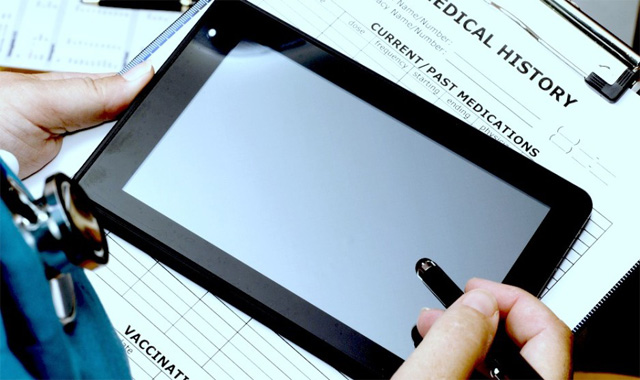

















The invitation extended to Dr. Vandana Ahluwalia to purchase an electronic medical records system (EMRs) for her Brampton, Ontario, rheumatology practice was both welcome and challenging. On the one hand, the offer came with a tantalizing cash incentive — up to $28 000 in free money from the Ontario and federal governments. On the other hand, Ahluwalia had to choose between 13 commercial systems. “It was overwhelming,” she recalls. “The selection range was incredibly complicated.”
To make matters even more daunting, Ahluwalia soon learned that none of the electronic medical record (EMR) systems approved for government funding by OntarioMD (a subsidiary of the Ontario Medical Association funded by eHealth Ontario) was designed with her needs as a specialist in mind. “The EMR systems are geared toward family practitioners,” she explains. “Specialty-specific tools require customization.”
The experience made Ahluwalia realize that part of the reason Canadian specialists have been slower than general physicians in adopting EMRs is that they require customized systems that can meet their specific and often very exacting clinical needs, while also being able to share information with off-the-shelf EMRs used by generalists. It’s a problem, Ahluwalia concluded, that can’t be solved by e-health bureaucrats and software vendors. “We specialists have to solve this for ourselves,” she explains.
To cut through the confusion, Ahluwalia and colleagues from the Ontario Rheumatology Association, where she was president at the time, swiftly reduced the list of possible systems to two. She also mapped out an EMR customization process based on a standardized checklist that allows other rheumatologists to efficiently set up and modify their systems. Within 18 months, more than half of Ontario’s rheumatologists were using the process to install their EMRs.
Ahluwalia’s next move was to suggest to OntarioMD that it begin using her model to help specialists in other fields — a suggestion its CEO, Brian Forster, accepted enthusiastically. The system is now being piloted with pediatricians and ophthalmologists, he says.
With more than 80% of Ontario family physicians eligible for EMR subsidies using the systems, the big challenge now is to persuade more specialists to adopt them, says Forster, who estimates that only half of Ontario specialists use EMRs. To increase that percentage, he adds, physician leaders like Ahluwalia are instrumental. “We had to get the EMR vendors to listen to the specialists,” he explains. “To do that, you need strong leaders like her.”
Thanks to such leaders, more specialists across Canada have, in fact, been flocking to take advantage of subsidy programs before they expire. “The rate of EMR funding for specialists is going through the roof,” says Jeremy Smith, program director for British Columbia’s Physician Information Technology Office, which supports doctors in collaborating to form “communities of practice” to select, implement and use EMRS.
As with Ahluwalia’s leadership in Ontario, key specialists in BC are now leading the process, says Smith. “Although specialists don’t tend to naturally coalesce around a common plan, they’re coming together at the micro-level,” he says, describing a group of more than 30 cardiologists at Vancouver General Hospital who recently adopted EMRs.
As more specialists come on board, the challenge then becomes connecting them to systems installed by family practitioners and other clinicians capable of electronically transmitting specialist referrals, prescriptions, and lab and hospital reports. “The biggest problem in getting specialists to work together and adopt EMRs is getting them to agree on common sets of information needs,” explains Bill Pascal, chief technology officer for the Canadian Medical Association. “I would encourage all specialty groups to map out common needs from the systems.”
As in Ontario, connecting general practitioners and specialists remains a huge challenge in BC. To help address that challenge, physicians will have to roll up their sleeves and get under the hoods of their machines, says Dr. Bruce Hobson, lead physician for an EMR community of practice in Powell River, BC. “It’s all about getting physicians to change their way of thinking about using the EMRs to assist in clinical decision-making and team work,” he says. “Until you have true interoperability everything is just a big work-around.” source


