








































Exclusive Article at EMRIndustry
By Thanh Tran, CEO, Zoeticx, Inc.
Thanh Tran is CEO of Zoeticx, Inc., a medical software company located in San Jose, CA. He is a 20 year veteran of Silicon Valley’s IT industry and has held executive positions at many leading software companies.
This byline from Zoeticx CEO Thanh Tran focuses on the various interpretations of EHR interoperability requirements by medical stakeholders across the healthcare continuum. Pain levels vary depending on the specific needs of those groups being impacted by the continuing lack of connectivity, ranging from caregivers and IT staff to hospital administrators and most importantly the patients themselves.
Healthcare Interoperability
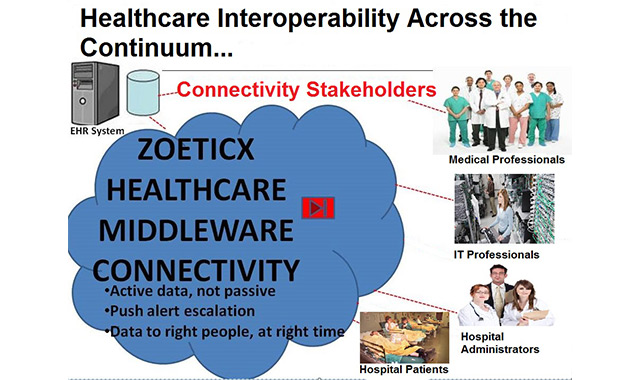
Interoperability is the ability to make sub-systems and organizations work together (inter-operate) for attainment of a common goal. In healthcare, implementation and connection of EHR systems and the data they collect allows for us to impact patient care to become a value-driven one for all patients.
The opposite of interoperability is not the lack of connecting EHR systems, but instead the failure of healthcare systems and organizations to collaborate in an efficient, effective, safe and consistent way to support patient care. To better understand the ecosystem of healthcare, we need to look at this redefined concept of interoperability in greater depth while also considering the needs of various stakeholders and their views of the system.
Care Providers Want Care Continuum
Care Providers are not a single entity whose needs can be fulfilled with a single solution. The focus of all providers is on the patient care continuum and their role in it. The lack of EHR interoperability is fundamentally defined as the inability to share patient medical records across this continuum.
Each provider brings a unique view and delivers specialized, customized care to the patient over different time periods. The care delivered by each provider is interdependent on other providers taking care of the patient for a current encounter. To deliver care, healthcare providers must have the ability to access not only summary information about a patient, or the outcome of a prior intervention, but also be able to drill down into the specific data where they can provide meaning and insight for the patient and the rest of the care team.
Collaborative healthcare, care delivered by specialized and focus teams of providers, has become standard in medicine. Access to the information and meaning provided by various providers is essential. It must be delivered in near time, to the proper provider on the team.
For care providers it is about the ability to see the whole care spectrum; to drill into details with on-demand and near time access.
IT Pros Need Information Flow
With healthcare IT pros, interoperability begins with patient medical information flow. As the patient transits through healthcare facilities, they are treated by different care providers using different systems. Care providers depend on the above medical flow to ensure effective and quality care delivery. Proprietary patient medical records from diverse EHR systems prohibit that flow, leaving healthcare IT crippled, along with care providers, in enabling a seamless workflow across the system.
Healthcare IT organizations impacted by merger and acquisition face the lack of EHR interoperability under another major challenge, IT integration of disparate EHR systems. Rip and replace is a costly solution to achieving integration and overcoming EHR interoperability among diverse EHR systems.
Furthermore, healthcare IT faces the continued demand for solutions to patient care effectiveness, efficiency and improving patient care quality. However, healthcare IT application developers have been bogged down by the lack of EHR interoperability as well. The EHR agnostic environment is required to seal off applications from the EHR infrastructure. Without this layer, the development would be focused on addressing infrastructure challenges instead of innovative solutions for care providers.
As any other IT organization, healthcare IT faces the challenge of doing more with less. EHR systems share a number of characteristics as its siblings, enterprise applications from other IT industries. EHR systems form the backbone of healthcare systems, but they are also complex, slow to react to care providers’ requirements and costly to maintain. That cost is already in place, leaving healthcare IT with a smaller budget to address the lack of interoperability. Any solutions to EHR interoperability must be low total cost of ownership, lightweight to deploy and portable to a variety of healthcare IT applications.
Administrators Require Compliance and Data Protection
Healthcare administration is charged with complying with patient privacy requirements (HIPAA). Solutions for EHR interoperability with additional copies of patient medical records are not optimal since they represent additional compliance activities and agreements (such as Data Service Agreement) between the data source and destination. These additional compliance activities represent complexity, cost and risk of non-compliance that would result in potential penalties, legal and IT maintenance costs. For healthcare administration, simplicity and practicability of the solution are critical.
Patients Suffer Most
The greatest impact to all stakeholders in EHR interoperability is on the patient. Being at the center of the healthcare delivery model, patients must be brought into the interoperability equation. A vital component for gaining control of increasing healthcare expenditures is engagement of patients.
Not only do we need patient engagement, but patients are demanding security and control over who accesses their medical data. These two are not independent, but are intimately connected. Without control and understanding of who accesses the data, patients will lose trust in the system leading to disengagement and disempowerment.
Patient control over medical record access must be dynamic, secure and able to occur in near time. Above all, patients have full control of who has the full access of their medical records. Current concepts of Opt-In or Opt-Out choice for medical data duplication does not address these dynamic and secure requirements and give patients the control of who has access.
The Optimal EHR Interoperability Solution
EHR systems are database oriented. To address EHR interoperability by creating an additional centralized database layer is not an optimal approach, let alone the failure to satisfy the stakeholders impacted.
The next wave of healthcare challenges needs to be addressed by innovative applications aimed at supporting care providers such as that offered by Zoeticx. The best approach is a middleware infrastructure, supporting open architecture for healthcare, capable of performing data switching and value added data redistribution capabilities from various EHR systems. The middleware solution must be lightweight, embedded as part of healthcare applications supporting on-demand, near time access to diverse EHR systems. It is where interoperability must be implemented.


