

NTFGH’s lessons behind Singapore’s first HIMSS EMRAM Stage 7 revalidation
In November 2020, Ng Teng Fong General Hospital (NTFGH), a 700-bed hospital located in Jurong East in Singapore under the National University Health System (NUHS) cluster, successfully revalidated their EMRAM Stage 7 achievement by HIMSS.
The successful revalidation is the first for Singapore’s healthcare system – it is also the first revalidation to be done virtually in the APAC region since the start of the COVID-19 pandemic and the first revalidation at Stage 7 under the revised EMRAM criteria, which was updated in 2018.
However, the three-day virtual revalidation also came with its fair share of challenges, both from technical and execution standpoints. Healthcare IT News spoke to Dr Gamaliel Tan, Group CMIO, NUHS, as he shared insights behind NTFGH’s journey towards a successful (virtual) EMRAM Stage 7 revalidation.
Preparation for revalidation
The preparation for EMRAM Stage 7 for NTFGH began in early 2019, when the hospital had to seek funding from Jurong Health’s management, Dr Tan explained. From a technical standpoint, preparations included:
Configuring the EMR system for bar coded collection of blood specimens in the wards (new to HIMSS EMRAM 2018)
Writing a new report for the compliance bar coded blood specimen collection and re-running reports for bar coded blood product administration and medication administration
Training the ground teams in the ward / ED for bar coded blood specimen collection
Validating the reports and closing gaps on the ground in areas where compliance was low (releasing compliance reports to ground team managers, purchasing more mobile devices and scanners)
Ensuring compliance to the new security requirements that staff had to undertake a security learning session every year (new to HIMSS EMRAM 2018)
Key lessons from a virtual revalidation
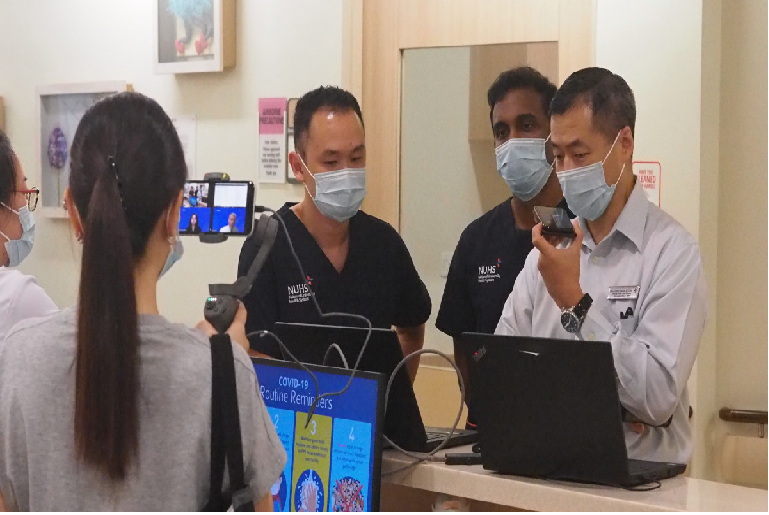
Being NTFGH’s first virtual revalidation, the various presentation teams had to rehearse their presentations and tours using the Zoom platform. The hospital also had to obtain several mobile phones with Zoom accounts and gimbals to make sure the presentations came across well.
“We had to ensure the internet bandwidth was good enough and we had no blind spots where signal is weak. A zoom jockey (coordinator) is essential to coordinate the ground teams moving around and keeping their presentations on time and the virtual validators entertained during the intermissions when the ground teams were moving from point to point,” said Dr Tan.
The lack of physical interaction made communication harder compared to a face to face validation.
On the flip side, the virtual validation also brought about new opportunities for other hospital departments to participate and learn in the process. In this case, the MI department attended the virtual validation as observers, which was very meaningful for them as they spend hours configuring and planning the workflows which are used by the clinical staff.
According to Dr Tan, attending the virtual validation helped the Medical Informatics (MI) department become more aware of the opportunities for improvement and areas they could focus on for some quick wins in terms of EMR adoption.
Working with IHiS
IHiS, which is Singapore’s national HealthTech agency, works with NTFGH on the set-up of the IT infrastructure which links to the EMR system, as well as look after the cybersecurity aspects of the network. As part of the EMRAM Stage 7 revalidation process, the IHiS team provided inputs on the availability of IT infrastructure like anti-virus software, firewall and IT disaster recovery system etc.
In particular, a system analyst from IHiS assisted with the configuration for bar coded blood collection. As part of the process, the analyst, who is in-charge of the lab systems, took ownership of the barcoded blood specimen collection.
He gathered requirements from the nurses and worked closely with the end user device team to configure the scanners and label printers for the barcoded blood specimen collection, as well as troubleshooting of the workflows and devices.
Upcoming projects
Given the challenges of the COVID-19 pandemic, achieving the HIMSS Davies Award during the same time of the EMRAM Stage 7 revalidation was a high point for NTFGH. In the near future, as more sites go live with the EPIC EMR, Dr Tan hopes to gain from economies of scale by harmonizing their workflows within the NUHS cluster, which consists of three acute hospitals, two community hospitals, several polyclinics and a regional health system which reaches out to their community partners.
“We hope to leverage on artificial intelligence by interfacing our data onto an AI platform in the coming years and also to roll out a patient portal to empower our patients with relevant health information, scheduling and payment platforms,” he concluded.
Source : Healthcare