



















































Thanh Tran is CEO of Zoeticx www.zoeticx.com, Inc., a medical software company located in San Jose, CA. He is a 20 year veteran of Silicon Valley’s IT industry and has held executive positions at many leading software companies.
Whether driven by simple technological advancements or Obamacare, the digitization of medical records and data is a necessity. Almost 80 percent of U.S. hospitals currently use some type of electronic records software, according to the U.S. Department of Health and Human Services. Approximately $2.05 trillion is spent on these systems yearly, reports the Healthcare Information and Management Systems Society.
What is still being debated is how to mesh the almost daily mobile technology shifts, mixed with social media and security concerns to enable medical professionals and patients to unite in ending needless medical errors. These errors cause 200,000 patients deaths yearly, 40 percent of which are directly related to information omissions and miscommunications. If the Center for Disease Control reported a category for erroneous medical deaths, it would rank 6th in the U.S. These unnecessary deaths, along with reducing duplicative tests and procedures, waste billions needlessly on costs that drive up insurance premiums that are passed on to consumers.
Proliferation of Redundant Electronic Medical Records
There are hundreds of Electronic Medical Records (EMR) software tools in existence today. Most hospitals, because of medical mergers and acquisitions, have multiple EMRs in place. Unfortunately, most of these programs don’t connect and they all present the data they store differently, often in proprietary databases with HIPAA creating a secondary set of data in many cases.
The expectation was of EMR data sharing through open architecture, but instead hospital IT departments were burdened with systems lacking interoperability. To address these challenges, it is being suggested that Health Information Exchanges (HIE) use an additional consolidated database on top of the existing EMR software. However, the HIE database not only causes data duplication, but also requires additional database synchronization and data privacy. These requirements only add an additional layer of difficulty rather than solving the actual data sharing that was intended to support patient care.
Information Rich, But Data Poor
The focus on being data rich, but information poor also creates gaps. Differing sets of data between a current care environment and the previous care environment, such as existing emergency room data and new data at an outpatient facility, easily causes miscommunications. EMR tools need collaboration between caregivers, and caregivers and patients. There is also a lack of real time medical information over geographical distances.
When you add the lack of access to the original records by the family physician and the inability of EMR systems to offer an analysis of the impact of new medicine on a patient, we are almost back to square one. EMRs, as passive components, fail the basic purpose of having paperless records. If the data is not moved into the active environment, how can care providers deliver on the promise of better patient outcomes in 2014?
How many more patients will wind up like Bill White who almost died because an order to check his potassium level was never received by his night physician after a shift change? How about 12 year old Rory Stauton who did die from lack of timely medical record communications between a hospital and his family physician?
It’s Not the Boom of the Beep, but the Success of the Signal
EMRs also often fall short in patient tracking by medical professionals suffering from beep fatigue who turn off their devices. Often the beeps are not even going to the appropriate provider. What is critical is not the beep, even though many times coming from hand held devices, but the signal. How accurate and timely is the beeped information and does it correspond with other current data?
Another form of fatigue is the additional time now needed for training on new, unfamiliar systems that nurses’ must use rather than delivering the patient care they were originally trained for. These environments easily lead to misdiagnosis, negative impact on productivity, and time taken away from patients, contrary to the goals of Obamacare.
Time for Band-Aid to be Changed
Obamacare’s emphasis on quality care also impacts the method of reimbursement, from pay-per-procedure to pay-per-performance, non-reimbursement for readmission within 30 days of discharge, and quality guidelines. These enforcements dramatically change the need for care quality, efficiency and productivity for care providers from nice-to-have to must haves.
With Obamacare’s paperless records mandate beginning this year, 2014 is the time to finally fulfill the original promise of ending medical deaths and needless spending. This is the year to resolve these issues and go beyond the EMR band-aid approach.
Bridging the Data Gap
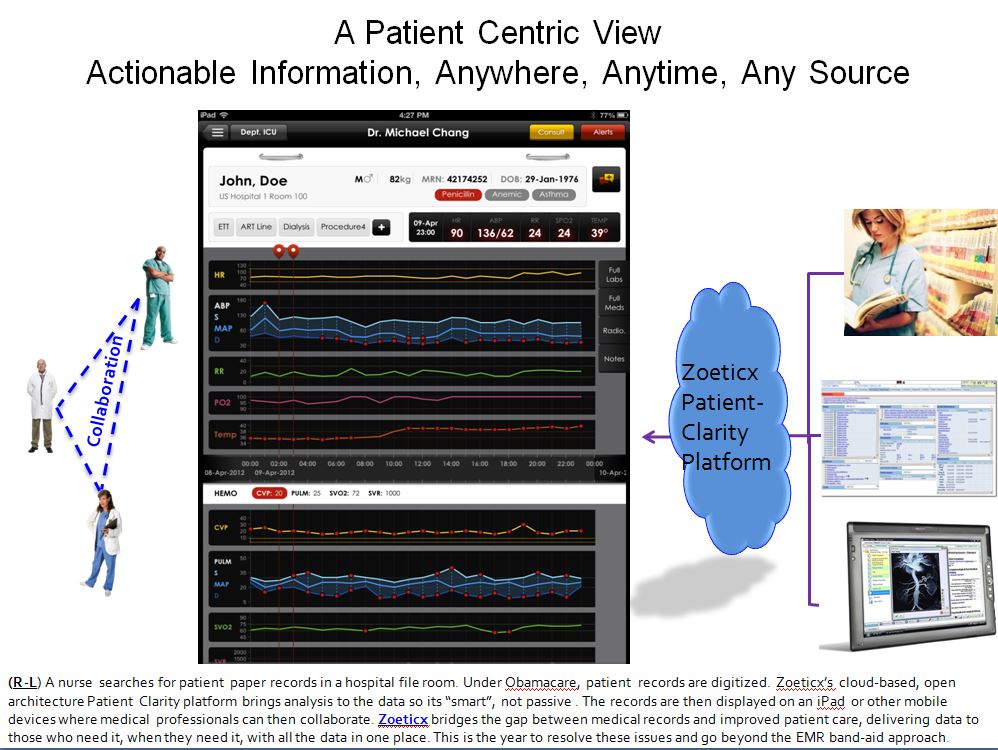
What the medical industry needs to finally bridge the gap between medical records and improved patient care is technology that works the way medical professionals work. A system to align medical professionals with data that needs to be collaborative, not passive, and include analysis. The right data also needs to be delivered to those who need it, when they need it, with all the data in one place. A true electronic replacement for the all encompassing and universally deployed nurses’ chart.
Provide an open architecture so third-party developers can save on development costs when creating new, innovative solutions. A cloud-based data network that connects to multiple databases and legacy systems instead of proprietary databases. Systems that make the data smart through collaborative platforms that can analyze and interpret the data.
Add voice to text capability to save valuable physician and nurse time and help end miscommunications. Replace the nurses’ sheet with a single screen that can compare and analyze all the necessary data with all medical professionals using the same device.
Medical Record Hubs for 2014
While EMR software can still be used for more limited point-to-point solutions, there needs to be a paradigm shift with a patient centric approach that connects all the points. Smart collaborative hubs need to be developed that enable hospital IT administrators to differentiate between these new data hubs and traditional EMR services.
However, developers must ensure that present EMR tools can connect and share data with these new overarching hub systems, side lining yet another set of tools and further implementing the costly, resource wasting practice of replacing old systems with new. This scrap and build IT practice at many medical facilities is one of the leading causes of high hospital costs that are passed onto insurance companies and ultimately consumers.