



















Events Calendar

Mon
Tue
Wed
Thu
Fri
Sat
Sun
M
T
W
T
F
S
S
27
30
31
1
2
3
4
5
6
7
8
9
10
11
12
13
14
15
16
18
19
21
22
23
24
25
26
27
28
29
30
CHIME College of Healthcare Information Management Executives
2014-10-28 - 2014-10-31    
All Day
The Premier Event for Healthcare CIOs Hotel Accomodations JW Marriott San Antonio Hill Country 23808 Resort Parkway San Antonio, Texas 78761 Telephone: 210-276-2500 Guest Fax: [...]
The Myth of the Paperless EMR
2014-10-29    
2:00 pm - 3:00 pm
Is Paper Eluding Your Current Technologies; The Myth of the Paperless EMR Please join Intellect Resources as we present Is Paper Eluding Your Current Technologies; The Myth [...]
The New York eHealth Collaborative Digital Health Conference
2014-11-17    
All Day
 Showcasing Innovation Join a dynamic community of innovators and thought leaders who are shaping the future of healthcare through technology. The New York eHealth Collaborative [...]
Big Data Healthcare Analytics Forum
2014-11-20    
All Day
The Big Data & Healthcare Analytics Forum Cuts Through the Hype When it comes to big data, the healthcare industry is flooded with hype and [...]
Events on 2014-10-28
Events on 2014-10-29
Events on 2014-11-17
Events on 2014-11-20
Articles

Oct 07 : How Can We Achieve EMR Interoperability When We Have No Intraoperability?

emr interoperability

Article Summary :

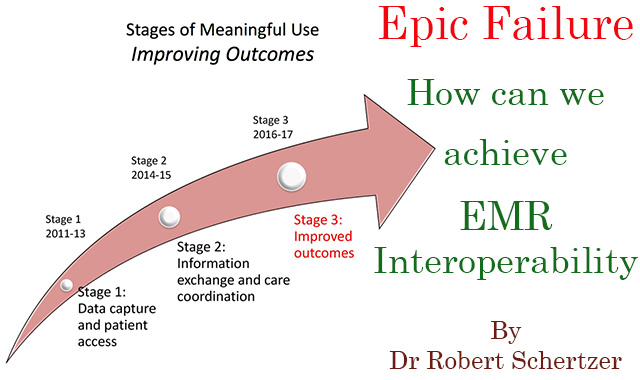
We are trying to reach a point with Electronic Medical Records where we can easily share medical information between providers at different geographic  locations. The road map for “meaningful use” had targeted this for 2014-15. Yet, the most widely used hospital based EMR system in this country, EPIC, fails to even allow sharing of data within our own hospital about a given patient let alone between other hospitals and ours. How did we drift so far from the goals of having EMRs actually help us care for patients?

Dr. Robert Schertzer, in his article, tried to explain that the ultimate goal in encouraging everyone to move to electronic health records has been to improve patient outcomes. Improving patient outcomes means, patients who are healthier, catching them earlier in the course of a disease so that they are healthier and live longer. But not, what we necessarily measure when it comes to outcomes, opting instead to set benchmarks for closing the encounter within 72 hours and giving the patient a printout that shows they were seen.


For complete article, click here
