































By Donald M. Voltz, MD, Aultman Hospital, Department of Anesthesiology, Medical Director of the Main Operating Room, Assistant Professor of Anesthesiology, Case Western Reserve University and Northeast Ohio Medical University.
Board-certified in anesthesiology and clinical informatics, Dr. Voltz is a researcher, medical educator, and entrepreneur. With more than 15 years of experience in healthcare, Dr. Voltz has been involved with many facets of medicine. He has performed basic science and clinical research and has experience in the translation of ideas into viable medical systems and devices.
Thanh Tran, CEO of Zoeticx, Inc. also contributed.
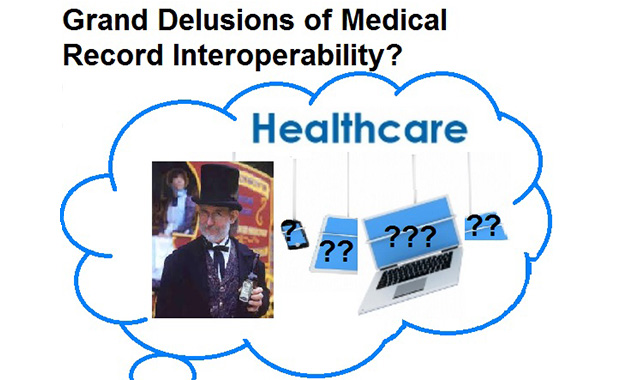
There was a time in the US when summer meant a visit to communities across the land from the traveling medicine show. Alchemists, magicians, soothsayers, and abracadabra experts of all stripes would engage the young and old with snake oil elixirs, tonics and potions to remedy what ailed you. Prescriptions for baldness, warts, bumps, lumps, general ugliness, love problems and every other conceivable illness imaginable. Solutions that would either cure you or kill you, depending on the dosage, of course.
Healthcare has come a long way since those times, but similar to the dubious compositions of past medical concoctions, today’s patients still don’t know what is in their medical records. They want transparency, not secret hospital –vendor contracts and not data blocking, like the practices being questioned by the New York Times. One patient, Regina Holliday resorts to using art to bring awareness to the lack of patient’s access to their own medical records.
Even analytical powerhouse Frost & Sullivan in their report last week, Healthcare and Medical Device Connectivity and Interoperability, found that the adoption of connected healthcare infrastructure is not uniform across the world. They attribute this to the lack of a holistic digital healthcare strategy that focuses on integrated care models. The ECRI Institute released in May a survey outlining the Top Ten Safety Concerns for Healthcare Organizations in 2015. The second highest concern is incorrect or missing data in EHRs and other health IT systems.
Hospital system CEOs and CIOs are cognizant of the increasing value of satisfaction and personalization that is often locked up in EHR systems. They are under pressure to respond to increasing IT challenges from customers, employees, insurers, providers, government officials and more. These requirements are being addressed by hospital systems, just not in such an efficient and succinct way.
The health record is a transcript of healthcare delivery. Even on the simple and routine visit, a great number of people touch each one of our patients. The goal of any hospital communication platform is to bring meaning and understanding to our patients’ concerns and problems. It is also notes the understanding we gather through the process of investigating our patients’ illnesses, presenting symptoms that need to be recorded so our colleagues and consultants are clear on the decisions, interventions and care paths across a temporal and geographic continuum.
The Vanishing Act
Recently, I learned more about the structure of EHR systems through my working within them as well as my exploration between different technologies. During the course of charting on a patient who presented with chest pain, I documented by findings, the interventions I undertook and the plan for the next phase of care. The note was contained within another form located in the medical record. Given the time pressures to manage multiple patients at any given time, most healthcare providers do not have the luxury of closing the record and then immediately reopening it to confirm what was documented was actually saved.
Serendipity brings great realization when you are open to what it reveals. For whatever reason, I reopened the document I had just completed only to find my entire narrative of the chest pain assessment was no longer present. Curiosity forced me to explore further.
I exited from the current patient’s record and reopened it, thinking this was just an updating issue and the data was there and would magically reappear with the utterance of an Abracadabra. This was not the case. So I completely closed the EHR session and reopened it. Again, nothing of my documentation existed so I recreated it, chalking it up to a glitch with the entry.
Now on a quest to ensure the documentation was sound, I reopened it only to find another blank document. Changing computers and reopening the system once again did not resolve whatever glitch the system was having. In order to capture my process and thoughts, I created a new document and once again reentered all of the information for the third time. This time it worked, however, no one in my specialty would be able to find the document since it was not part of the form normally used for such a situation. Like the medical barker illusionist on the big stage, the EHR pulled a fast one on my senses and a little more of my trust for the system has warn away.
Algorithm is the Magician
Although many reading this article will likely have had similar encounters with EHR systems and have raised their concerns with their IT departments, the vendor of the technology or to their administration and leadership. Although these issues have been well documented, the algorithm used to store data in health databases appears to be the magician, extending into the functionality and usability of these systems by their end users, patients included.
Given the complexity of healthcare, with many providers interacting with our patients’ medical information, we need to redesign the interfaces to meet the needs of the multitudes of users of this information. Access and visualization of the information in the most effective, safe and efficient manner. It requires iteration of designs and experimentation and customization for the specific users of these systems and on the platforms they choose to use.
Given the frustrations I personally experience with EHR usability as well as those many of my colleagues, I have been working to bring such a platform to healthcare. Much as indie developers can build sophisticated pieces of software to entertain, connect and enhance our lives, healthcare providers should have the same opportunity to impact their immediate working environment and share their creations with others who would likely benefit and enhance the development. Designing visual layouts, data entry interfaces and tools our patients can use to interact with their healthcare data is not only possible, but has already been developed. The hurdle is not connecting these applications to the various EHR’s, but instead getting others in the healthcare sector to realize the value of such as platform to address the needs of our patients, providers, and hospitals. This continues to be a struggle; driven partly by the disbelief it is even possible.
Interfaces Are Nice, but an Open Middleware Foundation Must Be Used
Finding any two physicians to agree on the optimal display of information or user interface to best meet their documentation and communication needs would seem impossible. Designing a best of breed interface is also a daunting and unlikely successful endeavor. What is needed is not a solution, but instead an open, middleware-based foundation upon which customized solutions, services, processes, workflows, pathways and other medical applications can be developed.
While systems like EHRs are critical to the operation of the hospital, hospital executives must take the necessary steps to ensure they are open and can be integrated with healthcare 2.0 middleware based software solutions that already exist, such as those from Zoeticx and others. Middleware is software that serves to connect previously disconnected systems which vertical markets such as retail, banking, transportation, and others have long ago instituted to solve interoperability. This is fact, not hocus pocus.
Middleware Systems—Just What the Doctor Ordered
These new breeds of small footprint, low-cost and non-invasive 2.0 middleware and other open systems technology is just what the doctor ordered to bridge the gap between medical data and better patient outcomes. Software that integrates with hospital system solutions, but enables connectivity, turning passive data into active data, transporting the patient’s electronic life blood seamlessly through IT systems and nourishing life sustaining medical applications along the way.
The destination of these active vessels of data is to providers who need it delivered to the right place at the right time. Caregivers can then conveniently collaborate on mobile devices, saving resources while saving lives. Some vendors even take it to the next level by opening their APIs to medical entrepreneurs so they can focus on building the applications of the future without concerns over the expense and difficulty of being tied to specific EHR databases.
Middleware has transformed technology to bring about uses of data to solve problems and middleware is poised to do the same for healthcare.


