









































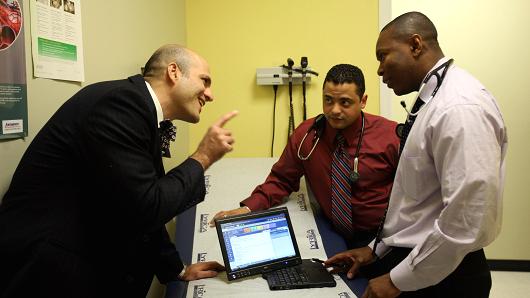
- Start-up Aledade aims to both lower the cost of US healthcare and increase quality
- The company has raised $75 million from investor
If you watched the drama in Washington last month, you may have come away with the impression that the American health care system is a hopeless mess.
In Congress, a doomed plan to repeal the Affordable Care Act, President Obama’s health care law, has turned into a precarious effort to rescue it. Meanwhile, President Trump is still threatening to mortally wound the law — which he insists, falsely, is collapsing anyway — while his administration is undermining its being carried out.
So it is surprising that across the continent from Washington, investors and technology entrepreneurs in Silicon Valley see the American health care system as the next great market for reform.
Some of their interest is because of advances in technology like smartphones, wearable health devices (like smart watches), artificial intelligence, and genetic testing and sequencing. There is a regulatory angle: The Affordable Care Act added tens of millions of people to the health care market, and the law created several incentives for start-ups to change how health care is provided. The most prominent of these is Oscar, a start-up co-founded by Joshua Kushner (the younger brother of Mr. Trump’s son-in-law, Jared Kushner), which has found ways to mine health care data to create a better health insurance service.
But perhaps the most interesting and potentially groundbreaking company fostered by the Affordable Care Act is Aledade, a start-up founded in 2014 by Farzad Mostashari, a doctor and technologist who was the national coordinator for health information technology at the Department of Health and Human Services in the Obama administration.
Aledade, which has raised about $75 million from investors, has an agenda so ambitious it sounds all but impossible: Dr. Mostashari wants to reduce the cost of health care while improving how patients are treated. He also wants to save the independent primary care doctor, whose practices have been battered by the perverse incentives of the American health care system.
And here is the most interesting part: His plan is working.
A few weeks ago, I visited two primary care practices in southeast Kansas that have worked with Aledade for more than a year. Their operations had been thoroughly remade by the company. Thanks to Aledade, the practices’ finances had improved and their patients were healthier. On every significant measure of health care costs, the Aledade method appeared to have reduced wasteful spending.
“The whole idea is to align incentives between society and doctors and patients,” Dr. Mostashari said, adding that Aledade has helped reduce hospital readmissions and decrease visits to specialists in many of its markets. “We’re reducing unnecessary and harmful utilization and improving quality of care.”
Of course, such promises are not new at the intersection of health and technology. Many companies have made big bets and blown up — among them Theranos, the lab testing start-up, which turned out to have been more puffery than product. Aledade faces its own share of hurdles, including whether its investors can ride out a long and costly expansion before it starts to realize any big paydays.
Still, its plan — which mainly involves using software to achieve its goals — looks promising.
The American health care system is a fragmented archipelago, with patients moving through doctors’ offices and hospitals that are often disconnected from one another. As a result, many primary care physicians — who often see themselves as a kind of quarterback who calls the shots on a patient’s care — have no easy way to monitor a patient’s meandering path through the health care system.
Aledade’s software addresses that by collecting patient data from a variety of sources, creating a helicopter view. Doctors can see which specialists a patient has visited, which tests have been ordered, and, crucially, how much the overall care might be costing the health care system.
More important, the software uses the data to assemble a battery of daily checklists for physicians’ practices. These are a set of easy steps for the practice to take — call this patient, order this vaccine — to keep on top of patients’ care, and, in time, to reduce its cost.
For example, say you’re a doctor at a small practice in rural Kansas and one of your patients, a 67-year-old man with heart disease, has just gone to the emergency room.
“In the past, we’d only find out our patients were at the hospital maybe weeks afterward,” said Dr. Bryan Dennett, who runs the Family Care Center in Winfield, Kan., with medical partner, Dr. Bryan Davis. With Aledade, Dr. Dennett is now alerted immediately, so “we can call them when they’re at the emergency room and say, ‘Hey, what are you doing there? Come back here, we can take care of you!”
It is not just emergency room visits. Aledade tells doctors which of their patients is eligible for preventive care like vaccines or an “annual wellness visit.” The doctors said that during such visits they have discovered several conditions that would have ballooned into much bigger problems without treatment. The software lets doctors know when their patients have been discharged from the hospital, allowing them to schedule “transitional care management” visits.
“The whole idea is to align incentives between society and doctors and patients. We’re reducing unnecessary and harmful utilization and improving quality of care.”
Such visits are a gimme for the health care system — they have been proved to reduce hospital readmissions (which are extremely costly), and patients say they find them valuable in navigating the health care system. And because these visits are so effective at lowering overall health care costs, Medicare pays doctors a higher rate to provide such care — meaning that primary care doctors can make money by following Aledade’s alerts.
Yet even though Aledade thinks of itself as a technology company, its doctors said its software is the least interesting thing it does. Independent primary care doctors tend to be cautious about technology, especially if it seeks to thoroughly alter how they work. So the real battle Aledade faces is to integrate technology into doctors’ practices — and to do so in an nonintrusive and pleasing way. The software’s instructions must also prove financially rewarding for clinics, while still somehow saving money for the overall health care system.
To do all this, Aledade — which now operates in 15 states and has relationships with more than 1,200 doctors — has had to become more than a software company. It has hired a battalion of field coordinators who visit practices and offer in-depth training and advice.
The company has also taken advantage of several health care ideas that were introduced or accelerated by the Affordable Care Act. One of these is known as the accountable care organization, or A.C.O., which lets groups of health care providers unite to coordinate care for a patient. Studies have shown that such a structure lowers overall medical costs; under the Affordable Care Act, Medicare encouraged the formation of these organizations by promising to share any savings it realizes with doctors. Aledade took the accountable care organization idea and made it its primary business model. (The structure was reaffirmed by a 2015 law passed overwhelmingly by Congress, so a repeal of the Affordable Care Act would not have affected its structure.)
For Aledade, the upshot is that it will only make a lot of money if it actually succeeds in reducing health care costs.
“Say Medicare thinks that it’s going to spend $100 million next year on our patients in Kansas,” Dr. Mostashari said. “A lot of this is from bad stuff — hospitalization, complications, you know, bad stuff. So we come in and say, if we can work with the primary care doctors to reduce bad things from happening while increasing quality, then we can save money for Medicare. Medicare says we thought we were going to spend $100 million on those patients, and we only spent $90 million. So, Medicare keeps half of the savings, and the other half of it goes to Aledade — which we split with the doctors.”
In addition to Medicare, Aledade has begun signing up several commercial health insurance companies under similar cost-savings plans. But given that the company gets paid only when it cuts health care costs (while improving health outcomes), Aledade and its investors are making a gamble.
In its first year of operation, for instance, Aledade managed to cut many costly procedures, yet its savings did not meet Medicare’s benchmark — meaning it realized virtually no revenue from the savings program.
The results for its second year are due in October. This time, because Aledade said its savings grow over time, the company is likely to begin making money. “We’re very confident in our model,” Dr. Mostashari said.


