































Events Calendar

Mon
Tue
Wed
Thu
Fri
Sat
Sun
M
T
W
T
F
S
S
25
27
28
29
1
3
5
6
7
8
11
13
15
17
18
19
20
21
22
24
25
27
28
29
31
1
2
3
4
5
3rd International conference on  Diabetes, Hypertension and Metabolic Syndrome
2020-02-24 - 2020-02-25    
All Day
About Diabetes Meet 2020 Conference Series takes the immense Pleasure to invite participants from all over the world to attend the 3rdInternational conference on Diabetes, Hypertension and [...]
3rd International Conference on Cardiology and Heart Diseases
2020-02-24 - 2020-02-25    
All Day
ABOUT 3RD INTERNATIONAL CONFERENCE ON CARDIOLOGY AND HEART DISEASES The standard goal of Cardiology 2020 is to move the cardiology results and improvements and to [...]
Medical Device Development Expo OSAKA
2020-02-26 - 2020-02-28    
All Day
ABOUT MEDICAL DEVICE DEVELOPMENT EXPO OSAKA What is Medical Device Development Expo OSAKA (MEDIX OSAKA)? Gathers All Kinds of Technologies for Medical Device Development! This [...]
Beauty Care Asia Pacific Summit 2020 (BCAP)
2020-03-02 - 2020-03-04    
All Day
Groundbreaking Event to Address Asia-Pacific’s Growing Beauty Sector—Your Window to the World’s Fastest Growing Beauty Market The international cosmetics industry has experienced a rapid rise [...]
IASTEM - 789th International Conference On Medical, Biological And Pharmaceutical Sciences ICMBPS
2020-03-04 - 2020-03-05    
All Day
IASTEM - 789th International Conference on Medical, Biological and Pharmaceutical Sciences ICMBPS will be held on 4th - 5th March, 2020 at Hamburg, Germany . [...]
Global Drug Delivery And Formulation Summit 2020
2020-03-09 - 2020-03-11    
All Day
Innovative solutions to the greatest challenges in pharmaceutical development. Price: Full price delegate ticket: GBP 1495.0. Time: 9:00 am to 6:00 pm About Conference KC [...]
Inborn Errors Of Metabolism Drug Development Summit 2020
2020-03-10 - 2020-03-12    
All Day
Confidently Translate, Develop and Commercialize Gene, mRNA, Replacement Therapies, Small Molecule and Substrate Reduction Therapies to More Efficaciously Treat Inherited Metabolic Diseases. Time: 8:00 am [...]
Texting And E-Mail With Patients: Patient Requests And Complying With HIPAA
2020-03-12    
All Day
Overview:  This session will focus on the rights of individuals to communicate in the manner they desire, and how a medical office can decide what [...]
14 Mar
2020-03-14 - 2020-03-21    
All Day
Topics in Family Medicine, Hematology, and Oncology CME Cruise. Prices: USD 495.0 to USD 895.0. Speakers: David Parrish, MS, MD, FAAFP, Alexander E. Denes, MD, [...]
International Conference On Healthcare And Clinical Gerontology ICHCG
2020-03-14 - 2020-03-15    
All Day
An elegant and rich premier global platform for the International Conference on Healthcare and Clinical Gerontology ICHCG that uniquely describes the Academic research and development [...]
World Congress And Expo On Cell And Stem Cell Research
2020-03-16 - 2020-03-17    
All Day
"The world best platform for all the researchers to showcase their research work through OralPoster presentations in front of the international audience, provided with additional [...]
25th International Conference on  Diabetes, Endocrinology and Healthcare
2020-03-23 - 2020-03-24    
All Day
About Conference: Conference Series LLC Ltd is overwhelmed to announce the commencement of “25th International Conference on Diabetes, Endocrinology and Healthcare” to be held during [...]
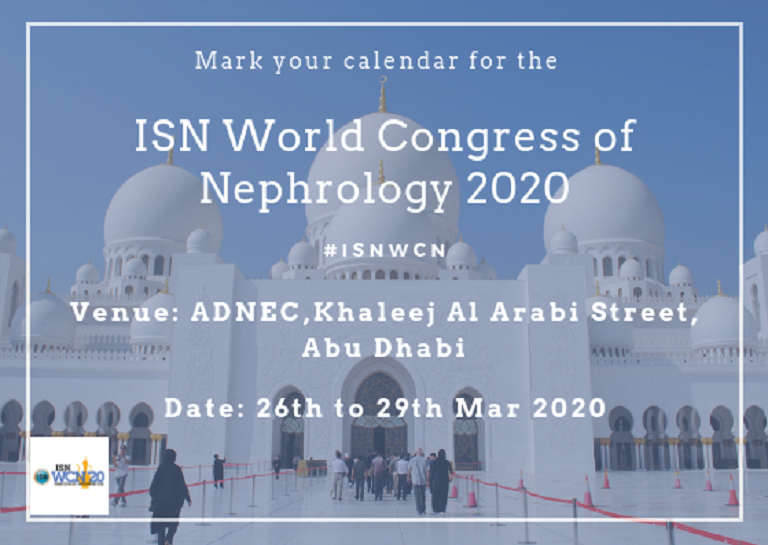
ISN World Congress of Nephrology 2020
2020-03-26 - 2020-03-29    
All Day
ABOUT ISN WORLD CONGRESS OF NEPHROLOGY 2020 ISN World Congress of Nephrology (WCN) takes place annually to enable this premier educational event more available to [...]
30 Mar
2020-03-30 - 2020-03-31    
All Day
This Cardio Diabetes 2020 includes Speaker talks, Keynote & Poster presentations, Exhibition, Symposia, and Workshops. This International Conference will help in interacting and meeting with diabetes and [...]
Trending Topics In Internal Medicine 2020
2020-04-02 - 2020-04-04    
All Day
Trending Topics in Internal Medicine is a CME course that will tackle the latest information trending in healthcare today.   This course will help you discuss options [...]
2020 Summit On National & Global Cancer Health Disparities
2020-04-03 - 2020-04-04    
All Day
The 2020 Summit on National & Global Cancer Health Disparities is planned with the goal of creating a momentum to minimize the disparities in cancer [...]
Events on 2020-02-26
Events on 2020-03-02
Events on 2020-03-09
Events on 2020-03-10
Events on 2020-03-16
Events on 2020-03-26
Events on 2020-03-30
Events on 2020-04-02
Events on 2020-04-03
Latest News

Study Sheds Light on How Brain Lets Animals Hunt for Food by Following Smells

Most animals have a keen sense of smell, which assists them in everyday tasks. Now, a new study led by researchers at NYU School of Medicine sheds light on exactly how animals follow smells.

Published online in the journal eLife on Aug. 21, the study measured the behavior of fruit flies as they navigated through wind tunnels in response to odor plumes from apple cider vinegar blowing past.

“Our study begins to dissect the brain functions that enable flies to hunt for food by following odors in the real world,” says senior study author Katherine Nagel, PhD, an assistant professor in the Department of Neuroscience and Physiologyat NYU School of Medicine. “Such insights could have many future applications, from the design of robots that find lost hikers like search dogs, to vehicles that steer themselves based on the combined sensing of odor concentration and wind or water currents.”

The new study is the first to come under the auspices of a grant received by Nagel as part of the NIH BRAIN Initiative. Announced by President Obama in 2013, the initiative seeks to develop tools to better understand the organ’s functions, as well as the mechanisms behind major neurological diseases.

Vinegar Plumes

Movement toward attractive odors is so basic to life that it occurs in organisms without brains, such as bacteria and plankton, say the study authors. Following odors in turbulent air or water is often difficult, however, because odors travel in plumes, which meander downwind or downstream and break up.

Fruit flies make a good model for studying detection of odors, say the authors, because the tools available to dissect brain circuits in flies are exquisite and because these animals likely share circuit mechanisms with humans thanks to evolution. In the current study, experiments showed that flies faced the wind when they sensed an odor on it, used their antennae to determine its direction, and then ran faster upwind toward the odor.

When they lost track of a smell, they danced around and cast about for where they had last smelled it, their actions for the moment appearing to be driven solely by the loss of odor (rather than wind direction). Based on these recorded movements, the researchers then built a computer model capable of detecting odor sources as well as the flies could detect them, and of moving toward them in similar trajectories. The results suggest that fly brains mix independent sensing of air flow, differences in odor over time, and differences in odor across their antennae to hunt for an odor source.

The researchers say their model captured the process by which sensory signals, like wind felt on antennae and the timing of odor concentration changes, are transformed by brain circuits into changes in forward velocity (walking speed) and angular velocity (turning degree).

“Such sensorimotor transformations in every case begin with a sight, sound, or smell and end with muscle movements,” says first study author Efrén Álvarez-Salvado, PhD, a postdoctoral researcher in Nagel’s lab. “Our work provides the framework for dissecting the neural circuits that generate olfactory navigation using genetic tools.”

Along with Nagel and Álvarez-Salvado, study authors from the Neuroscience Institute at NYU Langone Health were Angela LicataBenjamin King, and Nicholas Stavropoulos. Also authors were Erin ConnorMargaret McHugh, and John Crimaldi of the Department of Civil, Environmental and Architectural Engineering at the University of Colorado, Boulder, who designed the turbulent wind tunnels used in the study. Also an author was Jonathan Victor of the Institute for Computational Biomedicine at Weill Cornell Medical College.

The work was supported by National Science Foundation grant IOS-1555933 and PHY-155586, by NIDCD grant R00DC012065, and NIMH grant R01MH109690, and by fellowships from the Klingenstein-Simons, Sloan, and McKnight foundations. Also supporting the work were the Mathers, WhitehallAlfred P. Sloan, and Leon Levy foundations, a NARSAD Young Investigator Award from the Brain and Behavior Research Foundation, an NYU Whitehead Fellowship, the J. Christian Gillin, M.D. Research Award from the Sleep Research Society Foundation, and the Irma T. Hirschl/Weill-Caulier Career Scientist Award.


SOURCE NYU Langone

Related Links

https://med.nyu.edu/

