













by Darrell M. West and Niam Yaraghi
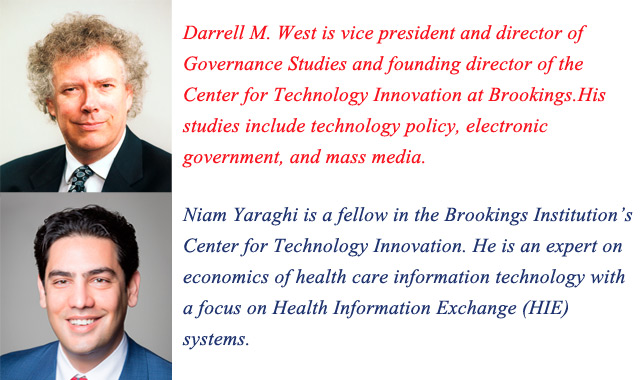
Darrell M. West is vice president and director of Governance Studies and founding director of the Center for Technology Innovation at Brookings. His studies include technology policy, electronic government, and mass media.
Niam Yaraghi is a fellow in the Brookings Institution’s Center for Technology Innovation. He is an expert on economics of health care information technology with a focus on Health Information Exchange (HIE) systems.
Introduction
Health care is in a time of major transition. Eighty percent of doctors now have deployed electronic health records. Health information exchanges are starting to share data and undertake analysis that helps people learn in real-time. And patients are getting more engaged with their medical treatment through Internet searches, medical chatrooms, and social media conversations.
There clearly are substantial opportunities to move health care into an evidence-based model using health information technology, social collaboration, and advanced data analytics. Yet there remain a number of challenges in order to gain the benefits of the information revolution. We need to address problems in terms of interoperability, privacy, and security to make necessary progress.
Recently, we held a dinner discussion at Brookings with leading health experts from government, business, and academia. We talked about new advances in consumer access, data sharing, and infrastructure development and ways to modernize our health care system. In this paper, we summarize key ideas that came out of that conversation and ideas that we believe are important for the future of health care.
Opportunities for Patient Engagement and Data Sharing
Several current trends have the potential to transform medical treatment. One is the rise of patient engagement in prevention, wellness, and treatment. Patients often supplement information from health providers with electronic sources and conversations with friends or family members. Digital technology gives people the capacity to broaden their searches and consult with a wide range of people. Patients get access to the most up-to-date information and this helps them make informed choices about their treatment. Educating patients and encouraging them to actively engage with care providers in the process of the medical decision making is the first step toward patient-centered care.
Second, greater numbers of patients and health care providers are engaging in collaborative activities. At the consumer level, patients are sharing their symptoms and treatments online and getting advice and reactions from other people. Recent studies show that such online platforms are playing an important role in educating patients and even reducing their need for inpatient care. Moreover, these online communities provide an abundance of patient-reported data that can be a valuable resource for evidence based medical research.
These data sources will potentially reduce the high costs of conducting medical research. There are listservs for people suffering from certain illnesses, and patients can compare notes on diagnosis and treatment. Sharing similar experiences with others will help the patients and their families to better cope with the emotional burdens of their medical situation. Among providers, collaboration takes the form of formalized consultation. The more serious the illness is, the greater the number of health providers who are likely to be involved. In those situations, information-sharing is vital in order to make sure there are no drug interactions or therapies that are inappropriate for the various diseases being treated. New solutions such as Health Information Exchange platforms enable care providers to have access to a more comprehensive medical history of their patients. This will not only enable them to provide better care to their patients, but also helps them to avoid unnecessary medical tests and procedures which results in considerable savings in health care costs.
Finally, regulators are paying greater attention to health outcomes. Governments have started penalizing hospitals for high readmissions rates. Those with rates above average have to provide an explanation and develop plans to improve their performance. Functioning information systems help providers track patient outcomes and ensure that patients receive treatments that have positive patient results.