


























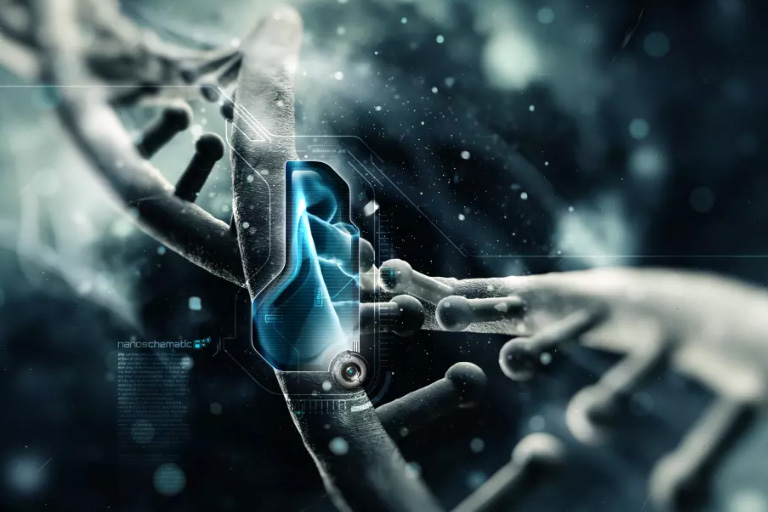
Kidney injuries are a prevalent issue, especially when one considers that every year there are 13.3 million new cases of acute kidney injuries (AKI) reported, resulting in 1.7 million deaths annually. Though there have been many methods and techniques applied to this area over the years, the advent of nanotechnology has allowed for more advanced and proficient procedures to develop.
Nanotechnology and the Future…
Many researchers, medical professionals, and scientists have asserted that the focus of medicine in the future will be less on correcting the symptoms and more heavily attuned to developing cures and remedies at a genetic level. In applying their DNA Origami nanostructures to treating acute kidney injuries, Hao Yan and his team, along with the in-vivo imaging team out of the University of Wisconsin-Madison, have declared the new method represents an unprecedented horizon for the future of DNA nanotechnology research.
HOW IT WORKS:
DNA can be confusing enough without convoluting all of the information with even further complicated technical terms and jargon. In an attempt to simplify the seemingly insurmountable data and research analyses so that it may be better understood by the masses, below is a breakdown of some of the concepts and methods involved in bringing nanotechnology for AKI treatment to the forefront of modern medical procedures.
DNA Origami
The four nucleotides of DNA’s base-pairing properties are used to create the DNA Origami nanostructures (DONs), Developed by the director of the Biodesign Center for Molecular Design and Biomimetics, Hao Yan and his fellow colleagues have introduced the revolutionary and innovative DNA Origami process of treating, and even preventing, acute kidney injuries and the ramifications thereof. Allowing for many to take advantage of this new method is the potential development of any new ecommerce platform which may be dedicated to procuring these miniature medical devices.
Nanotech Talk
The studies, which were performed on rats and embryonic human kidney cells, saw DONs acting as an active and accelerated protectant for the kidney, and may even alleviate the symptoms of AKI, as well. As nanotechnology, in essence, is the science of manipulating matter and particles which are one-billionth of a meter, the potential for scientists and medical professionals to alter weakened or otherwise disabled or diseased cells on a genetic level.
Since it was first mentioned by Richard Feynman in a lecture on theoretical physics in 1959, the pursuit of nanotechnology has been long anticipated, contingent only on the advancement of other science and technologies which would allow for the practices and theories to finally become a reality. The potential benefits of nanotechnology are abundant and, when applied properly, could possibly launch us into a technological evolution only before thought of in terms of science fiction. As humans become more and more biologically connected to technological devices, we will surely see a species-wide change in some form.
A Candid Conclusion…
Thinking about the future of nanotechnology is exciting. The potential to completely eradicate diseases such as cancer, Alzheimer’s, Parkinson’s, spina bifida, and so many more will be one of the building blocks for humanity’s next evolutionary jump. Progress is inevitable. We will always strive to live better and more meaningful lives. Those who are in the field of nanotechnology, especially as it pertains to advancements in medical science, are contributing to the future of humanity, itself. If our race is to survive and thrives for centuries to come, these research practices and proposed theories are essential.
Nanotechnologies are the essential key to being able to theorize and develop sustainable innovations. This is the science of immeasurable possibilities and provides the potential for many advancements which will be beneficial to our species and that of the world in which we live, as a whole. Being one of the most intelligent species on Earth, we should welcome the role of stewardship and care for the Earth as we do ourselves.
The advent of further nanotechnologies in the medical field is sure to open the door for future research and developments in this area. Progress, in any form and/or field, is necessary and inevitable. Brace yourselves… the future is nigh!


