






























Events Calendar

Mon
Tue
Wed
Thu
Fri
Sat
Sun
M
T
W
T
F
S
S
27
28
29
30
1
3
5
6
8
9
10
11
12
14
15
16
17
18
20
21
22
23
24
25
27
28
29
30
63rd ACOG ANNUAL MEETING - Annual Clinical and Scientific Meeting
2015-05-02 - 2015-05-06    
All Day
The 2015 Annual Meeting: Something for Every Ob-Gyn The New Year is a time for change! ACOG’s 2015 Annual Clinical and Scientific Meeting, May 2–6, [...]
Third Annual Medical Informatics World Conference 2015
2015-05-04 - 2015-05-05    
All Day
About the Conference Held each year in Boston, Medical Informatics World connects more than 400 healthcare, biomedical science, health informatics, and IT leaders to navigate [...]
Health IT Marketing &PR Conference
2015-05-07 - 2015-05-08    
All Day
The Health IT Marketing and PR Conference (HITMC) is organized by HealthcareScene.com and InfluentialNetworks.com. Healthcare Scene is a network of influential Healthcare IT blogs and health IT career [...]
Becker's Hospital Review 6th Annual Meeting
2015-05-07 - 2015-05-09    
All Day
This ​exclusive ​conference ​brings ​together ​hospital ​business ​and ​strategy ​leaders ​to ​discuss ​how ​to ​improve ​your ​hospital ​and ​its ​bottom ​line ​in ​these ​challenging ​but ​opportunity-filled ​times. The ​best ​minds ​in ​the ​hospital ​field ​will ​discuss ​opportunities ​for ​hospitals ​plus ​provide ​practical ​and ​immediately ​useful ​guidance ​on ​ACOs, ​physician-hospital ​integration, ​improving ​profitability ​and ​key ​specialties. Cancellation ​Policy: ​Written ​cancellation ​requests ​must ​be ​received ​within ​120 ​days ​of ​transaction ​or ​by ​March ​1, ​2015, ​whichever ​is ​first. ​ ​Refunds ​are ​subject ​to ​a ​$100 ​processing ​fee. ​Refunds ​will ​not ​be ​made ​after ​this ​date. Click Here to Register
Big Data & Analytics in Healthcare Summit
2015-05-13 - 2015-05-14    
All Day
Big Data & Analytics in Healthcare Summit "Improve Outcomes with Big Data" May 13–14 Philadelphia, 2015 Why Attend This Summit will bring together healthcare executives [...]
iHT2 Health IT Summit in Boston
2015-05-19 - 2015-05-20    
All Day
iHT2 [eye-h-tee-squared]: 1. an awe-inspiring summit featuring some of the world.s best and brightest. 2. great food for thought that will leave you begging for more. 3. [...]
2015 Convergence Summit
2015-05-26 - 2015-05-28    
All Day
The Convergence Summit is WLSA’s annual flagship event where healthcare, technology and wireless health communication leaders tackle key issues facing the connected health community. WLSA designs [...]
eHealth 2015: Making Connections
2015-05-31    
All Day
e-Health 2015: Making Connections Canada's ONLY National e-Health Conference and Tradeshow WE LOOK FORWARD TO SEEING YOU IN TORONTO! Hotel accommodation The e-Health 2015 Organizing [...]
Events on 2015-05-04
Events on 2015-05-07
Events on 2015-05-13
Events on 2015-05-19
Events on 2015-05-26
2015 Convergence Summit
26 May 15
San Diego
Events on 2015-05-31
Articles

The Importance Of Bioburden Testing

Bioburden Testing

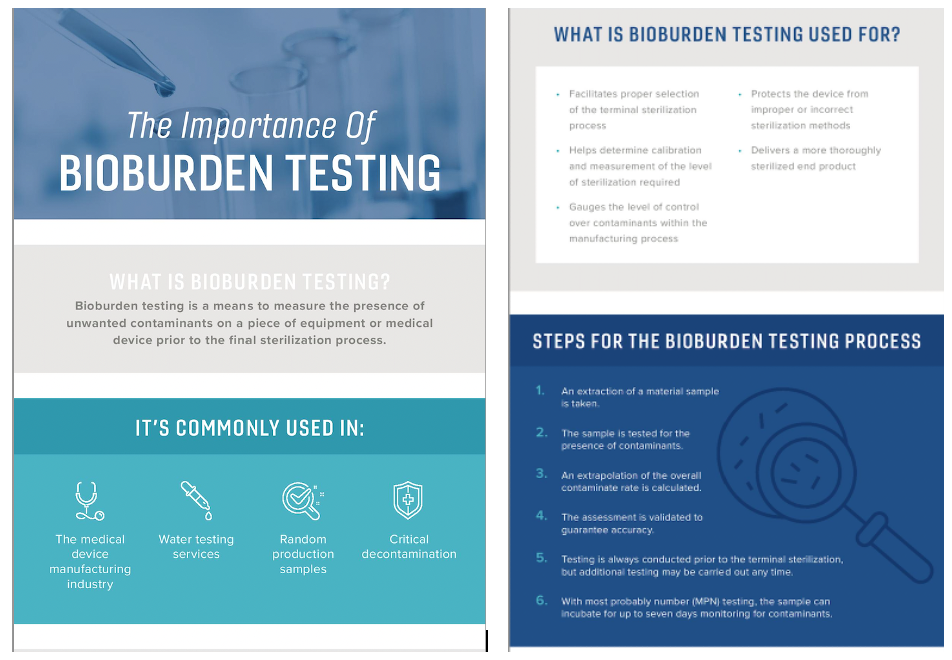
While we may think of an item straight off the production line as sterile, it can actually come into contact with numerous contaminants. To ensure the end product is safe for use, a series of proper sanitation steps must be followed. One such step that is especially critical in the medical device manufacturing industry is bioburden testing. Below is a brief look into what this assessment entails and why it is a key component in the sterilization process.

To start with, what is bioburden testing? Simply put, it is a method of measuring the contaminants present before the final sterilization process of a device, component or other manufactured good. Most frequently, the types of contaminants being tested for are microorganisms. These could include aerobic bacteria, anaerobic bacteria, spores and fungi, to name a few. 

What makes bioburden testing so important? When a patient receives a medical device, it must be properly sanitized. Otherwise, it risks introducing harmful contaminants, such as the microbes above, to the patient. As many of the recipients suffer from compromised health or are otherwise vulnerable, such contamination could result in a serious infection or may even be fatal. Thus, proper sterilization is paramount.

Bioburden testing works to ensure final sterilization is optimal. How so? With a reliable measurement of bioburden, a more accurate and effective process can be selected for sterilization. It also works to verify the correct calibration and level of sterilization required within that process. Without this step improper or incorrect techniques may be used and, consequently, the decontamination may prove to have been insufficient when the device is used or implanted. 

The steps for the bioburden assessment process are straightforward. First, an extraction of a material sample is selected for testing. Next, measurements of the presence of specific contaminants are taken. Once these quantities (or lack thereof) are determined, an extrapolation of the overall contaminant rate is generated based upon that sample. This is the most effective approach; however, there is an alternative method known as most probable number (MPN) testing. MPN involves monitoring the sample for growth or non-growth of contaminants over a seven-day incubation period.

The final step of the process is critical. It pertains to validating the testing method and sample results. It involves introducing a small, predetermined quantity of a specific micro-organism into the sample. Then, the test results are compared and validated against this known number. Such validation works to guarantee accuracy of the testing method. It also functions as a means to determine that the test was a non-destructive process and future readings are accurate.

For further information on the bioburden testing process and its importance, please see the accompanying resource by Technical Safety Services.


