

































Given the unprecedented severity of the COVID-19 global pandemic since the Spanish Flu in 1918, it is imperative healthcare providers work together not just with governments and health ministries in coordinated efforts to contain the virus – they must also work closely with various technology providers to leverage the power of data and telehealth. These will aid greatly in COVID-19 diagnosis, clinical decision making and managing manpower and hospital beds’ capacity covid-19 pandemic
Caroline Clarke, Executive Vice President and Market Leader, Philips ASEAN Pacific shared from the perspective of a technology provider on how the Dutch giant is helping healthcare providers during the pandemic around the world, the rise of virtual care and what the future for digital health holds in a post COVID-19 world.
Meeting the increased demand for professional healthcare products and solutions
“Our priority during this COVID-19 pandemic is in mobilizing our global resources to fulfill Philips’ triple duty of care: continuing to fulfill critical customer needs, ensuring the health and safety of our employees, and ensuring business continuity,” Clarke explained.
Philips has a broad portfolio of products, services and solutions that can help address the preparedness, response and recovery needs of an infectious respiratory disease such as COVID-19, including:
- Critical care point-solutions to treat respiratory disease. These include patient monitoring solutions to monitor a patient’s vital signs and detect subtle changes, and ventilators and medical consumables for invasive, non-invasive and mixed-mode ventilation to treat a broad range of respiratory conditions.
- Diagnostic imaging systems and services, including CT, mobile diagnostic X-ray, and ultrasound to help diagnose respiratory conditions.
- Hospital telehealth solutions for the ICU and telehealth solutions to connect caregivers and patients at home.
“Much of the COVID-19 conversation has focused on the lack of ventilators. However, any patient on a ventilator also needs to be on a monitor. Further, many other patients come to hospitals who do not immediately need ventilator support but do need some kind of patient monitoring. The increased complexity, patient volume, and pressure on devices and system integration demands new approaches and thinking in the delivery of high quality care to patients,” she added.
In Australia, West Moreton Health in Queensland has expanded its innovative virtual hospital program to support COVID-19 patients recovering at home and reduce demand for hospital services. MeCare or Mobile Enabled Care technology, was developed by Philips that allows chronically ill patients to track their daily health targets and manage symptoms and use videoconferencing to connect with a clinical team each day.
Ultrasound is considered to be one of the most important technologies to improve access to care in limited resource settings. Philips also has a broad portfolio of ultrasound products and solutions that can help hospitals in examining critical COVID-19 patients. By simplifying the process of diagnostic imaging, ultrasound can improve the overall hospital experience for both patients and healthcare professionals. Its role in improving emergency medicine is very important as it is a first-line diagnostic tool.
In addition, the Philips Foundation donated a range of diagnostic imaging, patient monitoring and respiratory therapy equipment and supplies to the Thunder God Mountain Hospital in Wuhan, China. The Foundation is currently working closely with Philips’ teams in Kenya, South Sudan and Italy to support their national healthcare systems, all of which have been deeply impacted.
Accelerating the move to virtual care
With the current demand on the health care system managing COVID-19 patients, the increased need for specific isolation of patients and added measures to help ensure protection for clinicians is paramount. To help deliver quality care and minimize risk to patients and staff, telehealth capabilities and digital technology that allow virtual care and remote patient monitoring are on the rise.
Clarke said, “Since COVID-19 is predominantly a respiratory illness, patients with more severe cases may require ICU care. In the ICU, a scarcity of critical-care intensivists and bed availability can compromise efficient patient flow through the hospital. To do this, general practitioners and healthcare institutions need digital tools to manage the increased patient flows resulting from the COVID-19 outbreak and dedicated, scalable telehealth solutions that facilitates the use of online screening, follow-up questionnaires and monitoring, and external call center collaboration.
These remote screening solution supports healthcare institutes to diagnose and treat patients at alternative points of care and is helping to safeguard the scarce critical care capacity.”
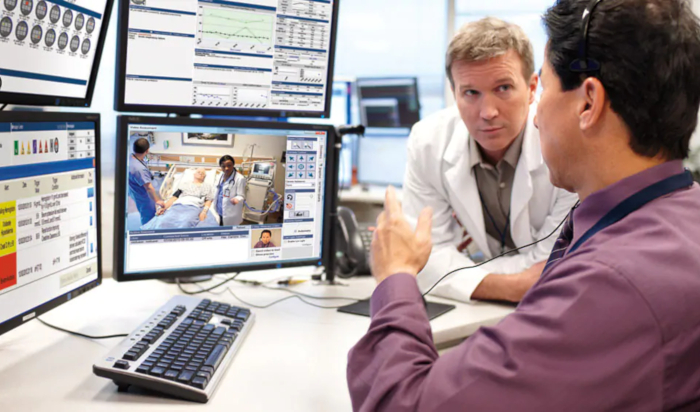
For example, tele-ICU or eICU enables a co-located team of intensivists and critical care nurses to remotely monitor patients in the ICU regardless of patient location. Intensivists and nurses based in a telehealth eICU hub are supported by high-definition cameras, telemetry, predictive analytics, data visualization and advanced reporting capabilities in order to support their frontline colleagues.
Algorithms alert to signs of patient deterioration or improvement. They help care teams to proactively intervene at an earlier stage or to decide which patients have stabilized and can be transferred, allowing scarce ICU beds to be allocated to more acute patients. The tele-ICU can be embedded in a larger Clinical and Operations Center that prioritizes patients on acuity and optimizes the patient flow and logistics.
“As we speak, we are helping hospitals with installed eICUs to expand their reach and exchange important information about COVID-19 indicators and protocols. We are supporting others to expand the reach of their ICUs into other settings.”
Interoperability and the significance of sharing healthcare data for better insights
Philips is with healthcare providers in ensuring transparent and evidence-based information and highlight the need for robust health-data infrastructures as technology can collect, qualify and analyze data in ways that quickly reveal patterns and hidden insights.
“In the Netherlands, we have contributed to the launch of a COVID-19 data exchange portal that connects providers to support patient transfers. With unlikely departments serving as pandemic units to help with overflow, patient transition periods can also result in gaps of essential data capture, such as respiratory rates, oxygen saturation, and changes in blood pressure.
Hospitals are looking to transport monitors that are integrated with traditional monitoring, as the need for mobile, wireless monitoring systems is more critical than ever to ensure clinicians have visibility at every step of a patient’s journey. Platforms like these ensure that a patient’s data is easily and securely transferred via the cloud from hospital A to B, and provide the most up-to-date, accurate portrayal of a patient’s health,” elaborated Clarke.
Philips is also collaborating with various stakeholder groups including government bodies as the company believes COVID-19 treatment depends on international collaboration. For instance, Philips is closely working with its suppliers in the US, Europe and Asia for an uninterrupted international flow of goods, including necessary medical equipment, which also requires the support of all the countries involved.
Digital health in a post COVID-19 world
“A whole raft of innovative new ideas and coping strategies are currently being tested in different countries around the world. In the near future, we could see digital services closing the loop between consultations and the dispatch of care or prescription drugs, drones as vehicles for getting drugs to patients, robots disinfecting contaminated areas,” said Clarke.
“Although these innovations won’t play global roles in the acute situation we are in right now, keep an eye on these developments. It may well be that many health systems go back to the drawing board to improve their care based on today’s experiences.”
She concluded that the COVID-19 pandemic has shown the world how much healthcare is in need of not just tweaking, but radical change: “The pressure on global health systems, providers and staff has already been increasing to unsustainable levels. But it also illustrates how much can be achieved in times of crisis: for example, both China and the UK recently built thousands of extra ICU beds in less than two weeks. Healthcare reform, with a totally different approach to how healthcare is organized, delivered and distributed, will be paramount in a (hopefully soon) post-COVID-19 era. It’s the only way we can deliver on the Quadruple Aim of healthcare: better health outcomes, improved patient and staff experience, and lower cost of care.”


