



















Why Sufficient Seatings Important in Healthcare Environments
A hospital is a place where each piece of furniture is necessary to keep. This includes a hospital bed, chairs, or waiting room chairs, among other furnishings. Regardless of the reason for an appointment, any patient visiting a medical establishment will likely spend some time sitting in a waiting room. A waiting room may be a large or a small space and can carry any number of chairs depending on the arrangement. Since these chairs have high-frequency usage, they need to be of high-quality to withstand the daily wear and tear. If you’re sourcing seats for a waiting room in a medical environment, ensure they are comfortable and suitable for all kinds of patients. We dug deeper and have prepared some benefits of adequate seating in medical settings.
1. To Accommodate a Big Number of Patients
Medical centers are busy places with a high number of people. Since people get sick every day, hospitals and clinics are usually occupied for the better part of a day. If you have a medical institution, we recommend investing in beam seating as it keeps a busy waiting room in order.
This is because the chairs cannot be moved around. Additionally, this also reduces the cleaning time since the seats remain in a uniform position. This means a cleaner can easily mop or vacuum around with no requirement to re-organize or tidy up. Hospitals are busy places, which is why time-saving is vital. If your hospital has a high patient attendee schedule, this likely means you offer good services. You don’t want to lower your hospital reputation for the mere fact that you cannot provide enough chairs.
2. It Might Be a Requirement by the Law
In some regions, it’s a requirement for each hospital to have an appropriate seating arrangement. In some cases, your license may be canceled if you fail to meet the proper seating guidelines. Additionally, this might also set you up for a lawsuit for any damages a patient suffers. If a patient suffers any harm caused by your reluctance to provide suitable seating, they may sue you for personal injuries. This may be costly and has dire effects. Among them is ruining your hospital’s reputation and license cancellation, among others. Medical institutions in the private and public domains are regularly checked by relevant health authorities to meet the expected standards. If it’s established you’re not meeting the expected guidelines, you may be forced to close.
3. Health Benefits
The benefits of seating ergonomics cannot be ignored in any organization and, specifically, a medical institution. Having the right seating arrangement is also a critical factor in a patient’s health. One key benefit is in improving a patient’s posture. If you sit or stand in a reclined position for an extended time, this stresses your back. Additionally, it puts pressure on the posterior structures of the spine, muscles, and ligaments. Adapting to a good sitting position starts with the right seat. You can customize your hospital seats to include footrests, backrests, or wrist pads. This will come in handy for patients who have mobility issues and cannot stand for too long. Such customization is bound to favor patients and especially seniors.
4. Plays a Role in Improving Your Hospital’s Reputation
As human beings, we are visual creatures. This means that we are most likely attracted to what we see. Your waiting area should have the right seating arrangement if you want to attract patients and improve your reputation. Having a good reputation helps to attract patients, competent staff, and recommendations from referring physicians. The healthcare environment is very competitive nowadays, and hospitals compete fiercely over patients and skilled medical staff. There are a few considerations for putting your medical institution on the path towards good reputability. This starts with having the right professionals for the simplest method of changing your layout plan in the waiting area.
5. It’s Good for Corridor Waiting Areas
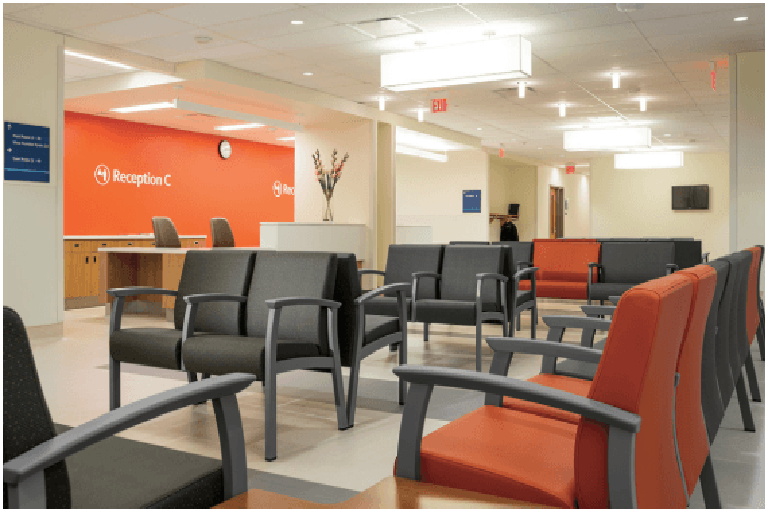
There are many consulting rooms and hospitals within medical institutions where patients may be required to wait outside the door. In many cases, these spaces are often in corridors where space for seating is limited. It might also be that other walkways in the hospital still need to be maintained. These corridors provide seating where visitors and patients can take a short rest. They’re also convenient for relatives or friends who have accompanied a patient to a waiting room. We recommend using colored upholstery for an excellent design if you want to brighten things up a bit. Adding a few pieces of art also paints the picture of a much more welcoming place.
6. Convenient for Short Rests
A medical institution is a bustle of activity, especially for doctors and nurses. They ensure that patients’ needs are well-catered for and that things are running smoothly. Because of the up and down movements in a hospital, they might be forced to have ample rests in between. Having sufficient seating can help achieve this. Additionally, this is convenient for patients visiting the hospital for a consultation or seeing their loved ones. The same space can also host other third-parties like suppliers or any visitor who’s waiting to be serviced.
7. The transition from Bed Rest to Ambulation
For many decades in the health sector, there was no patient seating but only the bed. In the past, bed rest was considered the only path to healing – Over the years, treatment protocols have changed. In the early 1800s, medics thought the bed to be the only place for getting better. However, recent studies have shown that bed rest affects nearly every system in the body. But, combining it with periods of walking and sitting has immense benefits. According to medical experts, the process of moving from the bed to the chair and greater independence is a good sign of recovery. Today, medical professionals routinely measure patients’ ability to sit successfully in a chair as the sign they can be discharged safely.
Sufficient seating is paramount in every field and not just in the medical area. When procuring chairs for a hospital environment, ensure that they are comfortable and sustain a patient’s weight. Experts say that unless a person is comfortable in a chair, all the other benefits offered by the chair are of little value. Finally, ensure that you check the chairs are easy to clean and are durable.


